China’s Atlas System: the future of AI swarm warfare
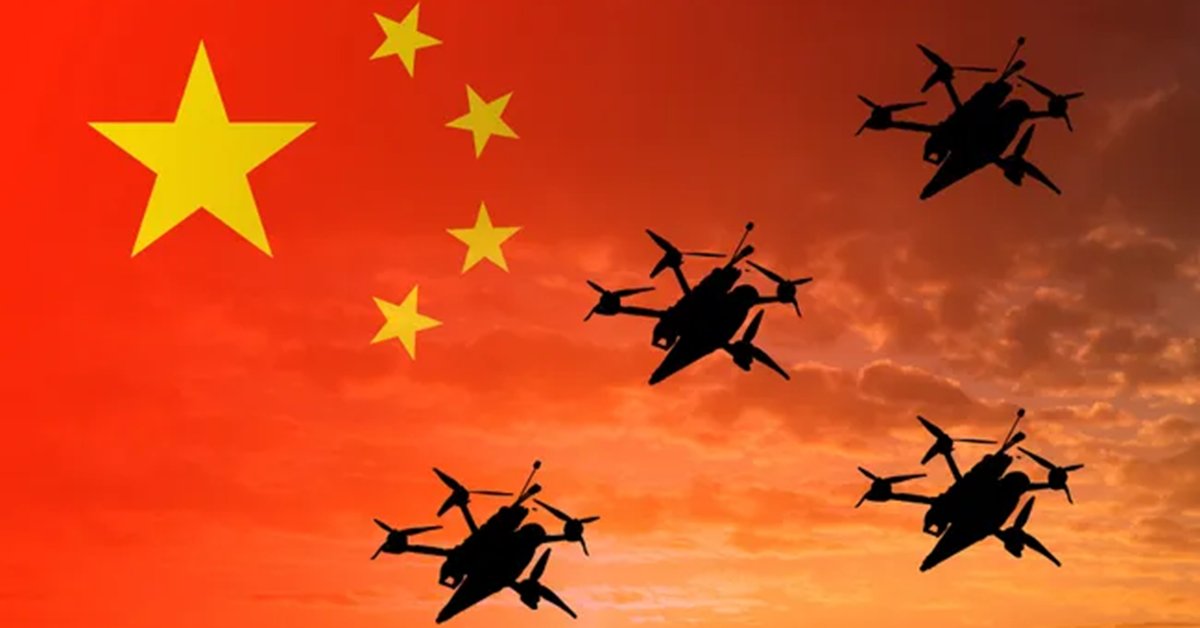
Imagine holding 96 kites in one hand with a single line. Not controlling each one, but controlling the wind itself. You set the intent, you pick the direction, and the kites will figure out how not to crash into each other.
That is the exact analogy Chinese state television used in March 2026 to describe what their new Atlas drone swarm system can do, and it might be the most honest thing Beijing has said about its military in years.
Because Atlas isn’t a drone, it is an AI-enhanced system designed to let one person, sitting behind a tablet, launch, coordinate, and direct 96 autonomous drones through a full combat cycle, from finding a target to putting a warhead on it, all in the time it takes you to microwave a corner-store burrito.
In March 2026, CCTV (China Central Television) aired a “full-process demonstration” of Atlas. Three visually similar targets sat in a “kill” zone. Reconnaissance drones launched first, identified the command vehicle among the decoys, and passed the targeting data.
The launcher, a vehicle called the Swarm-2, opened up and began vomiting fixed-wing drones into the sky at three-second intervals. Forty-eight drones spewed forth from a single truck, never coming close to jostling one another, then locked onto the designated target in flight, and one of them turned it into scrap.
In other words, the sequence starts with autonomous identification, followed by an autonomous strike visible through the drone’s own first-person feed. No human picked the target. No human guided the munition. The AI algorithm does it all.
China is telling the world, on camera, that the machine did the thinking and Skynet is now upon us.
Combined Arms on Wheels
Atlas is built around three vehicles: The Swarm-2 launcher carries 48 fixed-wing drones. Behind it rolls a command vehicle and a support vehicle.
State media footage shows the CETC logo, China Electronics Technology Group Corporation, on the launcher, which tells you a lot about who built the brain. Historically, CETC has handled networking, sensing, and algorithmic warfare for the PLA (People’s Liberation Army).
These drones come in different “flavors” as well, such as reconnaissance, electronic warfare, comms relay, and strike munitions. The concept is simple: If the enemy uses layered defenses, create autonomous offensive layered effects. Send the eyes first, jam what needs jamming, then send in the finale.
Chinese commentators crow about saturation attacks on air defenses, precision strikes, and deep-strike missions where you can afford to lose half the swarm and still complete the objective.
Atlas also reportedly can reorganize midair even after 50% of its counterparts have been lost. If that claim holds true, and that’s a huge “if,” the future of modern air defense just got interesting.
A Patriot interceptor costs roughly $4 million per shot. Nobody has published what a single Atlas drone costs, but the entire premise of this tech is that nobody cares. The drone’s job isn’t to survive. Its job is to make you run out of your expensive stuff.
Swarm-2 might even seem familiar to some of you. It is designed to look like a standard Chinese logistics truck.
It falls into a gray-zone scenario, the kind of war-lite that keeps Pentagon planners popping Tums and shots of whiskey. These things could be parked in a civilian lot, rolling in a normal convoy, looking like every other truck in Shenzhen. Then, in under 60 seconds, the back opens, and 48 artificial-intelligence-assisted drones are airborne.
Nothing about the architecture requires a military vehicle in the slightest. Just containerize for transport by semi-trucks, cargo ships, or railcars, then multiply. We are talking about a dozen semi trucks on any road, each carrying 48 drones.
That’s 576 autonomous weapons launched from vehicles that satellite surveillance might have mistaken for an Amazon delivery fleet. The intelligence community calls this a GEOINT (geospatial intelligence) nightmare. For the rest of us, you can just call it a nightmare.
Recent reports indicate Huawei has begun mass-producing the Ascend 950PR, an AI chip optimized for inference workloads, the exact processing a drone needs to identify targets midflight without phoning home. If the drone doesn’t need the data link to think, jamming the signal doesn’t stop the kill. The kite doesn’t need the string anymore.
Whether the Ascend 950PR is actually inside Atlas drones remains unconfirmed, but the timing of Huawei’s announcement, weeks before the Atlas, shouldn’t be dismissed as a mere coincidence.
Wait, Wasn’t This Done Before?
Before Atlas hit the headlines, Ukraine had already proven the concept in the only lab that counts: a real war. China’s new development sounds eerily similar to the Ukraine tech used in an attack on Russia dubbed Operation Spider’s Web.
Both Ukrainian and Russian forces have been launching FPV drones from vans and trucks for more than a year now. Containerized launch setups, relay drones extending range, short-range swarm attacks to overwhelm local defenses, none of it is pretty; however, all of it seems to work. Think of it as a Tony Stark with a box of scraps initiative.
Ukraine’s truck-launched drones opened Pandora’s box. Atlas is what happens when a state with the world’s largest manufacturing base watches real-time improvisation and says, “Hold our tea.”
If Ukraine showed the world how to turn a van into a drone launcher, Atlas is what it looks like when that idea gets a defense budget second only to America, an impressive AI chip, and a fresh logo from a state-owned corporation.
USA’s Answer: Death Rays, Spider-Men, and a Secret
To be fair, the Pentagon has not been asleep at the wheel. But it has been driving with one hand while trying to change the song on Spotify with the other.
Defense Secretary Pete Hegseth has accelerated the development of a dedicated Air Force drone swarm unit tasked with fielding cheap attack UAVs to match China’s mass-on-mass capability. On the counter-swarm side, the approach ranges from science fiction to something your dad might recognize.
America’s solution feels as if it were “borrowed” from the pages of a comic book, actually. Under Replicator-2, the Pentagon fast-tracked the DroneHunter F700 by Fortem Technologies, a counter-drone that shoots high-strength nets to physically capture enemy drones midair.
The latest variant carries four net-guns, meaning one defender can bag four Atlas-type drones per sortie. There is a certain poetry in the world’s most advanced AI swarm beaten by a glorified fishing net. Hopefully Spider-Man isn’t litigious.
Issues start to arise from the very nature of the Chinese regime, along with its tight control of any narrative in or out of the country. Our only public record on Atlas is almost entirely drawn from Chinese state media. That means every claimed capability arrives pre-filtered through a propaganda machine whose mission is to make the tech look impressive, not to prove its combat readiness.
Nobody outside of their military knows Atlas’s actual range, endurance, payload weights, data-link architecture, or survivability under serious electronic warfare. We do not know whether it is in PLA service, earmarked for export, or still a demonstrator dressed up for the cameras.
Ukraine’s battlefield experience has taught one lesson that applies here: Electronic warfare, jamming specifically, is just brutal. Autonomy claims made on a test range can’t use hopes and dreams to survive a contested electromagnetic environment.
Atlas sits somewhere between “important emerging capability” and “slick recruiting video.” It is almost certainly beyond a science-fair prototype. It is not yet a proven weapon of war.
The Point of it All
But here’s what stands out, even if half the claims are exaggerated.
China is broadcasting, in high definition, that it wants AI-driven, modular, massed drone warfare to become how the PLA fights. Cheap enough to lose, yet smart enough to find targets on their own, plus numerous enough to make air defenses choose between shooting everything down or running out of ammo, then being hit anyway.
CETC attempted its first mass drone swarm in 2018; by 2023, United States analysts began poring over Chinese records for any clues. Immediately after. In 2024, Swarm-2 debuted at Airshow China; by March 2026, Atlas showed full functionality on camera. An eight-year evolution, using existing battlefields to help develop, then displayed in plain sight.
Going back to the Chinese State TV’s assertion, the question here isn’t whether one operator can fly 96 kites on a single line. The question is whether anyone can cut their string fast enough.
Until the next drop, stand easy.
Don’t Miss the Best of We Are The Mighty
• Some military forces call autism a disqualifier. The IDF calls it an advantage. • SMASH2000: Finally, an AI-powered optic that turns your AR-15 into a drone hunter • Your standard rifle can now be an anti-drone weapon. Seriously.
The Pinkertons were America’s most powerful private army, then Congress banned them
By Daniel Tobias Flint
How to dispute a VA debt you don’t really owe
By Veteran Debt Assistance
Ukraine’s JEDI drone hunts Shaheds so your Patriot missiles don’t have to
7 hours of grit and determination that changed the Civil War
By Daniel Tobias Flint
How to join the National World War II Museum’s celebration for ‘Band of Brothers’ 25th annivesary