Ola Mize became ‘the Audie Murphy of the Korean War’ by fighting off a Chinese division
Every war has its heroes, its standout troops that come to national attention. Today’s constant media cycle and proliferation make it much harder to turn even a Medal of Honor recipient into a household name. Before we had more media than intellect, however, people paid attention to the great deeds performed by troops on the battlefield.
World War I saw Sgt. Alvin York, an attempted conscientious objector, become a hero after capturing a large number of enemy soldiers in France. In World War II, Audie Murphy’s battlefield heroics earned him every major decoration the U.S. Army had to offer—he even ended up portraying himself in his own Hollywood film.
The Korean War had its heroes, too. One of them, Ola L. Mize, didn’t quite receive the full “Audie Murphy,” but he came pretty close. The U.S. Army Special Forces soldier earned the Silver Star, two Legion of Merit medals, five Bronze Stars, a Purple Heart, and a slew of other awards, including those he would pick up during his three tours in the Vietnam War.
Ola Mize, the highly decorated soldier who served in the Army for almost 31 years, actually came close to never joining at all. As the son of a southern sharecropper, he worked for years at low-paying jobs. He decided to join the Army as soon as he was old enough, but every time he went to the recruiter, he was so underweight that the Army couldn’t accept him.
Finally, after two years of trying, the young man made the weight required to join the Army in April of 1950. It was just in time, too. The U.S. forces in South Korea would soon be fighting for their lives against a communist onslaught from the North. Sent to the 82nd Airborne Division before the war, he considered getting out almost as soon as he came in.
When the Korean War started, that all changed.
Korea is where Mize performed the actions for which he received the Medal of Honor. He volunteered for combat duty, and the Army was more than happy to oblige him. He was sent to the 15th Infantry Regiment of the 3rd Infantry Division to fight. He was promoted to sergeant after arriving in country.
By 1953, he was fighting in Korea’s infamous “Iron Triangle,” manning an outpost near Surang-ni dubbed Outpost Harry.
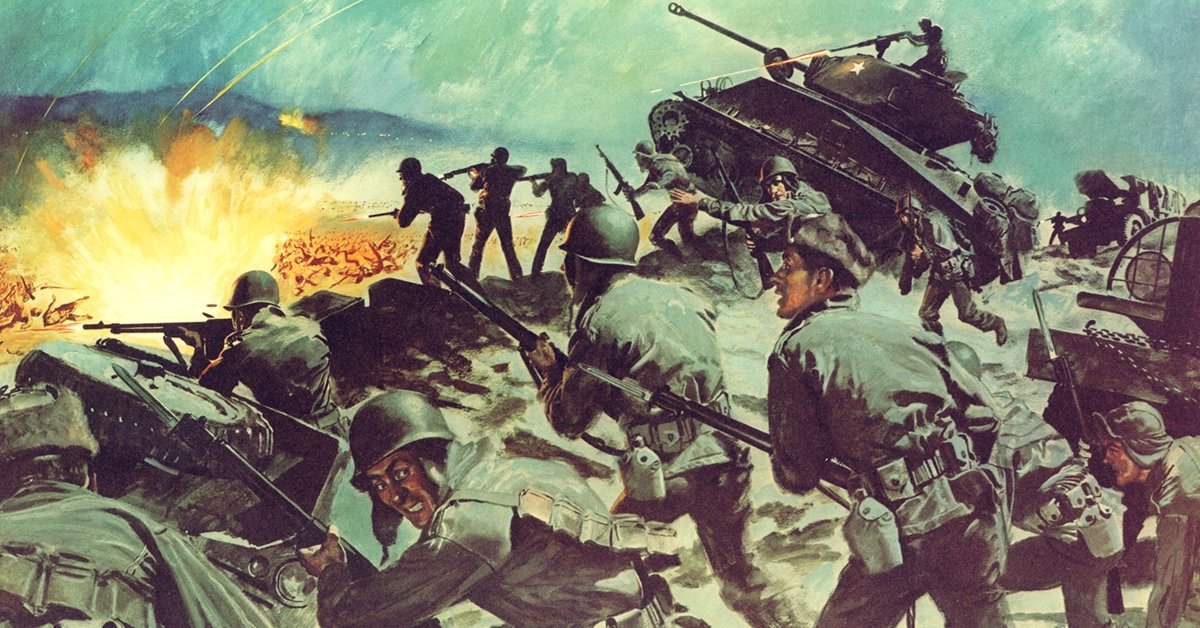
On June 10, 1953, Outpost Harry came under attack from an entire Chinese division. Unfortunately for the communists, Sgt. Ola Mize was there and ready for a fight. Early on in the attack, Mize learned that a listening post outside Harry was attacked and that a friendly soldier was wounded out there. Mize fought his way through the attack, escorting a medic to the position.
Once there, the man was treated and stabilized. Sgt. Mize then fought his way back to Outpost Harry with the medic and his wounded man. After returning to base, he refocused the defense, organizing Outpost Harry into an effective defensive posture. When the communists pressed their surprise attack, Mize’s renewed defenses inflicted heavy casualties on the Chinese and North Korean force.
Mize’s efforts weren’t perfect by any means. Enemy troops began slipping through Harry’s defenses, and Mize himself was thrown down numerous times by explosions from artillery and grenades. He saved the life of one of his men by killing an infiltrator at close range, because that’s how far the communists were able to advance inside the outpost. He then ran ammo to his men, fighting the enemy horde as he moved.
When he heard that one of his key machine gun positions was overrun, he organized a counterattack to retake it. Mize fought his way to the gun nest, killing ten enemy soldiers along the way. He then fought his way to his command post, where men were already wounded. As he protected the wounded, he called in artillery strikes.
Mize held his position against constant enemy attacks for more than 10 hours.
As the sun came up the next day, Ola Mize launched a counterassault that drove off the enemy. This was the action for which he received the Medal of Honor. Mize would not only stay in the Army but also make a career out of it. Mize eventually became a colonel before leaving the Army in 1981.
Don’t Miss the Best of We Are The Mighty
• How the soldiers of Outpost Harry decimated an entire Chinese Division • Jumping with the 187th Airborne Regimental Combat Team in Korea • Neil Armstrong survived ejecting from his fighter jet in Korea
That time Neil Armstrong survived ejecting from his fighter jet in Korea
The combat jumps of the 187th Airborne Regimental Combat Team in Korea
By Daniel Tobias Flint
What John Glenn did to save his famous wingman’s life in Korea
How the Marine Corps’ oldest division survived at Chosin Reservoir
‘M*A*S*H’ made television history while keeping Korean War history alive
By Daniel Tobias Flint