The secret telegram that defined the Cold War before it began
When students begin learning about the Cold War, they often encounter the most dramatic moments first: the Berlin Wall, nuclear weapons, espionage, and the crises that brought the world close to war.
But to truly understand the Cold War, we have to go back to its origins—before the arms race, before the proxy wars, and before the ideological standoff hardened into a global conflict.
One of the most important documents in understanding the beginning of the Cold War is the Long Telegram, written by American diplomat George F. Kennan in February 1946. Sent from Moscow to officials in Washington, the telegram offered a detailed explanation of Soviet motivations and behavior.
It argued that the Soviet Union was fundamentally hostile to the West and that the United States needed a long-term strategy to limit its expansion.
That strategy soon became known as “containment,” and it guided American foreign policy for decades.
The influence of the Long Telegram is evident in major Cold War policies such as the Truman Doctrine, the Marshall Plan, and the response to the Berlin Blockade, culminating in the famous Berlin Airlift.
These events defined the early Cold War and established the framework for the geopolitical struggle between the U.S. and the Soviet Union.
Understanding the Long Telegram allows students to see how ideas and analyses can shape history. It demonstrates that the Cold War did not begin with a single dramatic event. Instead, it developed through policies and decisions made in the uncertain years following World War II.
When World War II ended in 1945, the international system was fundamentally transformed. Six years of total war devastated much of Europe and Asia. Major cities lay in ruins, transportation networks were destroyed, and entire economies collapsed.
The United States and Soviet Union emerged from the conflict with enormous power and influence.
The U.S. became the world’s strongest industrial economy. Its factories produced vast quantities of weapons, vehicles, and supplies during WWII. The country also possessed a powerful navy, global economic influence, and the newly developed atomic bomb.
The Soviet Union, meanwhile, suffered catastrophic losses during the war but emerged with the largest land army in the world. It was the Soviet Red Army that pushed Nazi Germany back across Eastern Europe, ultimately capturing Berlin in May 1945.
By the war’s end, Soviet troops occupied large portions of Eastern Europe, including Poland, Hungary, Romania, Bulgaria, and eastern Germany.
At first, many American leaders hoped that wartime cooperation with the Soviet Union might continue into the postwar period. During the war, Allied leaders Franklin D. Roosevelt (and later Truman), Winston Churchill, and Joseph Stalin worked together to defeat Nazi Germany. But that alliance was always based on necessity rather than shared values.
The U.S. supported democratic institutions, free markets, and political pluralism. A one-party communist state under Stalin’s leadership governed the Soviet Union. This was the crack in the Allied foundation.
As the war ended and Soviet influence spread across Eastern Europe, American officials grew increasingly concerned about Moscow’s intentions.
This growing uncertainty led American policymakers to ask a critical question: Was the Soviet Union a wartime ally that could help build a peaceful world or a rival power seeking to expand its influence?
That’s when the Long Telegram changed everything.
George Kennan and the Long Telegram
In February 1946, George F. Kennan was the chargé d’affaires at the U.S. embassy in Moscow. He’d spent years studying Russian history, language, and politics, making him one of the State Department’s leading experts on the Soviets.
When officials in Washington asked for an explanation of Soviet behavior, Kennan responded with an extraordinarily detailed message.
The telegram he sent on Feb. 22, 1946, was more than 5,000 words long and offered a sweeping analysis of the Soviet system.
Kennan argued that leaders in the USSR believed they were locked in a permanent struggle with the capitalist world. Capitalist nations were hostile forces that ultimately sought to destroy socialism.
At the same time, he explained that Soviet policy was shaped by Russia’s long history of insecurity. For centuries, Russia faced invasions from foreign powers, from Napoleon’s Grand Armée to Operation Barbarossa.
This history led the Soviet Union to believe that security required control over neighboring regions. Kennan concluded that Moscow planned to expand its influence wherever possible, using political pressure, propaganda, and ideological movements rather than direct military confrontation.
However, he also argued that the Soviet system had weaknesses. It relied heavily on strict internal control and could not tolerate political dissent. If strong and stable democratic societies confronted the Soviets, the system might eventually weaken under its own internal contradictions.
Kennan was clear: The United States should pursue a strategy of patient but firm “containment” of Soviet expansion.
Containment was not a call for immediate military conflict. Instead, it was designed to limit Soviet influence while avoiding direct war between the two superpowers.
Kennan believed the USSR intended to probe for weaknesses worldwide. If the U.S. and its allies consistently resisted those pressures, the Soviet system would gradually lose momentum. The strategy required patience, and as a result, Kennan believed the Cold War might last for decades.
But containment also required a combination of tools. Military strength was important, but economic stability, diplomatic alliances, and political influence were equally critical. The goal was to strengthen democratic societies while preventing communist movements from gaining power in unstable regions.
Kennan’s ideas quickly gained attention within the U.S. government. Many policymakers believed his analysis provided the clearest explanation of Soviet behavior they had yet received. That’s how his ideas began shaping American policy.
The first major test of containment came in 1947. At the time, political instability threatened Greece and Turkey. Greece was engaged in a civil war between its government and communist insurgents, while Turkey faced increasing diplomatic pressure from the Soviet Union.
American leaders feared that if these nations fell under communist influence, it could destabilize the eastern Mediterranean and open the door for further Soviet expansion. In March 1947, Harry S. Truman addressed Congress and announced a new American policy.
The Truman Doctrine declared the United States’ support of nations resisting communist pressure through economic and military assistance. The president framed the issue as a global struggle between freedom and oppression. He argued that the United States had a responsibility to help nations defend their independence.
Economic Strength as a Weapon
While military aid helped stabilize Greece and Turkey, American leaders understood that Europe’s greatest postwar challenge was economic recovery.
Millions of people faced poverty, unemployment, and food shortage, while the war destroyed the infrastructure necessary to face those issues: factories, transportation systems, and agricultural production across the continent were gone.
These conditions, it was believed, created an environment in which communist political movements could gain support. In 1947, U.S. Secretary of State George C. Marshall proposed a bold plan to rebuild Europe’s economy.
The Marshall Plan, officially known as the European Recovery Program, offered billions of dollars in financial aid to help Western European nations rebuild their infrastructure and industries. Between 1948 and 1952, the U.S. provided more than $13 billion in aid, equivalent to over $150 billion today.
The program provided the funds to rebuild roads, railways, factories, and energy systems across Western Europe. It also restored international trade networks and encouraged economic cooperation between European nations.
The Soviet Union and its satellite states were invited to participate in the program, but they ultimately refused. As Western Europe recovered economically, democratic governments became more stable and communist parties lost influence.
The Marshall Plan demonstrated that containment could be achieved through economic prosperity.
The next major confrontation of the early Cold War occurred in Germany, which had been divided into four occupation zones under the control of the United States, Britain, France, and the Soviet Union. The capital city of Berlin, deep inside the Soviet sector, was also divided among the four.
As tensions increased between the Western allies and the USSR, Germany became one of the Cold War’s ideological battlegrounds. In June 1948, the Soviets attempted to force the Western powers out of Berlin by blocking all land and rail access to the western sectors of the city.
This Berlin Blockade cut off food and fuel supplies to more than two million residents of West Berlin, but instead of withdrawing from the city or sending troops to break the blockade, the Allies launched one of the most remarkable logistical operations in history.
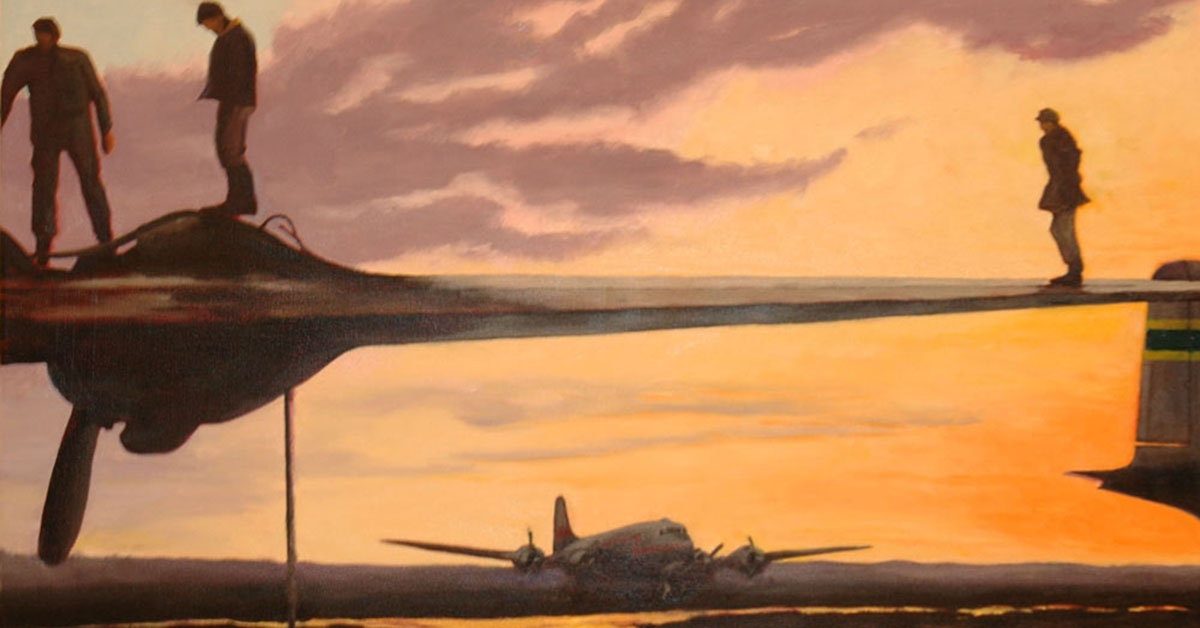
For nearly 11 months, aircraft flew continuous missions into Berlin delivering food, coal, medicine, and other supplies. “Operation Vittles” was its official name, but it became known as the Berlin Airlift. More than 200,000 flights delivered over two million tons of supplies.
The airlift demonstrated the Western powers’ determination to resist Soviet pressure without triggering direct military conflict, and in May 1949, the Soviet Union lifted the blockade. It was another victory for containment.
How I Teach the Origins of the Cold War
When I teach the origins of the Cold War, I always begin with the Long Telegram.
Too often, students encounter Cold War history as a list of events—the Berlin Airlift, the Korean War, the Cuban Missile Crisis—without understanding the underlying ideas that connected them.
So I start with a simple question: How do governments decide how to respond to potential threats?
This question helps my students understand that foreign policy decisions rarely happen in isolation. Leaders rely on intelligence, analysis, and interpretation when determining how to act.
That is where George Kennan comes into the story. I explain to my students that Kennan was not a general commanding armies or a president giving speeches. He was a diplomat studying a rival government and trying to explain its motivations.
We examine excerpts from the Long Telegram and discuss Kennan’s main arguments. Students often find it fascinating that a single diplomatic message influenced decades of American policy.
From there, we connect Kennan’s ideas to the major policies that followed. By the end of the lesson, students often realize that the Cold War was not just about nuclear weapons or ideological slogans.
Containment shaped American foreign policy for more than 40 years. It influenced the creation of military alliances such as NATO, guided American involvement in conflicts like the Korean War, and shaped diplomatic relationships worldwide—for better or for worse.
Sometimes, containment became more militarized than Kennan originally envisioned. Kennan even later criticized aspects of Cold War policy, particularly the heavy reliance on nuclear weapons and military intervention.
But the central concept remained consistent: limit the spread of communism while strengthening democratic institutions and alliances. When the Soviet Union collapsed in 1991, many historians looked back at containment as one of the defining strategic frameworks of the 20th century.
Don’t Miss the Best of We Are The Mighty
• How Eisenhower’s ‘Atoms for Peace’ program started Iran’s nuclear program • Curtis LeMay: World War II bomber, cold warrior, and judo champion • Two veterans shaped the UFO phenomenon from a joke into real federal policy
The secret telegram that defined the Cold War before it began
By Daniel Tobias Flint
5 Reasons this could be the year homebuyers re-enter the market
It’s official: ‘Top Gun 3’ is in development
China’s Atlas System: the future of AI swarm warfare
The ‘Gray Ghosts’ of the Cuban Missile Crisis
By Daniel Tobias Flint