This No. 1 overall draft pick became the NFL’s MVP while in the Army
As thousands of citizens fled East Germany in the early 1960s, Soviet Premier Nikita Khrushchev became irate.
Berlin became a particular source of irritation. Khrushchev detested how the German capital was divided into four zones after World War II that the United States, Britain, France, and the Soviet Union oversaw.
Cold War tensions became white-hot after the Soviets shot down a U-2 spy plane in 1960. The incident prompted Khrushchev to abandon talks with the Eisenhower administration and try again once Ike’s successor, John F. Kennedy, moved into the White House. After those talks didn’t advance enough to the Soviets’ liking, they implemented a physical obstacle to the East Germans so desperate to leave Berlin.
With Khrushchev’s backing, East Germany constructed the Berlin Wall on August 13, 1961.
Reservists Called up to Active Duty
In late July 1961, Congress granted Kennedy’s request to call up to 250,000 Ready Reservists to active duty for up to a year.
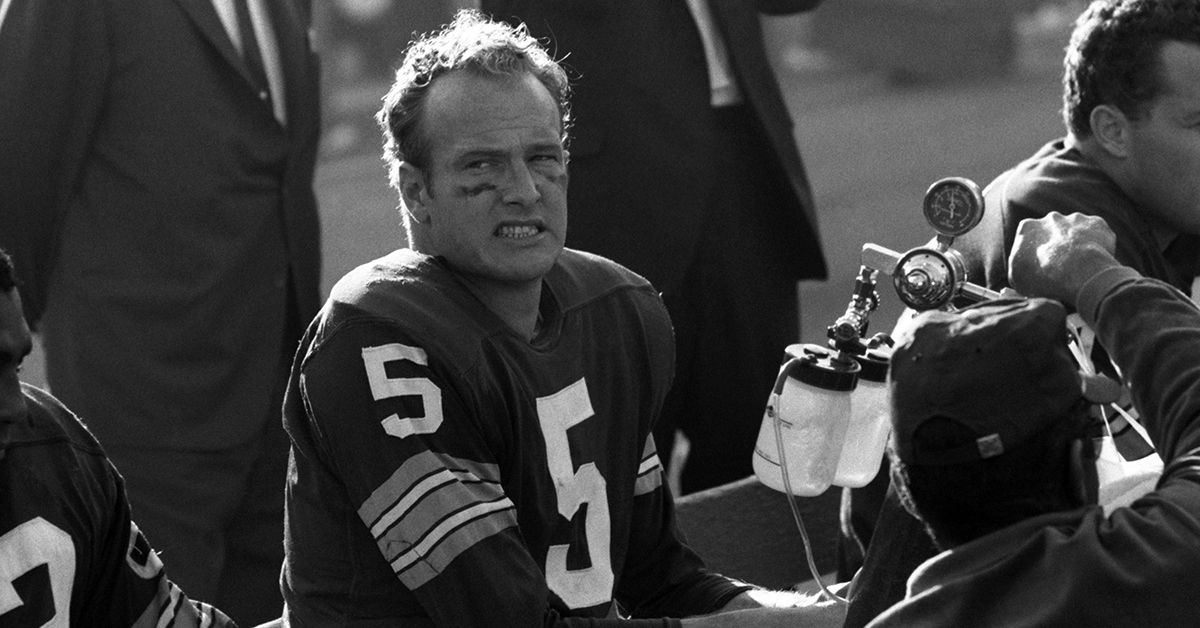
One of those reservists was Paul Hornung, the 1956 Heisman Trophy winner and the No. 1 overall pick in the 1957 NFL draft. By 1961, Hornung was arguably the best player in professional football, and his team, the Green Bay Packers, was among the NFL’s best.
When Hornung starred at Notre Dame, he took ROTC courses. That ultimately made him eligible for active-duty military service, and he was far from the only one. The switch affected more than two dozen NFL players, including two other key Packers: wide receiver Boyd Dowler and linebacker Ray Nitschke.
Neither Hornung, Dowler, nor Nitschke ever came close to being sent overseas. The U.S. Army ordered Hornung to report to Fort Riley in Kansas, where he became a jeep driver and radio operator. Meanwhile, Dowler (headquarters battery) and Nitschke (quartermaster company) were sent to Fort Lewis in Washington.
At the time the Army called those players up, the Packers had a 6-1 record and were bludgeoning opponents. The loss of their best player, one of their top receivers, and a future Hall of Fame defender could have sabotaged Green Bay’s chances on the field.
Lombardi Asks Kennedy to Step in
The three standout Packers served as soldiers during the week, then generally received leave on the weekends to play in games. Hornung, however, missed two games because of his Army commitments.
In 1961, the NFL consisted of two seven-team conferences. The Packers won the West with an 11-3 record, while the New York Giants ruled the East at 10-3-1. The NFL championship game was scheduled for New Year’s Eve in Green Bay, and Hornung was in danger of missing it because he had to return to base after his Christmas furlough.
Not wanting to face the Giants without their biggest weapon, Packers coach Vince Lombardi acted quickly. Lombardi, who was an assistant coach at Army from 1949 to 1953, met Kennedy during a campaign stop in 1960. The meeting went so well that Kennedy gave Lombardi his phone number.
Desperate times compelled Lombardi to dial that number.
He got Kennedy on the line and asked him to extend Hornung’s leave so he could play in the Packers’ biggest game that season. Kennedy, who admired Lombardi’s coaching style, heartily agreed to the request.
“Paul Hornung isn’t going to win the war on Sunday, but the football fans of this country deserve the two best teams on the field that day,” Kennedy famously said at the time.
When the president called Fort Riley, Hornung’s captain didn’t believe it was actually JFK. He got the message, though, and Hornung returned to Green Bay.
“Camouflaged in the Army”
Hornung admittedly wasn’t in the best condition to play in the championship game.
“Any time coach Lombardi asked me if I was working out at Fort Riley, I told him I was,” Hornung recalled to the Milwaukee Journal-Sentinel in 2011. “But I wasn’t. I had the shoulder [injury] and was kind of camouflaged in the Army.”
In fact, Hornung almost flunked his Army physical because of his injured shoulder and pinched nerve, the Journal-Sentinel mentioned. The pressure was on to play well, especially since Hornung was the Packers’ top running back and their kicker.
He rose to the moment. Hornung scored a touchdown, kicked three field goals, and finished with 19 total points as the Packers trounced the Giants 37-0. Hornung’s point total established an NFL record for a championship game that stood until 2017.
The Associated Press selected Hornung as the NFL’s MVP in 1961. He, as well as Dowler and Nitschke, rejoined the Packers for training camp in the summer of 1962. Despite missing the 1963 NFL season because of a gambling scandal, Hornung entered the Hall of Fame in 1986.
Hornung died on November 13, 2020, at the age of 84.
Don’t Miss the Best of We Are The Mighty
• An Air Force plane crashed in Death Valley during the Cold War (and is still there) • Why JFK’s first casket was buried at the bottom of the ocean • Decorated Navy vet Bob Feller is the only MLB pitcher to throw an Opening Day no-hitter
This No. 1 overall draft pick became the NFL’s MVP while in the Army
How this Air Force spy plane traveled from coast to coast in record time
Ola Mize became ‘the Audie Murphy of the Korean War’ by fighting off a Chinese division
Mighty MilSpouse
Your spouse just retired. Now your child wants to enlist. WTF.
Sailors relive the 1980s ‘Tanker War’ amid today’s Hormuz Crisis
Amos Chapple, Radio Free Europe/Radio Liberty