A field competition tests how Army chaplains face a modern battlefield
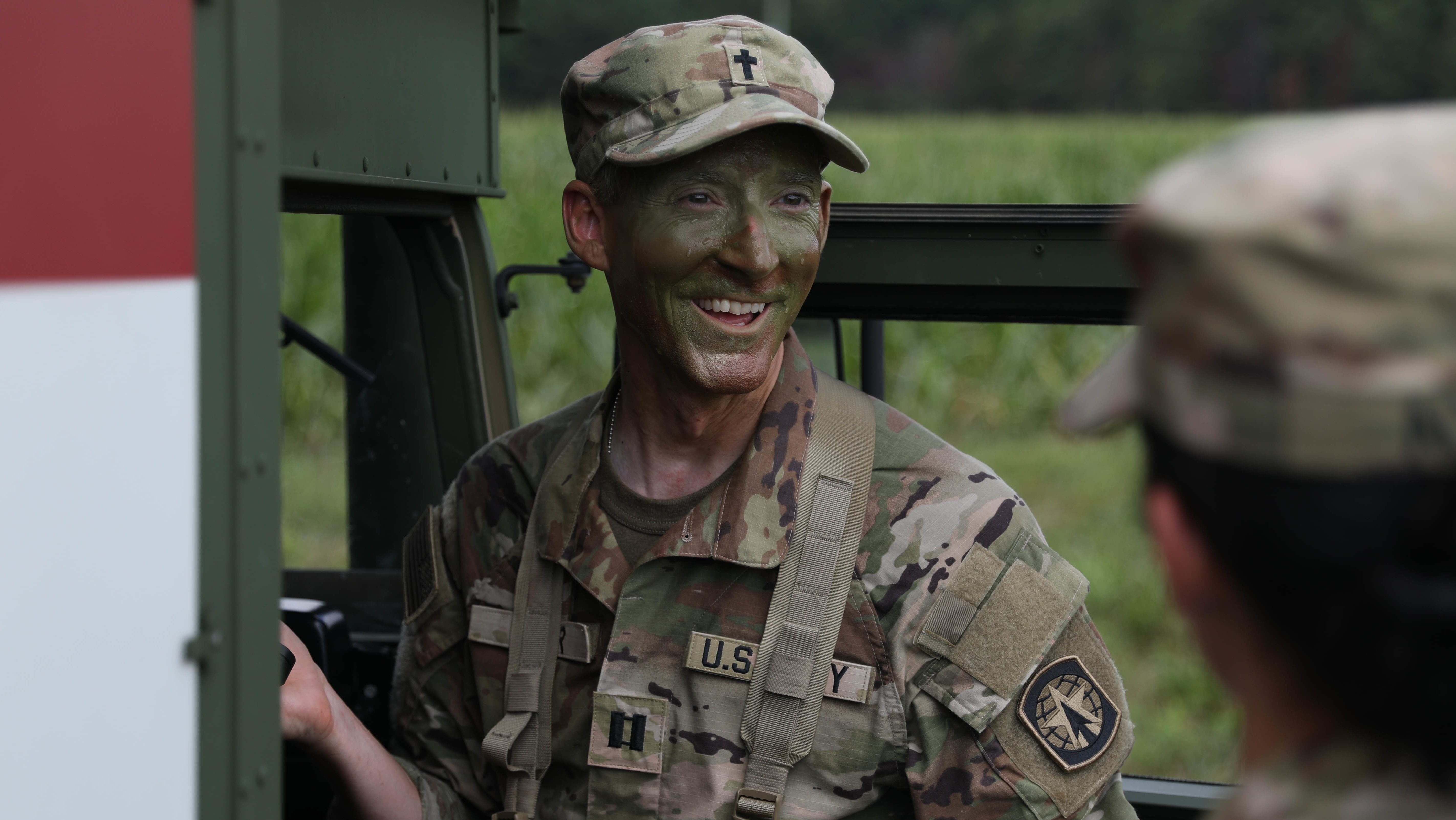
As U.S. forces prepare for future war with massive casualty rates, chaplains like Capt. Alec Correa are training to face the most existential parts of war, the moments between life and death.
Correa, a chaplain for the 2nd Battalion, 17th Field Artillery Regiment, recently competed in a training event at Camp Humphreys, South Korea, similar to Best Unit Ministry Team competitions held in the U.S. The contests put unit ministry teams of commissioned chaplains and enlisted religious affairs specialists, through events ranging from field medical care to administering last rites.
The Camp Humphreys event, Correa said, began by delivering an injured patient to a casualty collection point.
There, the stress really began.
“Who’s out there, who do I need to go to next, and what was our plan as a team?” Correa recalled. “There was another soldier that was minimal, so injuries weren’t as severe, but that was his buddy that he had just lost. So then I’m running over there to talk with him and try to provide that care and support. And then you’re going back and just checking on the medic, so making sure you’re hitting all those blocks.”
Correa, ministry teams, and Korean counterparts ran through training lanes that included comforting and administering last rites to soldiers near death, organizing honor walks, and even de-escalating confrontations between angry leaders when battlefield emotions run high.
“What we wanted to do was create combat scenarios, as well as obstacle courses for this kind of training. And it also involved realistic scenarios for our chaplains, our religious affairs specialists,” and their Korean counterparts, said Lt. Col. Bill Kim, Eighth Army Command chaplain. “We had not only medical training lanes but also hospital training, as well as combat field training and obstacle courses for the competition.”
The Best UMT competitions are part of training that the Army hopes will prepare them for conflicts likely to produce a higher rate of severe injuries and deaths than in Iraq and Afghanistan. Units in Kentucky, Georgia, and Washington have held similar events in recent years.
“It doesn’t happen when it’s convenient. It happens when it’s the middle of the night, you get that knock on your door, ‘Hey, chaplain, we’ve had something terrible happen, and we need you to provide the ministry.’ It’s kind of teaching them, you’ll be under duress,” said Maj. Ryan Mills, an Eighth Army chaplain who helped plan an event in Korea. “How do you do that to support the soldiers and to make sure that they’re continuing to stay in the fight.”
A renewed Pentagon focus
The training comes as Secretary of Defense Pete Hegseth has made reforms to the U.S. chaplain corps to focus on ministry. Hegseth, who regularly promotes his own Christian faith, argued in a December video that the chaplain corps had become more of a supporting force in recent years and “viewed by many as therapists instead of ministers.”
In March, Hegseth announced that they were replacing chaplains’ uniform rank with their religious insignia and reducing the number of recognized religion codes. He also scrapped the Army Spiritual Fitness guide as insufficiently focused on faith.
Though chaplains have joined troops in every major war since the establishment of an American Army in the 18th century, it’s unclear how far back chaplain-specific combat exercises and contests go. The Army put out press releases on events in 2017, 2022, and last August, for the first-ever competition at Fort Benning, Georgia last month.
Some Air Force and Navy units have also held similar chaplain training centered on mass casualty events.
Training lanes for ‘spiritual triage’
Mills said during the hospital scenario, three-person teams had to split up and make decisions about who did what. They had to help medics maintain calm, read last rites to “expectant” patients or those with injuries that are so severe they are unlikely to survive with medical care, and send notifications to families about their deceased service members.
“You had to figure out as a three-person team, where do we go and what we do, and how do we prioritize religious support?” Mills said.
Soldiers also ran through shortened tactical memorial ceremonies, which are designed to honor the fallen in combat. Also called a “fallen tactical pause,” the memorials only last minutes, to avoid exposure to enemy fire or overhead threats.
“You literally have three to five minutes. It is short to the point, and it’s honoring those they lost, but then it’s reminding them of why they’re there doing what they’re doing, and getting them in a positive attitude to continue fighting,” Correa said. “Losing any soldier, that is always a tough situation, so how do we bring again, that calm presence and a difficult, hard moment and ensure that we’re giving the soldiers the support that they need?”
Top Stories This Week
US Army and Navy helicopters sink six Iranian small boats, commander says
Navy says aviators can no longer command amphibious warships
The Marine Corps is overhauling its Recon training
By Nicholas Slayton, Jeff Schogol
Ministry teams provide religious support to all soldiers, regardless of their faith. Chaplains can offer specific prayers, like the Anointing of the Sick to Catholic soldiers, or general non-denominational prayers.
“We would try to find a Catholic chaplain to be able to take that. However, in combat situations and emergency scenarios, that may not always be the case. We may not have enough time [if] the soldier passes,” Kim said.
If service members are not religious, chaplains can also offer more general words of comfort.
“If they don’t want a prayer, we just have that presence where we would be with them, maybe hold their hand, put our arms on them, just to make sure that they know our presence is felt in their dying moment,” Kim said.
Correa described an event where a commander and a first sergeant were yelling at each other, “getting at it,” while a Korean soldier was screaming and dealing with grief after losing his friend. The chaplain’s role in that scenario was to be “calm amid the chaos,” he said.
“We just exited this high-stress situation where we’re ‘spiritually triaging.’ It’s a mass [casualty situation], how do we automatically then bring it down to be that calmful, peaceful presence to the situation, and just immediately intervene, separate, deescalate,” Correa said. “At the end of the day, even in high-stress situations, people just need to know that you are there and you’re present with them.”
Related Service stories

Yes, I Served in Iraq. But What if People Mistake Me for a Hero?
Illustration by Kim Vo The Department of Motor Vehicles was a good place to lose your identity, not find it, especially 30 minutes before cl
Officers only: New report lays out what a ‘US Cyber Force’ could look like
A new report argues that an independent Cyber Force should be staffed by only commissioned officers and warrant officers to better develop t
Navy researchers find wreck of World War II submarine that vanished 82 years ago
Nearly 82 years to the day after the USS Herring went missing during World War II, the Navy said it had found the wreck of a submarine that