An ode to the Deuce-and-a-Half: the M35 Cargo Truck
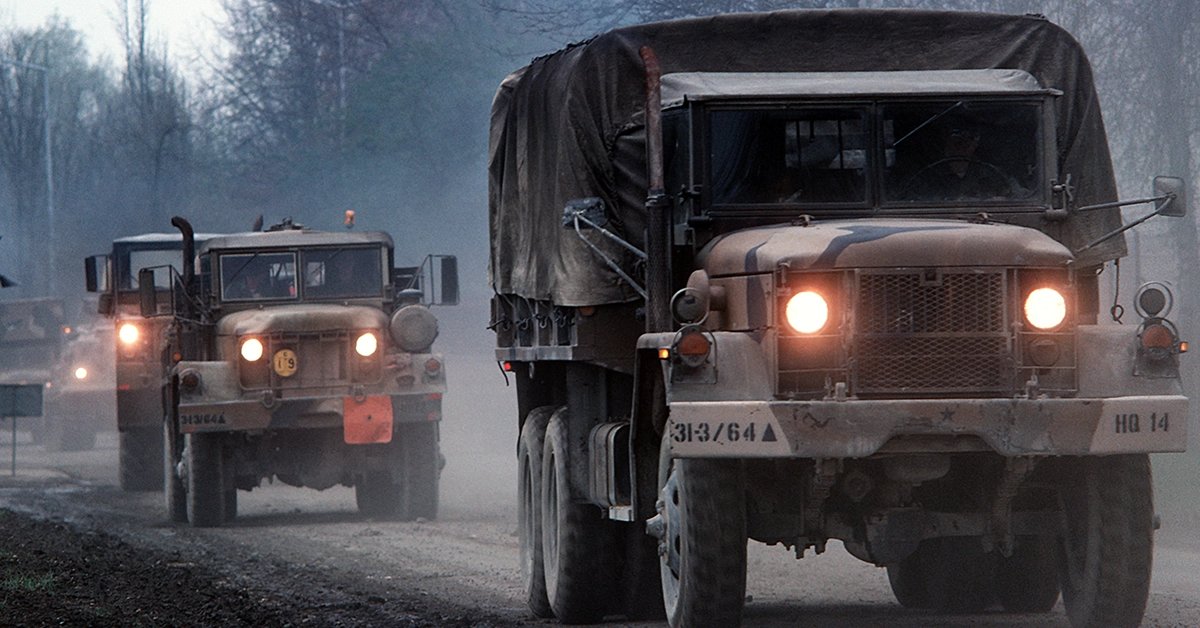
It smelled like old diesel and sounded like the apocalypse. Its bench was a wooden plank bolted to an aluminum frame that felt purposefully designed to make your back hurt and your legs go numb. The canvas overhead snapped in the wind like it was trying to get the heck out of there, and who could blame it?
If you ever climbed into the back of a 2½-ton M35 cargo truck, you remember it. The shaking and flying off every bump. The guy across from you, knees touching yours, both of you pretending not to notice. The grab strap overhead, because whoever was driving had apparently never heard of a smooth transition between gears.
The Deuce and a Half. Not a tank, nor a helicopter. Nobody, anywhere, ever, said, “Hey, let’s make a movie about her.” It was just a big, ugly, loud, diesel-chugging, unbreakable truck that carried more American soldiers to and from war than any other vehicle in U.S. military history.
Across eight decades and every American conflict from World War II to the Global War on Terror, the deuce did not care what war it was. This baby just showed up, loaded soldiers in the back, and drove toward the problem.
The Truck Won’t Quit
Brought into this world as the GMC CCKW, a 2½-ton 6×6 cargo truck that rolled off production lines in 1941. By 1945, more than 562,000 had been built, second only to the Jeep in wartime vehicle output. Supreme Allied Commander Dwight D. Eisenhower himself identified the 2½-ton truck as one of four pieces of equipment most vital to Allied success in Europe, noting that none of them were designed for combat.
The Deuce and a Half’s finest hour might just be the Red Ball Express, an emergency convoy operation that kept Patton’s Third Army fueled after the Normandy breakout. Nearly 6,000 trucks ran day and night across bombed-out French roads. Roughly three-quarters of those drivers were African American soldiers serving in segregated units.
One of them, Buddy Reynolds, recalled landing in France 30 days after D-Day and joining the Express. His unit wasn’t allowed to fight, but they supplied the front lines with ammunition and fuel. They weren’t allowed to stop for anything. One time during a run, he had to change a tire on a moving vehicle. Everyone was getting shot at.
By the time the Korean War kicked off in 1950, those same trucks were pulled from stockpiles and shipped east. The war changed. The truck did not.
By 1965, the CCKW’s successor, the M35, had arrived in Vietnam. Built by REO Motor Car Company and later produced by Kaiser-Jeep and AM General, it inherited the 2½-ton rating, the 6×6 drivetrain, and the nickname.
It also happened to inherit the mission of moving everything from the coast to the interior. That meant 100-truck convoys rolling from Qui Nhon to Pleiku along Route 19, through stretches of road the drivers called “Ambush Alley” and “The Devil’s Hairpin,” a switchback where traffic slowed to four miles per hour regardless of direction.
On Sept. 2, 1967, an ambush killed seven drivers, wounded 17, and destroyed 30 trucks. The answer was the gun truck: an M35 armored with steel plates and armed with M60 machine guns, .50 caliber Brownings, even miniguns. The trucks were painted black and given names: “Ace of Spades,” “Cold Sweat,” “Pandemonium.”
Dennis Belcastro, a veteran of the 8th Transportation Group, recalled how his convoys moved some 3,000 tons of supplies a day, running up a million miles a month. During a December 1967 ambush, his convoy commander moved among the vehicles under fire, encouraging soldiers while gun truck crews laid into the tree line with everything they had.
Not every crew made it out. Charles Soule, 19, from Lewiston, Maine, volunteered for a gun truck called The Protector. When his convoy was ambushed, a rocket struck the truck and killed him. He was the last service member from his hometown to die in Vietnam. The Protector was recovered, repaired, and sent back out under a new name: the Executioner.
Sand, Oil, and the Same Old
When Desert Storm launched in 1991, the M35A2 went to the Gulf. By then, the deuce was pushing 40 years old in some configurations. Photos from the theater show M35s with oversized rear tires swapped in for traction in soft sand.
Desert Storm was defined by GPS-guided bombs and stealth fighters. The main job of keeping these systems fed, fueled, and armed still fell on trucks that predated most of the soldiers driving them. The ground war lasted 100 hours; however, the logistics war that made it possible lasted months.
If you ever rode in the Deuce and a Half to a raid in Iraq, you know firsthand it was not meant for frontline warfare; the Global War on Terror turned them into frontline fighters, whether they signed up for it or not.
The M35 series remained heavily involved in Operation Iraqi Freedom through 2011. In Afghanistan, 400 M35s were shipped to the Afghan National Army because the truck was ideal for the conditions: standard transmission, mechanically simple, about as rugged as anything with ten wheels.
Parallels to Vietnam were impossible to ignore. In March 2003, a convoy from the 507th Maintenance Company was ambushed in Nasiriyah. Eleven soldiers were killed. Five were taken prisoner.
By June, insurgents were attacking convoys regularly, and the gun truck concept born on the M35 in Vietnam was reinvented on Humvees in Iraq. The Transportation Corps went back to its Vietnam playbook. Convoy routes became the front line of the insurgency, IEDs replacing RPGs as the weapon of choice.
On Good Friday 2004, the 724th Transportation Company ran a fuel convoy from Camp Anaconda to Baghdad Airport. They drove into a coordinated ambush of IEDs, RPGs, and small arms. The convoy commander was hit in the head and blacked out. His driver, Pfc. Jeremy Church, led the convoy to safety and became the first truck driver and Army Reserve soldier to earn the Silver Star since Vietnam.
A soldier from the 1450th Transportation Company, a National Guard unit in Iraq that same year, talked about what life was like on those roads. She described watching every person on the roadside, looking at their hands, watching for signals, looking into their eyes as the convoy passed, pleading silently for them not to push the button.
Years after coming home, she was driving in North Carolina and missed her exit by 10 miles. She had been unconsciously following a tractor-trailer carrying a shipping container, the same kind they used in Iraq, just like she had done for a year in the desert.
She captures the dark humor, too. Nobody thinks it’s funny, she said, when she jokes that getting shot at was nothing and that it was the IEDs they had to watch out for. But when she walked into the American Legion for her unit reunion and cracked the joke, everyone laughed.
For the first time since Fort Bragg in 2005, she didn’t feel like a crazy person.
Then-1st Lt. Jonathon Murray, an Air Force convoy security officer, reflected on the contrast that defined convoy life in Iraq. Most missions were extremely boring, he said, which was a good thing. Some 30 minutes from the end of a run, the radio crackled: Iraqi forces at the checkpoint ahead were jumping into their bunkers. An ambush followed. Afterward, Murray said the sounds and smells get ingrained into your brain.
Keep Rolling, Rolling, Rolling
The deuce is being replaced by the Family of Medium Tactical Vehicles. The transition has been underway for years. And yet, it is not gone.
It remains in the inventory of more than 20 countries, from Norway to Fiji, Bolivia to Djibouti. Nobody wrote songs about it. No blockbuster Hollywood extravaganza was built around a truck that hauled water, ammunition, and soldiers from one suck-fest to the next.
But that truck also carried Red Ball Express drivers across France without brakes. It carried gun truck crews into kill zones in Vietnam, then hauled fuel across the scorching Saudi desert. It drove IED-lined routes in Iraq, always bending, but never fully breaking. And in every one of those wars, the soldiers who rode it, loaded it, drove it, armored it, and sometimes bled in it, were the heroes; as will the future soldiers who will do the same, while looking up to see the last stars blink out forever.
Until the next drop, stand easy.
Don’t Miss the Best of We Are The Mighty
• No Boots, No Problem: Ukraine captured a Russian position using only robots and drones • Your standard rifle can now be an anti-drone weapon. Seriously. • The M72 LAW: the tube that toughened the infantry
That time American and Russian tanks faced off in a divided Berlin
WATCH: Navy veteran saves for 22 years to buy 1986 Porsche
Operation Desert Shield was the ultimate show of global strength
Last aid package to Ukraine announced unless Congress approves more
Israel bought nearly 14,000 tank shells for over $106M