Bill would secure justice for veterans of Cold War-era human experiments
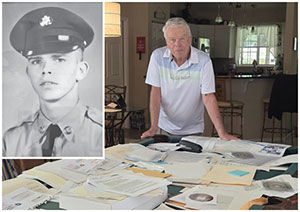
Dave Dufrane dined at the Denny’s off I-95 in Edgewood, Maryland, countless times. He enjoyed those breakfasts, but he could never fully relax. At the top of his mind was the military post a mile down the road that had plagued him with nightmares for over six decades: Edgewood Arsenal, the site where the Army conducted human experiments on its own soldiers.
In 2005, after his usual breakfast, Dufrane decided to do something he hadn’t done before. He drove to the arsenal and parked his car outside its back gate. He stared into the distance at the shacks that remained.
“And I had some bad stuff going through my head,” he said. “That’s a scary, scary place.”
Dufrane was one of an estimated 7,000 Army personnel who passed through Edgewood Arsenal between about 1950 and 1975 and were forced to sign secrecy oaths because of the covert human drug experiments that took place—experiments that forever changed their lives and left many of them with lasting physical and mental scars.
Because they couldn’t speak of their time at Edgewood, these veterans had no way of proving to the Department of Veterans Affairs that their ailments were connected to this part of their service, often preventing them from being able to access the benefits they earned and needed.
Even when Edgewood veterans were partially released from their secrecy oaths in 2006, they faced another insult. The effective date of their disability claims could only go back to the date they filed the claim, even though Edgewood veterans weren’t formally allowed to file for claims related to the experiments until after 2006.
As it stands, Edgewood veterans must individually plead their cases for service connection and fair effective dates. Now, a DAV-backed bill aims to secure justice for veterans like Dufrane by allowing them to receive retroactive benefits that have been blocked by secrecy oaths.
Another dimension
Frank Rochelle grew up in rural North Carolina. He was “just a country kid, never been nowhere” when he was drafted in 1968 at 20 years old.
While at Fort Lee in Virginia, Rochelle saw a bulletin for a volunteer program to help test Army equipment. Participants would be on duty only four days a week, with no kitchen or guard duty.
“I’d just finished basic at Bragg, where I was crawling under concertina wire,” Rochelle said. “So I volunteered to go.”
But when Rochelle arrived at Edgewood, the mission quickly changed. Instead of equipment, they’d be testing chemical warfare agents. Despite the bait-and-switch, Rochelle trusted the people in charge.
“They said, ‘We’re not going to harm you.’ Well, I believed them,” Rochelle said. “I was just a young country boy, and I was raised up [to think] anybody in uniform, you respected.”
The substances used at Edgewood included psychoactive drugs like LSD and PCP but also things like mustard gas, incapacitating agents and what Rochelle called “pharmaceutical rejects.” The program’s goal, he’d later learn, was to develop nonlethal agents that could literally make battlefield enemies lay down their weapons—either out of delirium or incapacitation. The program was born of Cold War-era fears and a race to develop the best in chemical warfare. Around the same time, the CIA was conducting mind-control drug experiments in operations like Project MKUltra.
In one experiment at Edgewood, Rochelle said, a drug he only knew by code name CAR-302,668 was administered to him as an aerosol through a breathing apparatus. He hallucinated for 2½ days.
“I was in a whole other dimension,” he said.
At one point, while in the bathroom, Rochelle believed the freckles on his arms were bugs crawling under his skin. He used a razor blade from a shaving kit to try to cut them out.
After that, Rochelle completed one more test and spent the rest of his two-month assignment hanging around the barracks.
Dufrane, who was at Edgewood in 1965, three years before Rochelle, had a particularly extreme experience. While most soldiers underwent two or three tests or received placebos, Dufrane was experimented on eight times with various drugs.
“I was never down off one chemical long enough to straighten out until they laced me with something else,” Dufrane said.
One of those chemicals was BZ, a drug with no recreational equivalent that has been described as a “nightmare” able to cause psychosis.
Dufrane said he was put inside a padded room on four different occasions, in one case for four days straight. One test caused temporary blindness for eight hours. Another drug was administered via a wind tunnel to several soldiers and a goat. Another one occurred in a dark, wooded area where soldiers were sprayed with a substance that left them glowing purple under a black light.
Like Rochelle, Dufrane trusted his superiors. He had dreamed of being a soldier since he was a kid. Even if he had been aware enough to object, he wouldn’t risk what, for him, was supposed to be the beginning of a meaningful career.
‘Doing our duty’
After Edgewood, Rochelle served seven months in Vietnam and finished his service in 1970. He worked in maintenance at Camp Lejeune, North Carolina, all the while struggling with memory loss, insomnia, breathing issues and other symptoms.
In 1971, after waking up nearly blind in one eye, he went to a Veterans Administration clinic. His doctor couldn’t explain the vision loss, and when Rochelle brought up the Edgewood experiments, nobody believed him. His first claim for benefits was denied.
In 1987, before he was formally relieved of his secrecy oath but more than a decade after bombshell Senate hearings exposed the Edgewood experiments, Rochelle again filed claims and was finally granted service connection for conditions related to Edgewood. He filed again over the years for additional conditions.
Dufrane was deployed to Thailand after Edgewood and immediately started experiencing nightmares, headaches, memory loss and neuropathy. Later, while at Fort Rucker, Alabama, Dufrane was approved for Christmas leave but forgot to sign out. He was demoted.
“They took my memory and then wanted me to remember everything,” he said.
In 1967, decades short of the career he had once dreamed of, Dufrane left the Army.
For roughly 30 years, he didn’t tell a soul about Edgewood. When he finally went to the VA, desperate for help, nobody believed him. It wasn’t until he got his hands on some of his records and in front of someone willing to listen that he was able to get help through the VA. In the late ’90s, he filed his first claims and was granted service connection for disabilities related to Edgewood.
Since Rochelle’s and Dufrane’s time at Edgewood, the Army’s human experiments have been well publicized, first through the 1975 Senate hearings and media coverage and later when veterans’ secrecy oaths were relieved and they could finally talk about what happened without fear of punishment. Then a 2023 decision in Taylor v. McDonough seemed promising. The court found that Edgewood veteran Bruce Taylor was entitled to disability benefits “retroactive to the date he would have obtained them if the government had not blocked his application with a secrecy agreement,” according to the American Civil Liberties Union.
Yet both Rochelle and Dufrane are still fighting for earlier effective dates for their Edgewood-related disability claims, appealing to the Court of Appeals for Veterans Claims. Like Taylor, they said, they couldn’t file for claims in a timely manner due to the secrecy oath and covert nature of the program. Their appeals cases are pending.
But in May 2025, they received a glimmer of hope that offers a different route to justice for themselves and other Edgewood veterans. Sen. Richard Blumenthal, ranking member of the Senate Veterans’ Affairs Committee, introduced S. 1665, the Obligations to Aberdeen’s Trusted Heroes (OATH) Act (The old Edgewood Arsenal site is now part of Aberdeen Proving Ground.) The bill would ensure that veterans who signed secrecy oaths receive benefits effective from the date they were discharged from service. It would also require the VA to identify all veterans who participated in the Edgewood experiments or other secrecy oath programs and to notify them of their earned VA benefits.
“For too long, secrecy oath veterans—especially those from programs like Edgewood Arsenal—were left outside the system built to support them,” said DAV National Legislative Director Jon Retzer. “The OATH Act corrects that failure by mandating outreach, establishing clear definitions and guaranteeing fair effective dates. It is a long-overdue step toward accountability and equity.”
Once they get what they earned, Dufrane wants his rank back. Despite the horrors of Edgewood, he and Rochelle take pride in their service.
“Nobody really realized why we were there,” Rochelle said. “We just knew we were doing our duty.”