From battlefield to justice: A combat engineer’s story
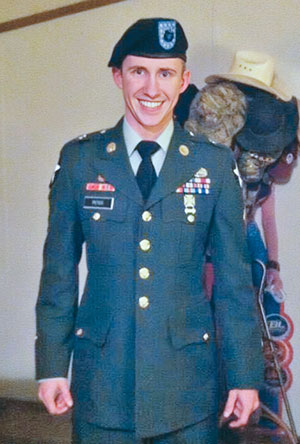
Richard Adams remembers precisely how far he was from the bomb’s explosion in Afghanistan in 2013. Ten feet—far enough to survive the improvised explosive device (IED) blast but close enough to watch his friend, a fellow combat engineer, lose both legs.
“We got tourniquets on almost immediately,” Adams said. “We were quick, and he made it.”
It was seven days after Adams’ 21st birthday. The blast threw him to the ground, knocking the wind out of him as he carried roughly 130 pounds of gear, including an M249 Squad Automatic Weapon. He spent two weeks recovering and being monitored for a brain injury since his eyes weren’t dilating properly.
“I didn’t know it at the time,” Adams said, “but it jacked me up pretty good.”
For him, coming home from war didn’t mean leaving it behind. During his deployment, he was hit with two additional IEDs. That left him with lasting injuries, including traumatic brain injury (TBI) and post-traumatic stress disorder (PTSD), conditions that often overlap, complicating access to care and benefits. But with guidance from DAV, Adams secured the health care, compensation and educational benefits that gave him a path forward.
Adams experienced gaps in memory from before Afghanistan, including his childhood and high school years. He was also in significant physical pain, enough that he sought medical help while still on active duty.
Recognizing he needed help, Adams turned to Fred White, a DAV benefits advocate and senior associate national service officer in Muskogee, Oklahoma.
“He was a little lost and didn’t know how to navigate the VA system,” White said.
White submitted initial claims with the Department of Veterans Affairs for PTSD, TBI, migraines and tinnitus, as well as injuries to Adams’ back, left shoulder and hand. Those ailments also traced back to other brushes with death during his combat deployment.
Two months after arriving in Afghanistan, Adams was driving the lead MRAP (mine-resistant, ambush-protected) vehicle on a route-clearance mission when it struck an IED.
“It was raining, and we couldn’t see the ground well,” Adams said. “I drew the short stick.”
The blast—equivalent to 90 pounds of dynamite—blew off both front tires and filled the cab with smoke and dust. Five soldiers along with Adams stumbled out the back, all concussed.
“Pain was a full-body experience,” Adams said.
A third, less perilous IED later struck his Husky, a single-seat vehicle Adams was operating to detect roadside bombs.
As Adams pursued his VA claims, the familiar challenge of merging PTSD and TBI came into the picture.
“The VA often says they can’t distinguish between PTSD and TBI symptoms,” White said. “But in this case, we were able to show they were clearly different.”
The key was pushing for separate medical evaluations focused on each ailment.
“The cognitive issues from his TBI had nothing to do with the nightmares and anger associated with PTSD,” White said. “It came down to making the VA do its due diligence.”
“The compensation lifted a financial burden,” Adams said. “It gives me peace of mind knowing that if I can’t work, that support is there.”
Those claims were approved, and in 2016, Adams’ disability ratings were increased to better reflect his medical reality. Then, after the DAV-championed PACT Act—the largest expansion of veterans benefits in history—was signed into law in 2022, Adams received benefits for presumptive respiratory illnesses linked to burn pit exposure, including asthma.
“We were on a zero-waste base, so we burned everything,” Adams said. “My tent was less than 100 feet from the burn pit.”
Today, his service is a constant reminder. Nightmares are frequent. Loud noises—especially children screaming while playing—can pull him back overseas. Migraines from his TBI still strike several times a month. He must sleep completely in the dark or risk getting sick from sunlight exposure. Musculoskeletal pain makes it difficult to sit, walk or get out of bed.
“I can’t pick my son up, and he’s only 78 pounds,” Adams said. “When I was younger, that wouldn’t have been a problem.”
Adams also used educational benefits secured with DAV’s help to earn associate and bachelor’s degrees from the Oklahoma State University Institute of Technology. While crowded classrooms posed challenges, the benefits and support he received helped him adapt.
“It was life-changing,” said Christopher Colon, assistant supervisor of DAV’s Muskogee office, about the assistance Adams received. “There were a lot of moving parts, and DAV was there for all of them.”
Related Community stories
DAV Applauds VA’s Study on MDMA for PTSD and alcoholism
DAV applauds the Department of Veterans Affairs for launching a new trial evaluating MDMA-assisted therapy for veterans living with PTSD and
DAV statement on Major Richard Star Act
The vote to turn the Major Richard Star Act into law is long overdue. Fortunately, a “ discharge petition ” can finally get this done.
How one veteran uses gaming to change lives
Melissa Allen chooses games that allow her to talk to viewers while she streams. While deployed in Afghanistan, DAV life member Melissa Alle