How the world’s first-ever Pyrrhic victory went down
Pyrrhus of Epirus was known for a few things, including his success on the battlefield, despite his name being forever associated with a term that basically means defeat: a Pyrrhic victory
He was a beloved king, benevolent leader, and—this may surprise some readers—one of the most successful generals of the ancient world. Pyrrhus was so successful that Hannibal of Carthage, who earned a name for himself by kicking around the Romans for a while, called him “the second greatest military commander after Alexander the Great.”
But no one would know any of that because his name is really remembered for that one thing: his big wins against the Romans at the Battle of Heraclea in 280 BC and Asculum in 279 BC, victories that nearly ended his army.
To this day, his name is evoked for any great victory that cost so much that it might as well have been a defeat. The United States has been able to inflict a Pyrrhic victory on its enemies at places like Bunker Hill, Chancellorsville, and the Chosin Reservoir. The enemy might have won the battlefield, but it cost an irreparable amount of lives to do it, and some would say cost them the war.
Pyrrhus had a rough time coming to and staying in power. His kingdom was Epirus, a Greek kingdom on the Ionian coast, just across from the “heel” of the Italian peninsula. Pyrrhus came to power as a teenager, but was overthrown at 17 and then managed to mount a comeback four years later.
He would later rule Macedon and Syracuse as well, but his biggest enemy (for a time) was the upstart Roman Republic.
In 280 BC, the Greek city of Tarentum, located in southern Italy, begged Pyrrhus for help in fending off the Romans, so Pyrrhus and Epirus answered the call. Pyrrhus, it turned out, wanted Sicily and southern Italy anyway, he just didn’t want to start a war to get it. Most importantly, he owed Tarentum, because they’d helped him take what is today the island of Corfu.
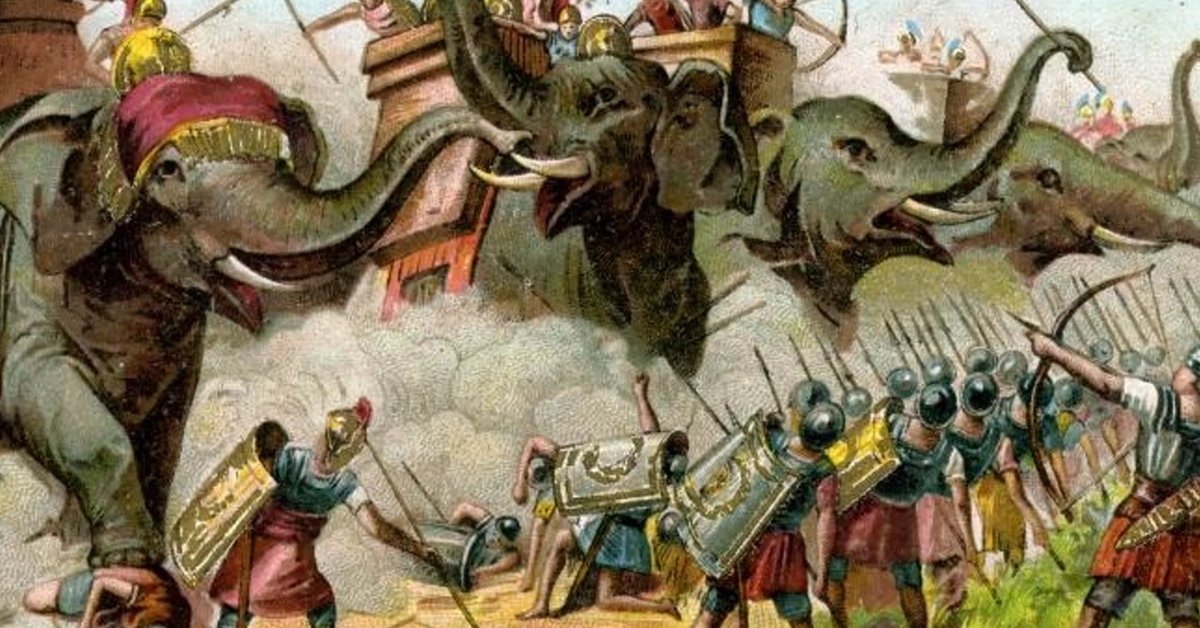
Now that he had an excuse to go to war, he was ready to take what he really wanted while giving Rome a black eye. He sent troops as soon as he could raise an army and arrived in Italy in 280 BC with 20,000 infantry, 3,000 cavalry, 2,000 archers, 500 slingers, and 20 war elephants.
Pyrrhus met the Romans at Heraclea that same year, where the Consul Publius Valerius Laevinus hoped to cut him off from joining an uprising against Rome. The Battle of Heraclea was important because it brought two legendary military formations against one another for the first time: the Roman Legion was squaring off against the Phalanx.
The unstoppable force had finally met the immovable object, and the battle hung as the two sides fought to a stalemate. That’s when Pyrrhus let his war elephants loose.
The Romans broke at the sight of the creatures, and the Greek cavalry finished off the stragglers who could not escape across a nearby river. They lost between 7,000 and 15,000 troops (depending on the source) while the Greeks lost between 3,000 and 11,000.
It was literally a Pyrrhic victory—but it was also a figurative one. Rome could afford to lose those kinds of numbers, Pyrrhus could not. The disparity was even more apparent the next year, after the two sides met at Asculum.
Both Roman consuls marched a massive 40,000-man army with 8,000 cavalry to meet Pyrrhus. The size of such a Roman force shocked the Greeks after Heraclea. The Greeks had about equal numbers, but the terrain put their phalanxes at an operational disadvantage against the Roman legions.
Even more troubling for Pyrrhus were the spiked wagons, some filled with fire throwers, which the Romans built to counter his war elephants. When the battle started, however, the wagons proved useless.
Roman cavalry engaged the Greeks as the legions crossed the river that divided the two forces. The troops in the wagons quickly abandoned those wagons as the elephants came to bear, which both disrupted the Roman infantry and allowed the elephants to drive the legions back.
The two sides then fought into the night. But Roman allies sacked Pyrrhus’ camp during the battle and his flank began to falter. As night fell, the Greeks were facing disaster. Both sides disengaged as darkness fell, but things looked bad for Pyrrhus.
Instead of going to camp (he didn’t have one), he reformed his army throughout the night.
When the Romans woke up in the morning, they found the Greeks were now formed up in the open plains, and they would have to either retreat or fight the Greeks on their ideal ground. After a brief cavalry skirmish, the infantry met and the phalanxes began to push the Romans back.
A devastating elephant charge sent the Romans running for the hills. But Pyrrhus had lost scores of irreplaceable men and most of his field commanders. He is reported to have said, “If we are victorious in one more battle with the Romans, we shall be utterly ruined.”
Instead of continuing the fight against Rome, he moved south to Syracuse, which was facing pressure from Carthage. After three years of fighting, he dislodged all but one Carthaginian city, but could never take it.
After trying to replenish his ranks with Greeks in Sicily, they all turned against him and he was forced to go to Southern Italy instead of taking the fight to Carthage in North Africa. The Roman Army defeated Pyrrhus at Beneventum, forcing him to finally return to Greece, defeated in spite of his victory—forever known as a Pyrrhic victory.
Don’t Miss the Best of We Are The Mighty
• 5 times armies fought battles against absolutely nobody • In 1866, 80 men went to war—81 came home • ‘The Battle of Palmdale:’ The Air Force’s most embarrassing dogfight
How the world’s first-ever Pyrrhic victory went down
21 facts about the First Gulf War
Why Saddam Hussein’s Fedayeen troops wore Darth Vader helmets
World War II
Kurt Vonnegut’s ‘Slaughterhouse-Five’ comes to life in a new Tralfamadore exhibit
A Navy veteran’s unintentional discovery led to the microwave