How this Marine veteran scrambled to survive after the USS Indianapolis sank
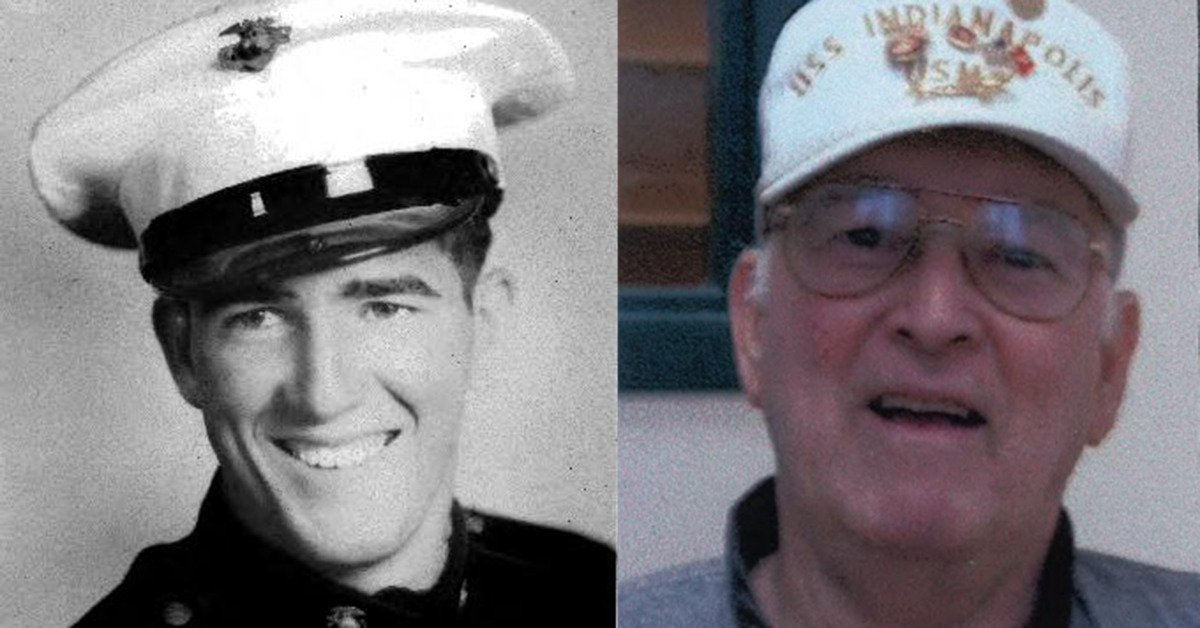
Dr. Giles McCoy served in the Marine Corps during World War II and was on the USS Indianapolis when a Japanese submarine sank it July 30, 1945. He was one of 316 men who survived four days in shark-infested waters. Nearly 900 members of the Indianapolis’ crew died. McCoy, who died in 2009 at the age of 83, spoke to the Library of Congress in 2002 for its Veterans History Collection. In the lead-up to Veterans Day on November 11, 2026, here is a transcript of that interview. It was edited for brevity and clarity.
“My mother had to sign for me, because I was only 17 years old when I went into the Marine Corps. My mother didn’t want to sign, and my dad was a World War I veteran. He didn’t want me to go, so I had to beg them. I went down there, and finally she came along with me and signed the papers for me and cried all the way. What a wonderful woman she was. I was very fortunate to have a mother like her.
“One of my buddies [in the Marines] turned out to be a gangster in St. Louis. I will never forget. He invited me down to his wedding, and I took my wife with me. Oh, God. He pulled a .45 [pistol] out of his holster and slammed it on the table. He had me in front with the wedding party [and said], ‘If anybody gives you trouble, you just tell [me], and I’ll come take care of them.’ Scared the living daylights out of my wife. ‘Put that away. You’ve got her scared to death. I’m ready to get out of here and go home.’ He said, ‘I don’t want you leaving yet. I’ll put it away.’
“I went through boot camp at the Marine Depot in San Diego, and then after I fired on the range, I made the mistake of firing too well. Out of the top possibility of 250, I shot a 248, and a major in the Marine Corps came up and said, ‘Where is this McCoy at?’ I said, ‘Right here,’ and he said, ‘We’re going to make a sniper out of you. We don’t have any, and you’re going to be one of the first ones.’ I said, ‘Why are you doing that to me?’ He said, ‘Look at your firing score. Before we leave here, I’m going to give you 10 rounds, and I want you from 500 yards to see how many you can put in the black.’ I put eight in the black. ‘That’s why we’re sending you to sniper school.’
Becoming a Marine Sniper
“That’s what I became, and I didn’t like the job. It was a nasty job. I almost got court-martialed a couple of times for not shooting two Japanese boys. They weren’t any more than 10, 12 years old, and I had a sergeant with me. He was an observer, and he told me to take those boys out.
“I said, ‘I’m not going to do it. I wasn’t brought up that way, and I didn’t come into this war to shoot kids. I’ve shot men, and I hadn’t liked it. I’m sure as hell going to shoot those boys.’
“And he said, ‘Well, I’ll get you court-martialed.’ I said, ‘Sergeant, you do what you have to do, but I’m not going to shoot them. Here’s my rifle.’ I’m not going to have that on my conscience. I have enough on my conscience. That was on Peleliu, and I didn’t think the boys were really in combat. One had a rifle, but I think they were doing chores around their bivouac area. They were waiting on the Japanese soldiers, and I don’t think they were combat soldiers.
“The transport that brought us in, on the morning of our disembarkment, they gave us all the powdered scrambled eggs that we could eat and all the powdered milk that we could drink. I just had my one share, but boy, when we got done, guys threw up on my back and all over the deck of the landing barge. You could hardly stand up, and I was trying to protect my rifle. When we got into the landing area, the landing barge went into shallow water. We were about 400-500 yards from the landing beach, so we had to get off the landing vessel and wade in the water. Some of it was up to our chest.
“The Japanese were trying to shoot us, and you could see machine gun bullets hitting the water all around us. Finally we got to where we could walk up the beach and onto dry land. That was quite an accomplishment, surviving that slippery deck on that landing barge because it was just full of junk. I told a sergeant when I got my feet on solid ground, ‘This beats that damn landing barge.’ We went onto shore, and he helped guide me. He had already been through one invasion. When he found out I was pretty good at my job and how young I was, he just took me on as his son. He kept telling me, ‘You just do what I tell you and don’t ask questions. I’ll get you through this invasion.’ That’s what I did, and he did. I had to do a lot of shooting that I wasn’t proud of.
“There were many casualties [in my unit]. There were a lot there right on the beach, and then further in, we got quite a bit of shelling, a lot of firefighting…. A Japanese sniper shot me through my groin and through my leg. I was trying to stop the bleeding, and I was trying to decide how badly wounded I was. My sergeant kept saying, ‘Do you see him? Do you see him?’ Of course. I said, ‘Hell, Sarge, I’m busy trying to stop my bleeding.’ He said, ‘Well, get that damn stuff stopped and pick him up. He’s moving.’ I looked up, and I found him. I said, ‘I got him,’ and so I kicked a round off. The sergeant said, ‘Did you get him?’ I said, ‘Sarge, you know I don’t miss at this range.’ He said, ‘OK. Now go on and stop that damn wound.’
“They sent me back to an island just north of Guadalcanal. It was filled with rats and land crabs. It was really bad, and they knew that I had to go farther to get my wound treated, so they sent me to Pearl Harbor. They took care of it, and when I got well, I got ready to go back to my outfit. One of my officers in the Marine Corps, he looked at my record, and he said, ‘You’ve done enough, son. I’m going to put you on the Indianapolis.’ Little did I know that I was going to have to swim for five days, but he put me aboard the Indianapolis.
Heading to the Indianapolis
“They pulled into Pearl Harbor, and some of the Marines got off. We had 39 Marine detachments on board, and some of them were eligible for reassignment. I replaced some of the Marines that got off. It was a beautiful ship, and the living quarters—once you’ve been in the Marine infantry and then, all of a sudden, you get on a clean ship like the Indianapolis. You can take a shower every day. Your food is not full of bugs, and you can eat food without gritting your teeth because of all the sand that comes with it. It was really a pleasure, and I was in heaven.
“I stayed on the Indianapolis, and I became a hot shellman. It was on a five-inch/38 [caliber twin-gun mount]. We had eight, and the Marines on board manned two of them. The Marines also manned the quad 40, which is a 40-millimeter anti-aircraft gun. On the five-inch that I was on, I would catch the hot shell when it would be shot out of the chamber. You can’t let them bounce around on deck, because they’d hit somebody and break a leg. It was my job to catch them and throw them into a net.
“I never lost a shell, and then I didn’t have to do any of the other parts of my training until they put me on Iwo Jima. We had the 25th Regimental Combat Team with the 5th Marine Division. They climbed [Mount] Suribachi, and the Japanese were around it. They would drop grenades down the side of the mountain and blow Marines off the side of the hill. Eighty of us were assigned to snipe the Japanese on Suribachi, and anybody who stuck their head out, one of us got him.
“The Indianapolis went on in the war, and we took a suicide plane in Okinawa. The kamikaze hit on the port side, where my gun was. I was catching shells, and as the gun was shooting straight up, I was jamming them into the deck and kicking them away from me. All of a sudden, there were no more shells coming up. I thought, ‘What’s going on here?’ I looked around, and my gun crew was down. They were all lying on the deck, right where I was throwing the shells. They saw the suicide plane come right down to us. It hit about 50 feet from our gun placement. I went back to the fantail where it hit. [We] pushed it over the side, because we didn’t want it to catch fire. I saw the Japanese pilot plastered up on the dash of the plane, and so the Navy boys wiggled it, and we pushed it off the side. We lost 29 men when that kamikaze hit us.
“My mother and oldest sister came out to California to see me [while the Indianapolis received repairs]. I had a good visit with them, and as we pulled out of our repair dock, I told my mother and sister goodbye. They left and went back to Missouri, and we left and went down to Hunters Point in San Francisco. I knew something big was up, because there were Marines out in motor launches in the Bay Area, and there were armed Marines all over the dock. We didn’t know what we were going to pick up, but we wound up taking the atomic bombs that were dropped on Hiroshima and Nagasaki. My mother and sister were still up in Vallejo, so I asked my executive officer if I could call my mother. He said, ‘No. I can’t even tell my wife I’m not coming home for supper.’ Being before dark, we up-anchored and took off.
Taking the Atomic Bombs to Japan
“They placed the bombs in the port hangar of the ship. They had it roped off, and we put a 24-hour Marine guard on board. I sat on it many times on my watch. I didn’t know what they were; no one knew what they were. The captain told us Marines to guard this with our lives, and we couldn’t let anybody come in there that wasn’t authorized. They assigned two scientists to the hauling of the bombs. They would check them over. Their job was after we put them off at Tinian [Island] and onto the Enola Gay, they would put them together in-flight to Japan and let them blow up there, drop them on Japan.
“The Indianapolis was a good ship. It was a happy ship. I know it sounds strange, but you kind of base combat ships on, ‘Did you have a happy ship, or did you have a bitch of a ship?’ Capt. [Charles Butler] McVay was a great skipper. We all had tremendous respect for him. He suffered out there like we did for our five days. He was lucky he got off the bridge. When the first torpedo hit us, it took 60 feet of our bow. It left us wide open, and the ship was still moving. It was going at 17 knots, and we were just scooping up water. That was why we sank so quickly.
“I was three decks before [when the Indianapolis was hit]. I had changed the watch a half-hour early. We had a brig watch. We had two of our sailors—a cook and a baker—that had got a deck court-martial because they misbehaved in San Francisco. They were going through a 10-day sentence, so we had to stand watch 24 hours a day. They were on bread and water, but they had the best food. All of their buddies from the cooks and bakers, and they brought food down. They brought enough for the Marines who were on guard. I had my share of it, but I changed the watch a half-hour early.
“It was so hot below decks. The Indianapolis had no air conditioning. We were on the equator, and it was 118, 120 degrees during the day, and it just was awfully hot at night. You couldn’t hardly sleep, and so I changed the watch, and PFC Davis was the guy who was on duty. He just got back to the Marine compartment when the second torpedo hit. It hit right below the Marine compartment, so he got back just in time to get killed.
“When the second [torpedo] hit, it blew up our eight-inch magazine, which was amidships, and it threw me from one side of the compartment to the other, and a lot of bunks and men in bunks came down on me. I squirmed out from underneath all of it, and all the lights, all the controls, went out. We had no light, so I crawled back to my battle station, where the brig was. I had an electric, battery-operated lantern, and I turned it on. The guys were hollering that they wanted to get the bunks off them and things. Fellas had broken arms, broken legs, and broken ribs, and so we started to get them out.
“That Was Going to Be Their Tomb”
“I got my two prisoners out and told them, ‘I can’t let you go topside. I need you to stay here and help me get these men out from underneath these bunks.’ That’s what they did. A chief petty officer stuck his head down, and he said that for everybody who was able in the department, get out because he was going to close and ‘dog’ the hatch. When they ‘dog’ a hatch on board a ship to make it watertight, that means it’s sealed permanently. They close it from above, and they put a metal pin in it where you can’t open it from below. My prisoners, they left me when he hollered.
“The chief knew me because I had done work for him. He said, ‘McCoy, you get your butt out of there, because I’m going to ‘dog’ the hatch. I went topside, and then I said, ‘Chief, let me go back down there. There’s still men down there that can’t get out. They’re buried underneath bunks and such.’ And he said, ‘That’s where they’re going to have to stay, son.’ That’s the part that still bothers me, even at my old age. I can still remember hearing those fellas hollering, trying to get out. That was going to be their tomb. They were going to die there. I wanted to try to help them, but he wouldn’t let me.
“I went up the hatch to the next deck, and as I got up there, the ship kept listing, dropping over on the starboard ship. When I got on deck, the ship was laying over, just real bad. I got back to the eight-inch gun, and I walked up the side of the turret to get up to my battle station. When I got up to my battle station, the ship just laid over on her side. She was sinking from the bow first.
“I just started walking down the side of the ship, and when I got to the keel, I knew—I got a life jacket—I had to get away from the ship. So when I got to the keel, I just slid on down until I got in the water and started swimming away. When I looked back, the ship was standing on her nose, the propellers were still going around, and men were still jumping off the fantail. Many hit the propellers.
“Anybody who got off the ship and was injured, they didn’t have a chance to live. They were going to die. But I was out there. I thought that I had to get away from the ship, so I started swimming. The ship sucked me down. I went down until my head felt like it was going to blow open. I caught an air bubble and came back to the surface. When I looked back, there was nothing left but a great, big mountain of foam. The Indianapolis was gone. She wasn’t there, and you could feel her still exploding. I could feel the explosions under the water, hitting me in the groin as I tried to get my life jacket on.”
Don’t Miss the Best of We Are The Mighty • How this Native American veteran honored her tribe by serving in the Air Force • Korean War veteran pinpoints the most important lesson of war • Why a fallen service member’s death in 1999 still hounds this Army veteran
World War II
How this Marine veteran scrambled to survive after the USS Indianapolis sank
Korean War veteran pinpoints the most important lesson of war
World War II
Kamikaze pilots couldn’t stop this Marine veteran, 104, during World War II
‘Invisible Battles:’ An infantry veteran’s essay on surviving and thriving with a TBI
Our huge list of Veterans Day 2025 freebies, discounts, and deals