How this Medal of Honor recipient saved the Union forces at Gettysburg
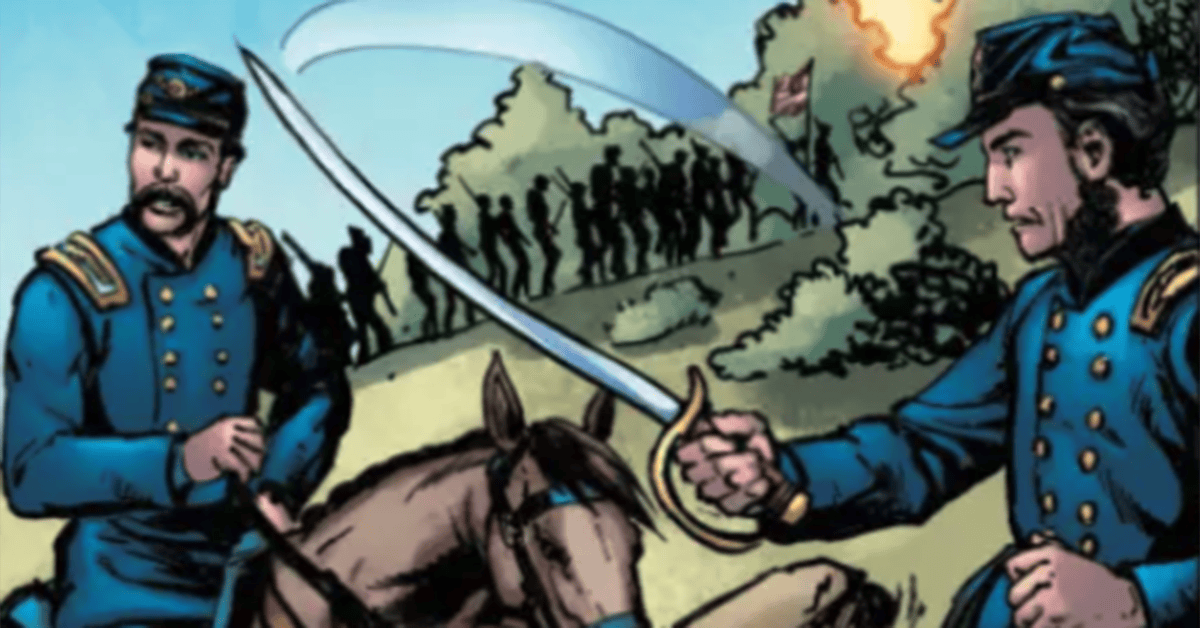
While the Confederacy attacked Fort Sumter on April 12, 1861, Joshua Chamberlain was probably in a classroom in Maine.
A professor at tiny Bowdoin College, Chamberlain loved teaching his students. He hated to leave them, but at the same time, he felt compelled to fight for his country. His bosses, though, were reluctant to let him join the Union Army, so Chamberlain asked for permission to study overseas. When they granted that request, Chamberlain did what he wanted all along.
He enlisted in the military.
Chamberlain started off as a lieutenant colonel in the 20th Maine Infantry Regiment, but that changed after the Battle of Chancellorsville in Virginia in May 1863. After the Union sustained more than 17,000 casualties there, Chamberlain’s superior rose to command his own brigade.
Chamberlain slid into his old spot leading the 20th Maine. Two months later at the Battle of Gettysburg, Chamberlain proved that was the right choice with a decision that allowed Union forces to emerge victorious in that three-day engagement in Pennsylvania. Their triumph at Gettysburg helped swing the war’s momentum toward the Union.
It also led to Chamberlain receiving the Medal of Honor. Chamberlain, the professor turned war hero, is the subject of the Association of the U.S. Army’s latest graphic novel. Starting Thursday, November 5, 2026, “Medal of Honor: Joshua Chamberlain” is available at the AUSA website or on its Medal of Honor series page.
Their First True Test at Gettysburg
The eldest of five children, Joshua Lawrence Chamberlain came from a military family. His relatives had fought for their country, dating to the Revolutionary War. Chamberlain’s father admired the military so much, in fact, that he named his first-born son after Navy Capt. James Lawrence, who famously implored, “Don’t give up the ship,” during the War of 1812.
For his part, Chamberlain joined the Army roughly a year before fighting broke out at Gettysburg.
Up until that point, he and the rest of the 20th Maine hadn’t done much. According to a Defense Department article in 2020, they did little fighting but were at the battles of Antietam, Fredericksburg, and Chancellorsville.
Gettysburg provided their first true test.
Fighting began July 1, 1863, and on the following day, the 20th Maine arrived after marching for nearly a day. They were undoubtedly tired, but this was no time for rest. As the graphic novel explained, the 20th Maine and three other regiments were told to defend a hill named Little Round Top. The stakes were high, because there was no backup plan in place if those intrepid Union soldiers did not succeed in that mission.
The Union regiments assumed a defensive position, bracing for the rebels’ attacks. They didn’t have to wait long. The Confederates rushed their adversaries six times, and each time, they could not overtake their northern counterparts.
“The Lion of Little Round Top”
The 20th Maine Regiment couldn’t hold out much longer. It was not a lack of will. Their efforts to repel the previous charges left their ammunition severely depleted. They even scrounged for some off their injured comrades and any dead rebel soldiers that they could search.
It didn’t matter. Realizing the crisis his men faced, Chamberlain changed the 20th Maine’s tactics. Instead of playing defense, they charged the rebels with bayonets. It worked, and in the process, the Union pushed the Confederates back and captured hundreds of prisoners.
As if that were not enough, Chamberlain and the 20th Maine next were tasked with securing another hill, the aptly named Big Round Top. They accomplished that as well. Thanks largely to Chamberlain’s decision to attack on Little Round Top, the Union thwarted the rebel forces’ second attempt to gain a foothold in the North.
“It is the discipline which is the soul of armies, as indeed the soul of power in all intelligence,” Chamberlain reportedly wrote after the war. “Other things—moral considerations, impulses of sentiment, and even natural excitement—may lead men to great [deeds]; but taken in the long run, and in all vicissitudes, an army is effective in proportion to its discipline.”
Chamberlain was nothing if not disciplined. He was dependable too, and Union leadership appreciated those qualities in him. They thought very highly of Chamberlain, so much so that he was at Appomattox Court House in Virginia to preside over the Confederates’ surrender in April 1865. As befitting his nature, Chamberlain did so graciously, ordering his men to stand at attention during the ceremony to show “respect for their defeated foe.”
For his heroism at Gettysburg, Chamberlain—whose actions there earned him the nickname “the Lion of Little Round Top”—accepted the Medal of Honor on August 11, 1893.
A Lifetime of Service
Chamberlain, who left the active-duty Army as a major general in 1866, did not emerge from the Civil War unscathed. The Confederates wounded him six times, according to the nonprofit American Battlefield Trust. The most serious of Chamberlain’s injuries occurred during the Siege of Petersburg in Virginia. The Union leadership actually thought he wouldn’t survive, but Chamberlain recovered.
After the war, Chamberlain joined the Maine National Guard and became a four-term governor of his home state. Once his time in politics ended, he returned to Bowdoin College as its president.
Chamberlain lived a long and productive life, dying February 24, 1914, at the age of 85 years old. Officials attributed his death to wounds that he sustained at Petersburg. Chamberlain is believed to be the last Civil War veteran to succumb from wounds originating in that conflict, per the DoD.
“It is by miracles we have lived to see this day—any of us standing here,” Chamberlain once observed of the scene at Appomattox.
A gifted writer and speaker, Chamberlain knew just what to say in that moment. Just like he knew what to do when his men were in danger of being overrun at Gettysburg.
You can read more about Chamberlain’s exploits at that historic battle in the AUSA’s latest Medal of Honor graphic novel.
Don’t Miss the Best of We Are The Mighty • How World War I ace Eddie Rickenbacker survived 24 days at sea • This Medal of Honor recipient’s healing hands spelled trouble for the Japanese at Okinawa • Graphic novel spotlights the covert dealings that helped win the American Revolution
The story behind the Civil War sub that sank a Union ship, then disappeared
The post-Civil War ban on home distilling is heading to the Supreme Court
Why grave robbing Confederate Civil War dead is big business
The Loyal Lee: Robert E. Lee’s cousin took the war to the South with the Union Navy
The Civil War started and ended at the same guy’s house