James Capers never gave up on his Marines. Marine Corps veterans never gave up on him.
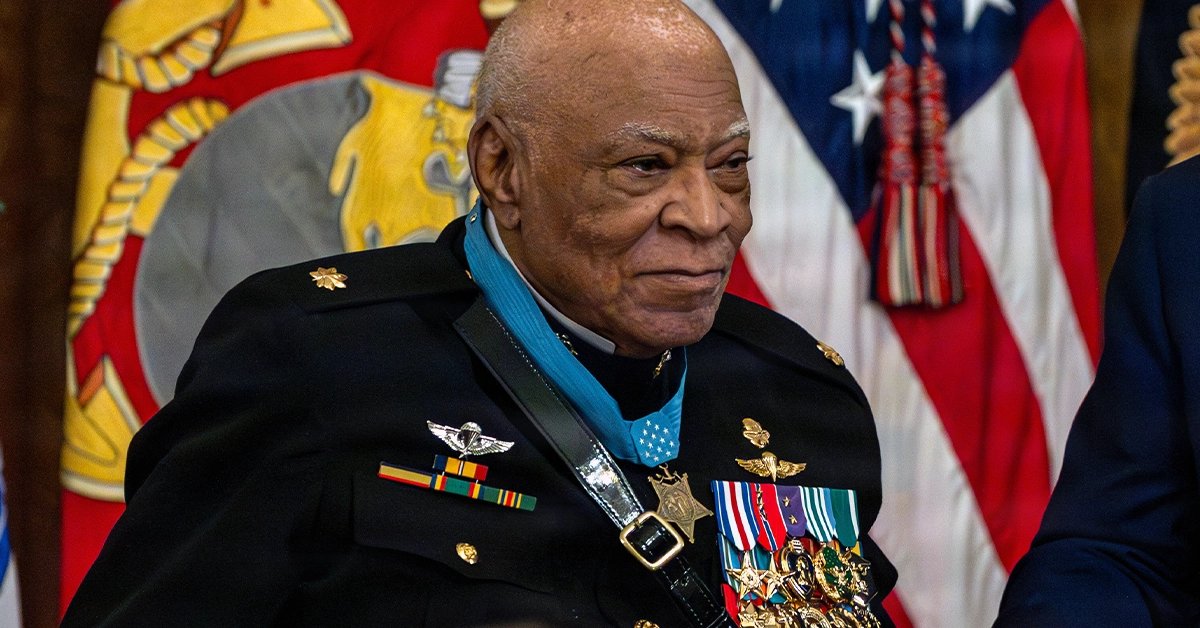
Retired Marine Corps Maj. James “Jim” Capers and the team behind him waited nearly 60 years to see him receive the Medal of Honor. After a lifetime of service to a flag and nation he loves, the delayed recognition for Capers comes with much celebratory joy. But despite the long-awaited moment, the weight of the medal is heavy.
During our interview, there were fierce thunderstorms rolling across Capers’ Jacksonville, North Carolina, home. He candidly shared that he doesn’t do well with storms these days.
“I still hear the thunder today, and I think of those massive artillery battles,” he added quietly. “The sound of it takes me back to those nights when they struck us hard.”
This is the story of how a sharecropper’s son from South Carolina carried his love for America through jungles, hospital wards and decades of grief, and why, when the President of the United States placed the Medal of Honor around his neck, Capers still wasn’t sure if he truly deserved it.
“It was a wonderful time in South Carolina as a child, living on the farm with the horses and the cows and those types of things. But it was not a good time there for African Americans back in those days, so we left and went to Baltimore,” he said.
As his family settled in Maryland, Capers felt a calling to serve.
“World War II was over, and the Marines were having a hard time in Korea. I was in high school and I thought I should do my duty for my country. I wanted to join the toughest outfit going and that was the Marines,” he recalled.
In 1956, Capers graduated from Marine Corps boot camp as the outstanding rifle marksman. His infantry training was interrupted by the Suez Crisis that same year, but it ended before his unit could see combat. He deployed during Operation Blue Bat to help evacuate Americans amid the Lebanon crisis and reenlisted in 1959 after marrying his high school sweetheart, Dottie.
That same year, Capers successfully completed the rigorous selection process for the Marine Force Reconnaissance, becoming one of the first Black Americans assigned to Force Recon.
After close to 15 months overseas with 1st Force Reconnaissance Company, he was assigned to Fort Meade on humanitarian orders so that his son Gary, who’d been born blind and with special needs, could attend one of the few schools in the country that taught Braille.
It was the 1960s and the Vietnam War was heating up, and as the news of the fallen hit his television each night, Capers said he struggled to continue doing ceremonial events while others fought overseas. In his oral history recorded with the Pritzker Military Museum, Capers shared that Dottie told him she knew he needed to go, and she and Gary would be there at home waiting for him when he returned.
With her blessing, Capers volunteered to go to Vietnam with the 3rd Force Reconnaissance Company and arrived in May of 1966.
That same year he received a battlefield commission, the first Black enlisted Marine to do so, and moved ranks from staff sergeant to second lieutenant. Capers would go on to command Team Broadminded, the elite reconnaissance patrol that conducted some of the war’s most dangerous behind-the-lines missions.
After one such mission he saw someone giving out American flags and put one in his pocket.
“On those missions I fought and I had that flag,” Capers shared. “I couldn’t let it go. That was my flag, my country. The blood that we’d shed was for that flag.”
Many missions later, he lost that flag when the wind took it from his pocket. Recalling the moment, he had to choose between chasing it down or leaving his team waiting on a helicopter to go to their next mission; Capers believes it was a premonition for what was to come.
From March 31 to April 2, 1967, he led his eight-man team through a reconnaissance patrol and what felt like endless battles before it culminated with a devastating ambush. Within seconds, every Marine on the patrol was wounded and the team’s war dog, King, was killed shielding Capers.
With a broken leg, a ripped-open abdomen, and his body riddled with bullets and shrapnel, Capers led two other Marines in engaging the enemy. For more than an hour, wounded and bleeding, he fought to suppress enemy fire and get his wounded Marines to the medevac helicopter he radioed for.
When the North Vietnamese attacked his Marines and others who’d joined them at the landing zone for the medevac, Capers jumped back into the fight. He exhausted his rifle magazines and had to utilize his pistol towards the end.
The enemy retreated.
Once he determined his Marines were all on the helicopter, Capers finally joined them but only after making a crew member grab their fallen war dog, King. When it appeared the weight was too much for the bird to bear them all, Capers tried to jump off but one of the crew members kept dragging him back on.
After a series of medical evacuation flights through Phu Bai, Da Nang, Japan, Alaska, and finally Virginia, Capers was reunited with Dottie and Gary who were waiting as promised. There, Capers began a painful year-long recovery at Bethesda Naval Hospital (now Walter Reed National Military Medical Center).
Doctors initially told him he’d never walk again but Dottie refused to let him give up. After taking him on a drive one day, they pulled over and she got out of the car. Dottie told him to walk to her after drawing a line with chalk. Fighting through the physical and mental pain, Capers didn’t think he could do it.
“I finally walked to her, but my legs gave out and I fell into her arms and she held onto me. She said, ‘I knew you could do it. I knew you could do it.’ It was the first time I’d walked, but it was for her,” he said. “They kept me in the hospital for almost a year. Mostly for physical healing but then psychological healing also. I revisited too many battles from Vietnam where I heard the sounds of young men dying.”
While still recovering, Capers was selected as the face of the Marine Corps’ groundbreaking and now iconic “Ask a Marine” recruiting campaign.
Rather than accepting medical retirement, Capers worked his way back to full duty and completed classified covert Cold War assignments. He wrapped up his 22-year career as the commanding officer of 2nd Force Reconnaissance Company at Camp Lejeune.
During the years after his military retirement, Capers mentored many young Marines and also began speaking openly about post-traumatic stress disorder. He frequently worked with those struggling and taught leadership seminars.
In 2003, his son Gary tragically died in his arms from misdiagnosed appendicitis. Capers credits his Christian faith with surviving the grief.
“I lost my men and I lost my family, but I never lost my faith in God,” he said.
Capers was initially awarded two Bronze Stars with Valor following his return from Vietnam, though it was originally submitted as a request for the Medal of Honor. Nearly 40 years later in 2006, a group of former Force Recon Marines began the fight to recognize Capers with an award befitting his actions on that fateful day.
The group was led by the now retired Maj. Gen. James L. Williams, who served under Capers in the 1970s as a young Marine officer and joined the Marine Corps after seeing Capers on that iconic recruiting poster. Efforts were backed by the late U.S. Rep. Walter B. Jones Jr. of North Carolina.
During this time, his beloved Dottie was diagnosed with cancer. Eight days after the couple celebrated their 50th wedding anniversary, she passed away.
“When she was dying in the hospital, I was holding onto her like I’d held onto her when we were walking that day at Bethesda. She said, ‘I love you,’ and closed her eyes and went to God. God had claimed her. I never loved another lady like I loved her,” Capers shared.
In 2010, Capers received a letter from the Secretary of the Navy saying that the request for the Medal of Honor had been downgraded, and he’d been awarded the Silver Star instead.
Though he received no true explanation, many believed it was a miscarriage of justice.
After suffering more losses of loved ones and experiencing significant health battles, Capers relocated to North Carolina. In 2018, he published his memoir “Faith Through the Storm: Memoirs of Major James Capers, Jr.”
Two years later he made his way back to his childhood home of Bishop, South Carolina, for the unveiling of a massive plaque honoring him and his service. It was a full circle moment but unbeknownst to him, Capers’ story wasn’t done being written.
David “Bull” Gurfein, a retired U.S. Marine Corps lieutenant colonel and combat veteran, caught wind of Capers’ story. After a 25-year Marine Corps career, he became CEO of United American Patriots, a nonprofit that supports service members and veterans in legal and advocacy matters.
Gurfein was approached by Marines who served with Capers and was told about the failed Medal of Honor pursuit. He immediately joined the group in their advocacy efforts and began writing letters, published opinion pieces and championed Capers on national media outlets in interviews.
Years later, Army Green Beret veteran Ruben Ayala traveled to Capers’ home in 2023 to interview him for BLK Ops, a documentary series which tells the stories of underrepresented special operators. During the process, Ayala learned about the decades-long and stalled progress to get Capers the Medal of Honor.
Ayala led efforts to coordinate a renewed campaign, promising Capers he wouldn’t give up and was all in.
Robert “Zack” Zackery III, a retired Air Force special warfare tactical air control party (TACP) and command chief master sergeant, joined the cause and utilized his role as a senior fellow for the Center for the Study of the Presidency and Congress to knock on doors and get the conversation moving.
The fight was truly on, and the newly formed “Team Capers” was founded.
One of the doors Zackery knocked on was Rep. Ralph Norman of South Carolina. He listened, joined the mission and introduced H.R.3377 on May 13, 2025: “To authorize the President to award the Medal of Honor to James Capers, Jr., for acts of valor as a member of the Marine Corps during the Vietnam War.”
Less than a year later, on March 26, 2026, President Donald Trump signed the bill into law after it passed unanimously through the U.S. House and Senate. Then, on June 18 of this year, Capers, surrounded by his team, advocates and loved ones, finally received his much-delayed recognition.
“He [the president] was a gentle man. He took me by the hand and said, ‘OK, James, I got you,’ and he was walking me to where we needed to be, then he stood me there and he put the Medal of Honor around my neck. It’s the first time and only time an African-American Marine Corps officer has ever been given the medal,” Capers said. “I felt a sense of honesty, and I felt a sense of compassion. In my lifetime, I didn’t see a lot of compassion. I saw more horror and pain.”
The moment was bittersweet. Though Capers is credited with saving many lives on the battlefield during the Vietnam War, he can’t help but be reminded of the men who didn’t come home.
“God spared me and allowed me to be there to have all those accolades, but I didn’t feel like I deserved it,” he added.
Capers credits his friend and caregiver Frank Roberts for keeping him going, lovingly referring to him as his “chief of staff.” For the retired Coast Guard captain, it’s a title he said he’s proud to hold. Capers is also helped by his neighbor, Bill Strand. Together, the duo ensures Capers is supported with whatever he needs.
Crediting his faith, the now 88-year-old Capers said he is at peace despite the current healthcare struggles, lingering pain and the unimaginable tragedies experienced during his lifetime. For him, it was all worth it.
“I love this country. I love that flag, you know, this country is pretty much all I have,” Capers said. “From a teenager, I served this country. I served this flag. I did the best I could.”
He once chased an American flag down a windswept slope during war. Years later that same country draped a different symbol around his neck. For the next generation who hears his story, the question is simple: what will we do with the freedom he bought?
Don’t Miss the Best of We Are The Mighty
• Two legendary Vietnam War Marines and a GWOT Green Beret received the Medal of Honor • Mighty 25: ‘Ask a Marine’ became one of James Capers’ lasting impacts • Robert Zackery is a father, founder, and a quiet force behind Team Capers
Medal of Honor
Medal of Honor
James Capers never gave up on his Marines. Marine Corps veterans never gave up on him.
Medal of Honor
How ‘the real Forrest Gump’ got his stolen Medal of Honor back
Medal of Honor
How this Medal of Honor recipient finally came home from the Korean War
Medal of Honor
This Medal of Honor recipient’s healing hands spelled trouble for the Japanese at Okinawa
Medal of Honor
The ‘Purple Heart Battalion’ fought Nazis abroad and injustice at home