Marines mark one of the most somber days in the Corps’ history
On arguably the worst day in the Marine Corps’ glorious history, Steve Reuss celebrated the birth of his first child.
Reuss, who then was a master sergeant in the Corps, was in Lebanon as part of the United States Multinational Force (USMNF) to maintain peace in the country. He returned to the U.S. to be there when his wife delivered their daughter Gina. That meant Reuss was not at the Marines barracks at Beirut International Airport on October 23, 1983, when a suicide bomber drove a truck bomb into the complex.
The explosion killed 241 American service members, including 220 Marines.
“The doctor who delivered her knew I was a Marine, and he said, ‘Aren’t you glad you’re not in Beirut?” Reuss recalled, according to a 2023 Defense Department article. “I didn’t know what he was talking about, because I hadn’t yet heard the news.”
The horrific images coming out of Beirut chronicled the Marines’ biggest loss of life since the Battle of Iwo Jima during World War II.
The Lebanese Civil War
The Marine barracks bombing occurred during the Lebanese Civil War, a 15-year-long conflict that started in 1975. Amid the conflict, Israel and the Palestine Liberation Organization agreed to a cease-fire deal, including the creation of an international peacekeeping force. U.S. service members, including about 800 Marines, arrived in Lebanon in August 1982, as did contingents from France and Italy. They had one primary mission. They were tasked with overseeing the withdrawal of the PLO and its leader, Yasser Arafat, from Beirut and keeping Palestinian civilians there safe.
Once they achieved those goals, they briefly departed, only to return after a member of a pro-Syrian faction assassinated Lebanon’s president-elect, Bashir Gemayel, on September 14, 1982. That assassination came during Israel’s invasion of Lebanon that year and resulted in the killing of hundreds of Palestinians in refugee camps as retaliation.
The U.S. Multinational Force returned quickly to Lebanon, and its efforts appeared to be working, if only for a brief while. (A group of British peacekeepers joined the USMNF in 1983.) Then a car bomb exploded at the U.S. Embassy in Beirut. The blast resulted in the deaths of 52 people, including 17 Americans.
One month later, the Israelis agreed to withdrawing their troops as part of a peace agreement with Lebanon. Their withdrawal only would occur, however, if the Syrians agreed to do the same. The Syrians did not. Nonetheless, in July 1983, Israel started a unilateral withdrawal of its military members, prompting an increase in fighting among various groups. According to various reports, it was not uncommon for the Marines there to calm tensions to face enemy fire.
Despite the peacekeepers’ best intentions, the situation remained tenuous.
The Barracks “Just Disappeared”
It got even more tenuous after U.S. gunships in the Mediterranean Sea shelled Syrian-backed militias in September 1983. For some, that destroyed any perceived neutrality of the peacekeeping force.
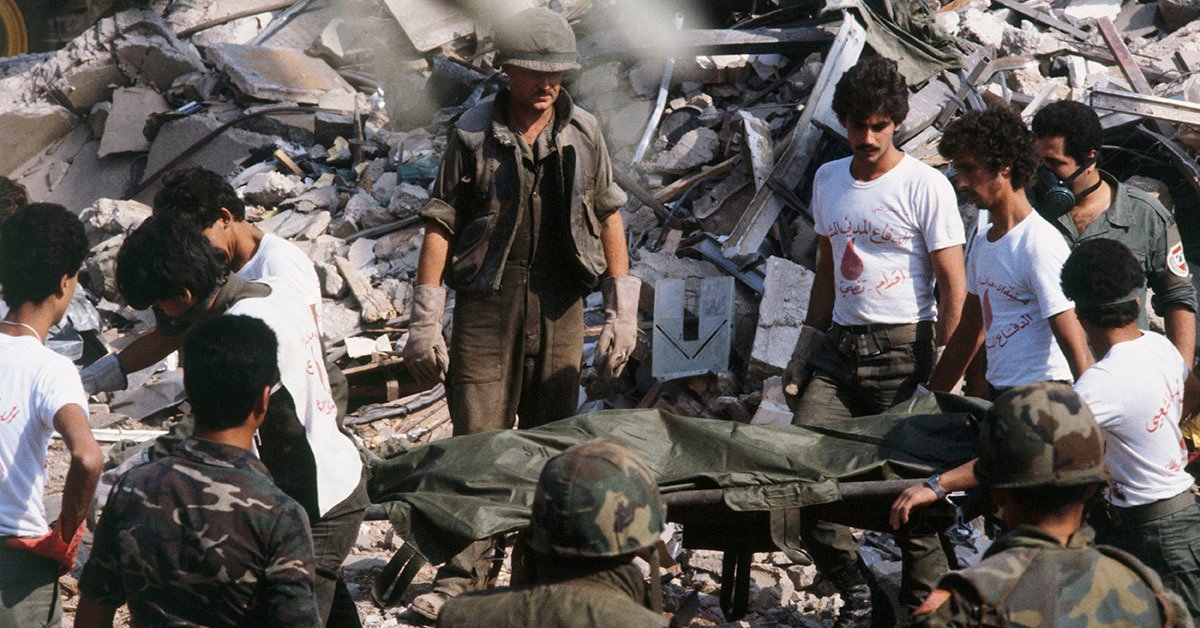
A month later, on the morning of October 23, a yellow Mercedes-Benz truck approached the Marine barracks at Beirut’s airport. Weighed down with the equivalent of more than 12,000 pounds of TNT, the truck breached the perimeter, and the suicide bomber did not stop until he rammed into the headquarters.
The barracks imploded in mere seconds.
“The giant, four-story building that I expected to see was so demolished that it seemed as if it had just disappeared,” said Rabbi Arnold Resnicoff, a Navy chaplain who survived the explosion. “Through the smoke and the air filled with dust, I could see the rubble and, worst of all, the pieces of bodies strewn throughout the area.”
Islamic Jihad, part of the Hezbollah terrorist organization, claimed responsibility for the bombing. (Islamic Jihad also took credit for the U.S. Embassy bombing in Beirut.) While the death toll at the barracks attack overwhelmingly involved Marines, 18 sailors and three soldiers also died.
According to DoD’s story three years ago, Resnicoff and another Navy chaplain, Father George Pucciarelli, frantically tried to help. They tended to the wounded while others desperately searched for survivors in the rubble.
The search efforts lasted five days.
Sadly, another suicide bomber struck that day in Beirut in a largely forgotten attack. Moments after the blast striking U.S. forces, a second terrorist targeted a nearby building containing military personnel. That attack killed, among others, 58 French paratroopers.
Remembering the Victims
President Ronald Reagan, the “Great Communicator” himself, struggled with the right verbiage to summarize the terror that unfolded in the Middle East that day.
“I know there are no words that can express our sorrow and grief for the loss of those splendid young men and the injuries to so many others,” Reagan said. “I know there are no words also that can ease the burden of grief for the families of those young men. Likewise, there are no words to properly express our outrage and, I think, the outrage of all Americans at the despicable act…”
The bombing created intense soul-searching at the highest levels of the U.S. government and military. Was this preventable? That was the question for a Defense Department commission, which Adm. R.L.J. Long spearheaded, to answer. Long story short, it came back with a finding that the Pentagon was ill-prepared to defend against state-sponsored terrorism around the world.
The so-called Long Commission also thought some officers should be punished, but Reagan decided against any courts-martial.
“If there is to be blame, it properly rests here in this office and with this president,” Reagan asserted. “I accept responsibility for the bad as well as the good.”
In 1984—the same year that the Marines withdrew from Lebanon—the White House released a directive that said terrorism was a national security issue. It authorized the military to use preemptive and retaliatory strikes, if necessary.
While no policy can bring back the Marines, sailors, and soldiers who died October 23, 1983, their sacrifices will never be forgotten. Each year, a memorial service is held at the Beirut Memorial at Marine Corps Base Camp Lejeune in North Carolina. There is a memorial for the victims at Arlington National Cemetery too.
“Let peace take root,” an inscription at the memorial in Section 59 at Arlington begins. “This cedar of Lebanon tree grows in living memory of the Americans killed in the Beirut terrorist attack and all victims of terrorism throughout the world.”
Don’t Miss the Best of We Are The Mighty • How this Marine veteran scrambled to survive after the USS Indianapolis sank • What it means when a Marine Corps officer hands over a sidearm during a war • A Marine Corps general led a fictional Iran against the US military—and won
Marines mark one of the most somber days in the Corps’ history
Why this retired Marine colonel and cancer survivor runs 50 marathons a year
World War II
Kamikaze pilots couldn’t stop this Marine veteran, 104, during World War II
Medal of Honor
James Capers never gave up on his Marines. Marine Corps veterans never gave up on him.
How the Marines’ greatest sniper killed 16 enemy soldiers in 30 seconds in Vietnam