NASA’s X-59 breaks the sound barrier without the sonic boom
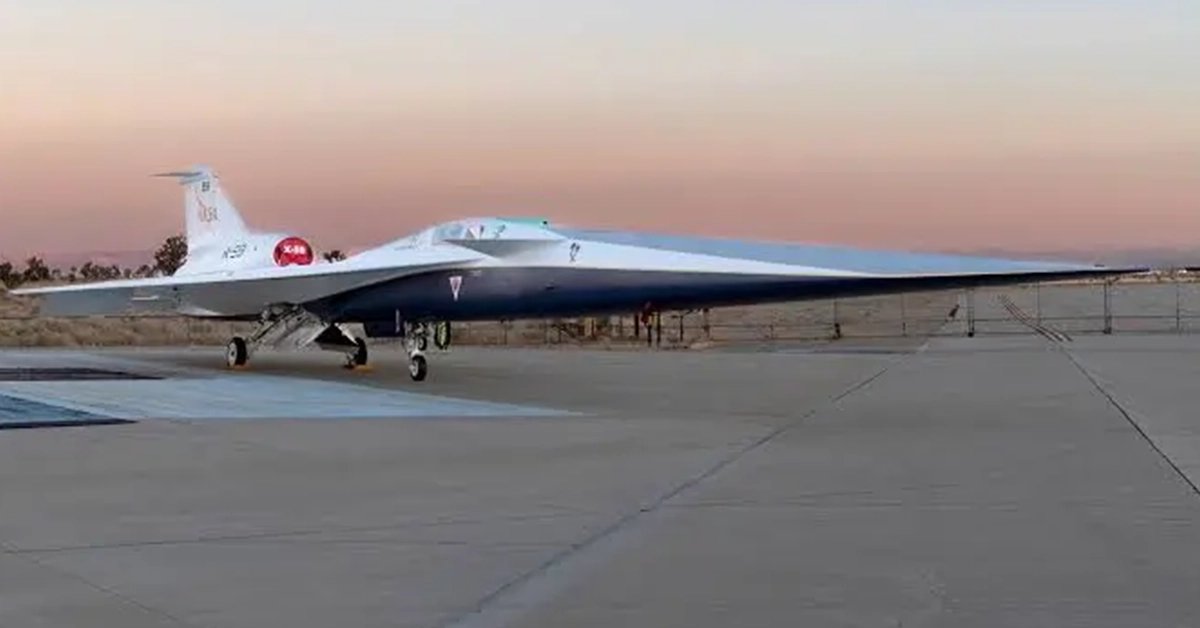
A “sonic thump” may not have the same awesomeness factor as a sonic boom, but it still has the right stuff. And like it or not, it’s the new standard in supersonic flight. NASA’s Quesst mission (“Quiet SuperSonic Technology”) is demonstrating the ability to fly faster than the speed of sound, but without generating the sonic booms that come with breaking the sound barrier.
The X-59 aircraft the space agency developed to achieve this instead creates a sonic thump, which NASA says is an acceptable threshold that could make supersonic commercial flight over land possible. Basically, if NASA can make flying faster than the speed of sound a lot quieter, we can all do it—without breaking all the windows below.
With its needle-like tip, the X-59 was made to travel at more than 1,000 miles per hour, twice as fast as a commercial jet and 1.3 times the speed of sound. It’s not just the tip, however, that reduces the sonic boom to something akin to the sound of distant thunder. It’s the entire airframe design.
When a normal aircraft approaches the speed of sound, it begins to move faster than the pressure waves it creates. Those wavs start to compress and stack, then begin to spread in a cone shape. Despite its name, the boom created is not a single noise, announcing that a plane is going faster than sound, it continues as long as the plane is pushing air molecules aside in flight. The boom’s intensity changes with the aircraft size, weight, and altitude. The larger the plane, and the closer to Earth it is, the louder the sonic boom.
The X-59 is 99.7 feet long, but its needle-like nose alone is 30 feet long. Its design spreads the pressure waves out, preventing them from forming the high-pressure cone that produces the sonic boom we’ve all come to know and love. The position of its engines, canards, and tail direct shockwaves away from the ground. All of these features also separate the initial shocks to weaken them before they can reach the ground.
Probably the most interesting feature is how the pilot sees. There’s no forward-facing cockpit window. That would create a large shockwave, defeating the purpose of the entire plane. Instead, the X-59 has an external vision system (XVS), a series of 4K cameras fed into the cockpit, and allowing the cockpit to remain an unbroken part of the smooth shape of the nose.
There was a time when civilians had the option to take a supersonic flight, despite the regular ol’ sonic booms it created. Between 1976 and 2003, British Airways and Air France operated the Concorde, a route between New York and London or Paris that cut the transatlantic flight time to under four hours. Flying at 60,000 feet, passengers would be able to see the curvature of the Earth as they flew twice the speed of sound.
The Concorde, while innovative, was pricey for both airlines and passengers. After Air France Flight 4590 crashed in Paris in 2000 (the only crash in its 27-year history), the program was retired.
NASA will one day fly the X-59 over residential neighborhoods to gather feedback from the people below, which could lead to resumed commerical supersonic flights.
Don’t Miss the Best of We Are The Mighty
• President Trump’s former royal Qatari 747 is now ready to be Air Force One • The Anduril Fury is the Air Force’s new autonomous wingman • ‘The Battle of Palmdale:’ The Air Force’s most embarrassing dogfight
NASA
NASA’s X-59 breaks the sound barrier without the sonic boom
The Artemis II crew made an 80s sitcom video as they flew to the moon
This Army pilot went from flying Black Hawks to setting a spaceflight record
That time Neil Armstrong survived ejecting from his fighter jet in Korea
What John Glenn did to save his famous wingman’s life in Korea
Related Legacy stories
This American flag survived D-Day, then was returned to the US 75 years later
When Howard Vander Beek died in 2014 at the age of 97, he left behind a distinct reminder of his World War II service. Vander Beek, a lieute
Medal of Honor recipient and legendary Vietnam War helicopter pilot ‘Old Snake’ has died
Retired Army Col. Bruce Perry Crandall, the legendary helicopter pilot who was awarded the U.S. military’s highest decoration for valor for
Air Force crew honors WWII-era Flying Tigers with A-10 paint job
It started as a routine transfer. Following an asset transfer from Korea, maintainers at Moody Air Force Base, Georgia, accepted and process