New Navy Spouse 101: Sea duty vs. shore duty
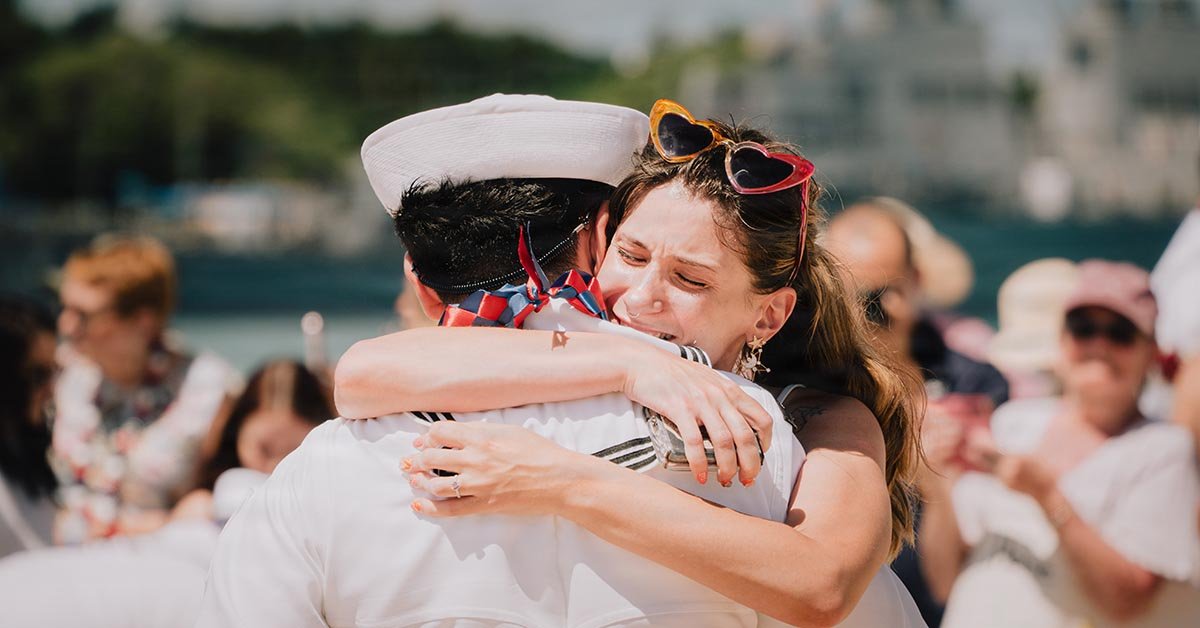
Before you dive into this, let’s get one thing straight: Navy life can look dramatically different, depending on your service member’s duty assignment.
If you’re reading this, you’re most likely a new Navy spouse. Hence the headline. So, first things first, welcome to Navy life! Maybe your sailor just made it through boot camp, is heading to Navy A-School, or is already on the way to a new command they probably know very little about. Either way, you might already have a few questions. One of the biggest is pretty simple: How much will my spouse actually be home?
Unfortunately, the Navy does not come with a handy little calendar that answers that question.
Whether your sailor is assigned to sea duty or shore duty can make a big difference, but even then, there is no one-size-fits-all Navy schedule. A ship, submarine, aviation squadron, training command, or shore-based assignment can each bring its own routines and demands. Understanding the difference between sea duty and shore duty gives you a starting point for figuring out what your sailor’s assignment might mean for your family and their Navy career.
So let’s start with sea duty. Buckle up. This might be a bumpy ride, and you’ll want to keep up.
What Exactly Is Sea Duty?
When you hear sea duty, you might immediately picture a ship or submarine heading out to sea, with your sailor constantly deploying. And yes, that can absolutely be part of the experience. But like most things in the Navy, it’s not quite that simple.
Sea duty generally refers to assignments connected to operational forces, including commissioned vessels and deployable squadrons. The Navy also uses specific sea/shore duty codes to classify assignments for personnel and career rotation purposes. In other words, sea duty doesn’t always mean your sailor is physically out at sea. I know. Make it make sense!
According to Navy HR’s duty classifications, there are different types of sea duty, and the details matter.
For example: Sea Duty, Type Duty Code 2, includes assignments aboard commissioned vessels and deployable squadrons homeported in the United States, including Hawaii and Alaska. Think destroyers, cruisers, aircraft carriers, amphibious assault ships, submarines, and littoral combat ships. It also includes U.S.-based aviation squadrons, such as patrol, strike fighter, and helicopter squadrons.
But wait, there’s more.
Certain land-based commands and operational units can also qualify as sea duty. This includes qualifying shore-based activities, construction battalions, and expeditionary or operational staff when the assignment requires sailors to operate away from their assigned duty station for more than 150 days per year.
Confused yet? You’re certainly not alone.
For a new Navy family, the important thing to understand is that an assignment’s classification doesn’t always tell the whole story. A sailor can have a land-based assignment that still counts as sea duty for career rotation purposes. So while the term gives you a general idea of the assignment, it doesn’t necessarily tell you how often your sailor will be home.
And, of course, the day-to-day reality depends on your sailor’s job, command, operational requirements, and schedule.
What Does Sea Duty Mean for Your Family?
Well, it might mean getting comfortable with pencil-in calendars.
Watch rotations, underways, late workdays, changing plans, and the possibility of limited communication can become part of your routine. Family plans might get rescheduled more times than you care to count. OPSEC will become part of your vocabulary, and having a strong support system can make all the difference.
You will miss each other. You will get frustrated, and you might find yourself handling things you never expected to handle alone. But you’ll also discover just how independent you can be.
People will call you resilient. You might get tired of hearing that word. You might not feel particularly resilient when you’re juggling everything at home and trying to figure out dinner for the third night in a row. But you’ll keep going, find your rhythm, and learn what works for your family.
That’s part of the sea-duty experience, too.
OK, But What About Shore Duty?
If you’re hoping shore duty means life suddenly becomes predictable, I hate to break it to you. Like most things the military throws our way, it isn’t necessarily easier. It’s just different.
Simply put, shore duty generally involves assignments at land-based commands, such as training facilities, administrative offices, recruiting commands, and other shore-based activities. These assignments differ from operational seagoing commands, but that doesn’t mean your sailor will automatically have a Monday-through-Friday, 9-to-5 schedule.
Duty days, long workdays, temporary assignments, schools, training, and other military requirements can still affect your family’s routine. Some shore-duty assignments may offer more traditional working hours, while others can keep your sailor just as busy as ever.
The biggest difference is that some families may find more consistency in their day-to-day lives. Depending on the assignment, you might have more opportunities to plan family activities, focus on your career or education, pick up a new hobby, or spend time building connections in your community.
And after a demanding sea-duty rotation, that change in routine can be a welcome adjustment.
Looking at the Bigger Navy Picture
Here’s another thing worth understanding early on: The Navy has a lot of moving parts, and sea duty and shore duty are often part of a sailor’s career rotation.
Rotations vary depending on the sailor’s job, rating, and career path. Sea duty may commonly last around three to five years, while shore duty may last around three to four years, but these are general ranges rather than guarantees.
For many Navy families, these rotations become part of the bigger picture when planning careers, raising children, choosing duty stations, and thinking about the future. Some families may eventually reach a shore-duty assignment that offers more stability, particularly later in a sailor’s career.
Even if your family is focused on getting through one contract at a time, understanding how sea and shore rotations work can help you ask better questions and make more informed decisions as opportunities arise.
Because if there’s one thing you’ll learn as a Navy spouse, it’s that knowing what questions to ask can be just as important as knowing the answers.
Don’t Miss the Best of We Are The Mighty • ‘Sesame Street’ is ready for military families to ‘Move with Elmo’ • What we learned from the last surviving Civil War milspouse • She found the military spouses no one was looking for
Mighty MilSpouse
Military spouse reveals the wounds military families carry in new book ‘For Now’
By Sara Jane Ginn
Mighty MilSpouse
‘Sesame Street’ is ready for military families to ‘Move with Elmo’
Mighty MilSpouse
5 strange household items common during the Civil War
Mighty MilSpouse
What we learned from the last surviving Civil War milspouse
Mighty MilSpouse
She found the military spouses no one was looking for
By Sara Jane Ginn