Our troops can get ballots by email. Why can’t they send them back?
The views and opinions expressed in this article are those of the author and not necessarily of any entities mentioned.
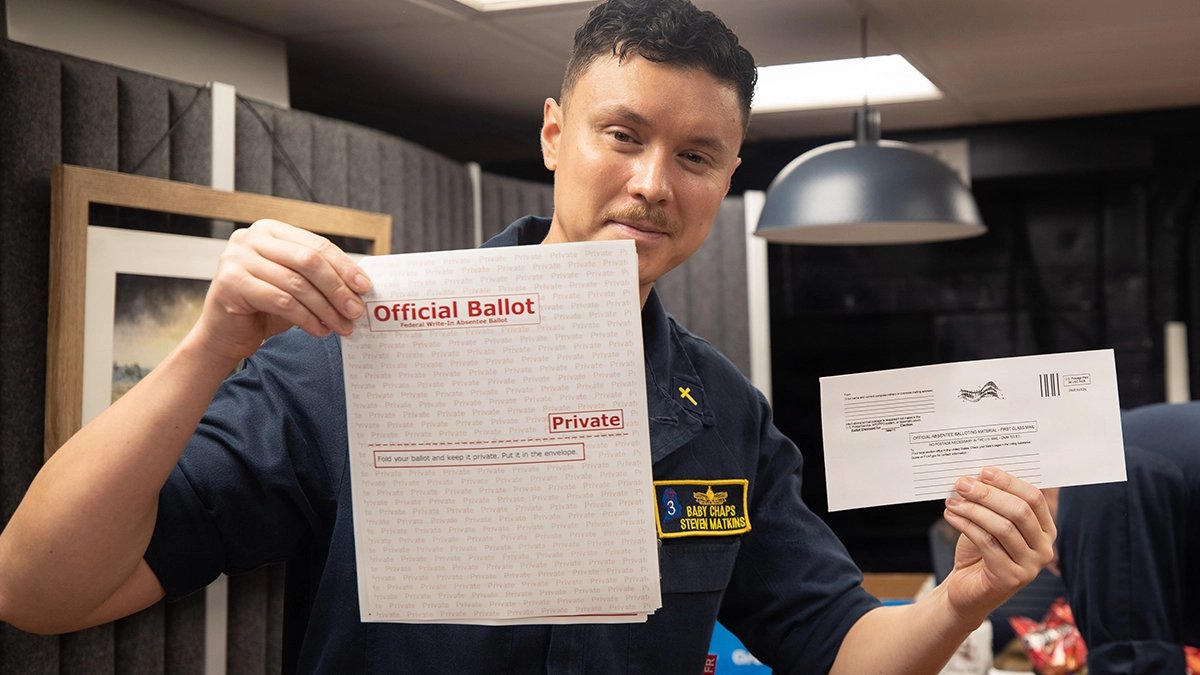
As votes continue to arrive in places like Mississippi and Alaska days after the polls closed, some of these last votes will come from Americans far from home. Whether serving at sea on ship outside the Strait of Hormuz, military families stationed overseas, or citizens living abroad, each is counting on a ballot to make it across an ocean to count.
Mississippi and Alaska let these voters send their ballots home electronically. In other states, the same ballot must leave by helicopter, catch a plane, ride in a postal truck and reach a county clerk’s desk before the deadline. When margins are this close, how a ballot gets home matters.
A 2009 federal law requires every state to send military and overseas voters a blank ballot electronically, but each state decides how ballots are returned.
Thirty-two states, Washington, D.C., and the Virgin Islands allow some voters to return ballots electronically, but the rest demand physical ballots sent in the mail.
Recent voting data shows the voter participation gaps. Only 46 percent of active-duty service members voted in 2024, while civilian participation was 70 percent. When military and overseas ballots are returned but rejected, the most common reason is that they arrive after the deadline. Navigating the patchwork of state laws for ballot return feeds this lack of participation. We now have two years before the next national election to get things right, and we must.
Alaska and Mississippi show what is possible. Alaska’s military or overseas voters can ask to receive and return a ballot by secure online portal. Ballots go out 45 days before Election Day, and a voter on a ship can return his ballot the same afternoon. Mississippi allows these voters to email or fax their ballots.
Confirmation can arrive within days, sparing already stressed service members weeks of uncertainty. These states allow voters to preserve their option to mail their ballots when it is practical, but the electronic options exist to ensure that votes are still counted in situations where it proves impossible to determine when the next supply ship will arrive.
New York is an example of what must be fixed. Even if a New Yorker receives a blank ballot by email, it must be returned by postal mail, postmarked by Election Day and received by November 16. Yet New York is lenient compared to New Hampshire, where a mailed military ballot must arrive by 5 p.m. on Election Day with no grace period allowed. For a Sailor working in a different time zone, whose ship sees mail once a month, it can be impossible to plan for such a strict deadline.
One of the strongest objections to electronic ballot return is cyber security. In 2020, the Cybersecurity and Infrastructure Security Agency and three other federal agencies released a report naming electronic ballot return as “high risk.” There is a real threat that ballots sent over the internet can be intercepted, altered, or lost. When choosing electronic ballot return, voters also give up their right to ballot secrecy.
For military and overseas voters, risk must be weighed against loss. Every election, ballots from people serving their country arrive late and are thrown out at higher rates than the national average. Military voters are a small, identifiable group, and each electronically returned ballot still carries a signed affirmation that officials verify. A risk that can be managed is better than disenfranchisement.
Until such changes are made, those who are serving our country overseas should not wait until their ship pulls out to learn their state’s rules. It is imperative that they understand state procedures for voters covered under the Uniformed and Overseas Citizens Absentee Voting Act (UOCAVA), including using the Federal Voting Assistance Program to check which methods are available for ballot return.
Meanwhile, another election cycle should not pass without substantive change. Veterans and military families carry weight with lawmakers in both parties and need to make their legislators work on behalf of their service member constituent. It should be simple for them to do. Members of Congress need to finish the job they started in 2009 and require every state to offer a secure electronic return option.
Don’t Miss the Best of We Are The Mighty
• Military promotions should not be political leverage • I served nearly 30 years explaining policy. The Survivor Benefit Plan still blindsided me. • It’s time for the VA to recognize spouse proxy for catastrophic veteran illnesses
If you would like to submit an opinion for publication, it must be exclusive to We Are The Mighty. It should be a strong argument about an issue affecting the military, veterans, or the greater military-connected community, and between 400 and 1,000 jargon-free words. Send submissions to info@wearethemighty.com. Please include an email address and phone number. We will protect the identities of current military members who wish to publish an opinion.
Our troops can get ballots by email. Why can’t they send them back?
Veterans built this country. Let them build their own homes.
By Peter Scarpulla, Jr.
What the WWII secret agent who rescued my grandpa can teach us about protecting democracy
By Katie S. Sanders, Author and Journalist
Military spouse business owners shouldn’t have to start over online with every PCS
America doesn’t win alone: Supporting our wartime allies
By Jerritt Lynn, Director, Membership and Communications, IAVA