Smith and Wesson revives the Indiana Jones revolver
Smith & Wesson has been making waves in the first quarter of FY27. First, its purchase of Savage Arms made the company the largest commercial American firearms manufacturer. Not long after that purchase, the company announced it would revive of one of its most iconic and historically significant handguns.
On Oct. 27, 2026, Smith & Wesson released two models in their Classic Series of revolvers: the Model 1917 and Model 22 Classics. Based on the N-frame revolver dating back to the company’s pre-World War I lineup, these revivals represent a significant offering for enthusiasts of Smith & Wesson history, military history, pop culture, and downright American history.
At the beginning of the 20th century, Smith & Wesson released what firearm legend Elmer Keith called “…perhaps the finest revolver ever manufactured anywhere, at any time.” In an era before model numbers, this revolver was called the .44 Hand Ejector New Century, differentiating itself from the company’s previous top break revolvers. It was also called the Triple Lock, advertising its third locking lug on the cylinder crane.
While the crane lock made for an extremely robust action and was deemed necessary for the powerful .44 Special cartridge, it also made the Triple Lock expensive. When the British came looking for pistols to arm its troops during World War I, they liked the Triple Lock and ordered 5,000. However, the third lock was unnecessary for the .455 Webley cartridge they used and was omitted in subsequent orders to save cost. This simplified Triple Lock was designated the Mk II Hand Ejector.
When America entered the war, General John J. “Blackjack” Pershing wanted to arm every soldier with a pistol in addition to their primary weapon. However, the revolutionary and newly adopted M1911 was not plentiful enough in military stocks and production couldn’t be scaled up quickly, even with additional manufacturers augmenting Colt.
Seeking an existing handgun that could chamber the Army’s new .45 Automatic Colt Pistol cartridge, the Ordnance Department contracted Smith & Wesson to produce its simplified Second Model Hand Ejector. While the revolver‘s large frame could handle the power of .45 ACP, a shelf was cut into the cylinder to hold the rimless cartridge at the necessary depth for the hammer to strike the primer.
To assist with loading and unloading, Smith & Wesson also patented the half-moon clip to easily load three rounds at a time and eject a full cylinder simultaneously.
The M1917, as the .45 Second Model Hand Ejector was known in military service, went on to be carried by troops in World War II, Korea, and even Vietnam. Some even followed service members home and were modified with shorter barrels to be more easily carried. In 1957, Smith & Wesson released the Model 22. An N-frame chambered in .45 ACP, the Model 22 featured a shorter 4-inch barrel compared to the M1917’s 5.5-inch barrel, giving the civilian market a factory alternative to cutting down a wartime take-home gun.
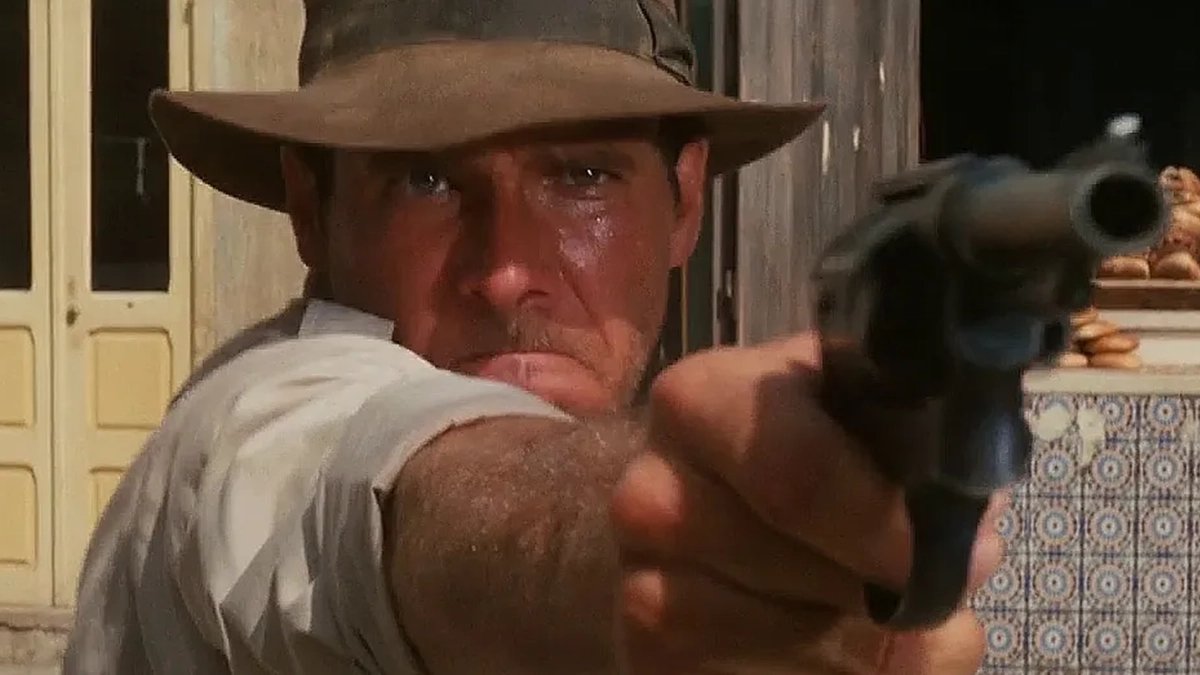
Notably, the 1981 classic “Raiders of the Lost Ark” puts two forms of the Smith & Wesson N-frame in the hands of the iconic character Indiana Jones. At the beginning of the movie, Jones surrenders his M1917 (modified by Stembridge Gun Rentals) and the golden idol to Belloq after escaping the Peruvian temple. The globetrotting archaeologist is a cautious fellow and had an identical M1917 that he packed before departing on his quest for the Ark of the Covenant.
Interestingly, the same scene also features Indy’s “other” Smith & Wesson packed in his suitcase, a British Mk II Hand Ejector. Supplied by Bapty and Co. for filming in the UK and Middle East, this is the revolver that Jones uses in the Nepal bar shootout, the Cairo chase, and the iconic showdown with the swordsman.
With surplus M1917s now over 100 years old and Model 22s not exactly readily available, Smith & Wesson is offering these old guns with modern production technology. Both the 1917 Classic and Model 22 Classic are constructed of blued carbon steel and feature period-correct walnut grips and a lanyard loop.
While the 1917 utilizes the iconic half-moon front sight, the Model 22 has a more practical serrated ramp front sight which is visually similar to Indy’s Bapty gun. Both models take moon clips and come with five full-moon clips for .45 ACP. However, the Model 22 is also chambered for .45 Colt for those wanting a little more power.
Whether you want a display piece of representative history or a functional sidearm for your Indiana Jones LARP, the Smith & Wesson Model 1917 and Model 22 Classic revolvers bring a new and exciting offering to the firearms market. MSRP for both models is $1,299, so try not to lose it to a jumped up French archaeologist.
Don’t Miss the Best of We Are The Mighty
• SAS operator Christian Craighead faces arrest in the UK for his book about Kenya terror attack • This might be the best EDC handgun for troops who carried the M9 • You could be the next owner of Darth Vader’s revolver
Smith and Wesson revives the Indiana Jones revolver
New Jersey Attorney General issues P320 safety alert amidst lawsuit against SIG Sauer
Smith and Wesson’s $160 million buy of Savage Arms makes it the largest commercial US firearms manufacturer
3 great chassis options for different budgets to turn your pistol into a PDW
Geissele wins $20 million contract for new Secret Service rifles