The time Army vet Mel Fisher found $450M in treasure from a sunken Spanish galleon
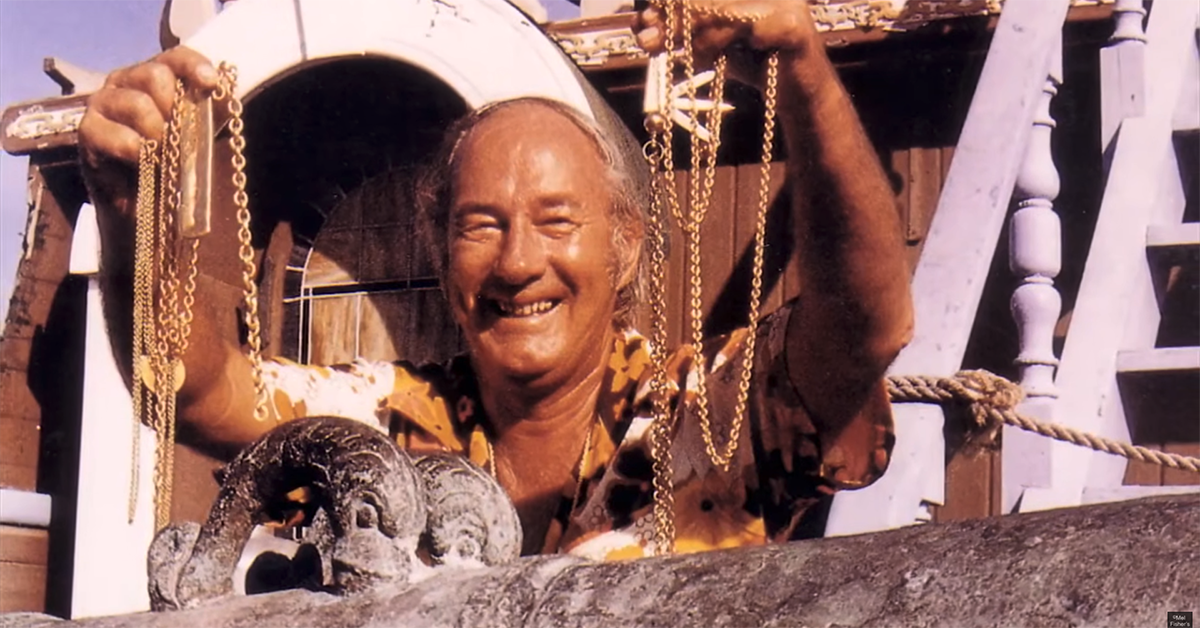
A hurricane sank the Nuestra Señora de Atocha, a Spanish galleon, off the Florida Keys on September 6, 1622. Besides the approximately 265 crew members and passengers on board, it carried tons of gold, silver, and other valuables deep under water.
Three hundred years later, a kindly Midwestern couple had a boy they named Mel in Indiana. Mel Fisher became fascinated with pirates and lost treasures as a child, in part because of his love of Robert Louis Stevenson’s book “Treasure Island.”
In time, finding the Nuestra Señora de Atocha turned into Fisher’s primary focus. Along with a small team, including members of his family, Fisher—who served in the U.S. Army Corps of Engineers during World War II—devoted 16 years of his life to locating this sunken treasure.
Treasure hunting requires an inordinate amount of patience. Fisher realized this better than anyone. He saw the Nuestra Señora de Atocha’s final resting place as a mystery he was intent on solving, no matter how long it took.
“Once you have seen the ocean bottom paved with gold, you’ll never forget it!” Fisher once enthused.
A Hurricane Sinks the Atocha
At more than 110 feet long and 33 feet wide, the Nuestra Señora de Atocha was part of a fleet of galleons that hauled huge amounts of cargo. It first launched in 1621, when it sustained a broken mast on its maiden voyage.
The next year, those aboard the Atocha weren’t so fortunate. En route from Havana back to Spain, the huge ship could not avoid a hurricane. The tremendous winds and rain were too much for the Atocha, causing much of the vessel to disappear below the surface.
Per an account from Thomas Numismatics Magazine, which publishes articles about rare coins and medals, what was lost held considerable value. The ship took with it 1,038 silver bars, 180,000 pesos in silver coins, 582 copper bars, 125 gold bars, disks of Columbia gold, and 600 kilos of silverware, the digital publication cited.
Desperately clutching the part of the mast still visible above the water, only five people survived the sinking of the Atocha. Intent on recovering its lost treasure, Spain dispatched salvage divers to the site. When they arrived, they could not find the mast or, for that matter, any other remnants of the Atocha.
They made a wasted trip, because in the time it took them to cross the Atlantic Ocean, another powerful storm sunk the Atocha’s mast and dispersed its debris. Where did it go? For the next few centuries, no one knew exactly.
Hunting for Treasure
After returning from the European theater in World War II, Fisher and his wife Dolores opened a dive shop in California. When they were not teaching others the intricacies of scuba diving, Mel began to increase his profile with weekly television segments. (For her part, Dolores still holds the women’s underwater endurance record of 55 hours, 37 minutes, which she set in 1959.)
They eventually raised five children, some of whom pursued the family’s calling for deep sea adventures. The Fishers foreshadowed their mutual interest by diving for shipwrecks off the Florida coast during their honeymoon. Once back in California, they did the same.
They didn’t resurface with much then, but that wasn’t the main objective. Mel Fisher was accruing knowledge, and then in 1962, treasure hunter Kip Wagner had a proposition for him. Wagner was focused on the 10 Spanish ships that another hurricane sunk off Florida’s coast in 1715. It was a massive undertaking, and Wagner didn’t have a large enough crew to handle it. He asked for Fisher’s help, enticing him with a 50-50 split of whatever they found.
Fisher assembled a small crew and moved to Florida for a year. He wasn’t receiving a salary for the job, so that provided an extra incentive to discover something. With five days left before their year’s work was over, they found nothing. Then, thanks to an invention that Fisher devised to help see items on the ocean’s bottom more clearly, they struck paydirt. They recovered more than a thousand gold coins, according to Fisher’s biography at MelFisher.com.
Fisher’s team continued searching for lost treasure from the 1715 Spanish fleet for another decade. It wasn’t their only focus, however. After reading about the Nuestra Señora de Atocha in a diver’s guidebook, Fisher saw a potentially large catch.
Finally Discovering the ‘Mother Lode’
Fisher began searching for the Atocha in 1969. He didn’t get off to a good start, because he was looking in the wrong place. Once they found a more precise location, thanks to a historian’s research, they brought the first items from the Atocha to the surface. It wasn’t much—and it took them five years to find them—but it was progress nonetheless. The Atocha’s booty was spread over an 11-mile area, leaving plenty of work to be done.
In 1973, Thomas Numismatics Magazine reported, Fisher’s team recovered three silver bars. Two years later, one of Fisher’s sons, Dirk, located five bronze cannons from the Atocha.
As these treasure hunters were discovering in real time, their line of work is thrilling, unpredictable, and grueling. It also is dangerous. That lesson was reinforced a week after the discovery of the cannons, when Dirk and his wife tragically died in an accident.
Although the Fishers certainly mourned their deaths, their mission continued. They made another breakthrough in 1980, when a section of the Santa Margarita (one of the Atocha’s sister ships that also sank during the 1622 hurricane) was discovered.
Then in 1985, another of Mel’s sons, Kane, contacted his father via his vessel’s radio with great news. At long last, they found where most of the Atocha was, about 35 miles west of Key West.
“Put away the charts,” Kane informed his father. “We’ve got the ‘mother lode.’”
“Mother lode” is right.
They recouped about $400 million to $450 million worth of treasure. The discovery became the crowning achievement of Fisher’s legendary career, but a prevailing question remained: Who owned the rights to the treasure? Fisher’s company had to go to court to defend its claim to the bounty, but both the U.S. Supreme Court and a lower court ruled in its favor.
The famous treasure hunter died December 19, 1998, but his spirit endures. Just this summer, divers from Mel Fisher’s Shipwreck Expeditions discovered a 55-pound copper bar. Capt. Drake Nicholas honed in on the bar after a metal detector started pinging, Fox News Digital reported.
“Faint hits are always the most exciting, because they lead to stuff very deep in the mud,” Nicholas explained to the news outlet. “And I got that very faint hit. I dug down like I always do… and it got louder, and that’s when the excitement really kicks in.”
Don’t Miss the Best of We Are The Mighty • How an alleged mutiny led to the creation of the US Naval Academy • How Teddy Roosevelt’s ‘Great White Fleet’ revealed the Navy’s potential • The enduring mystery of a Navy ship that sank in the Bermuda Triangle
The time Army vet Mel Fisher found $450M in treasure from a sunken Spanish galleon
How World War I ace Eddie Rickenbacker survived 24 days at sea
7 military lessons that made Roger Staubach a Hall of Fame football player
Why the Pentagon tried to convince Pat Tillman not to become an Army Ranger
Movies and TV
The ‘Jimmy’ soundtrack features an active duty Air Force Band