This Medal of Honor recipient takes you inside the scariest day of his life
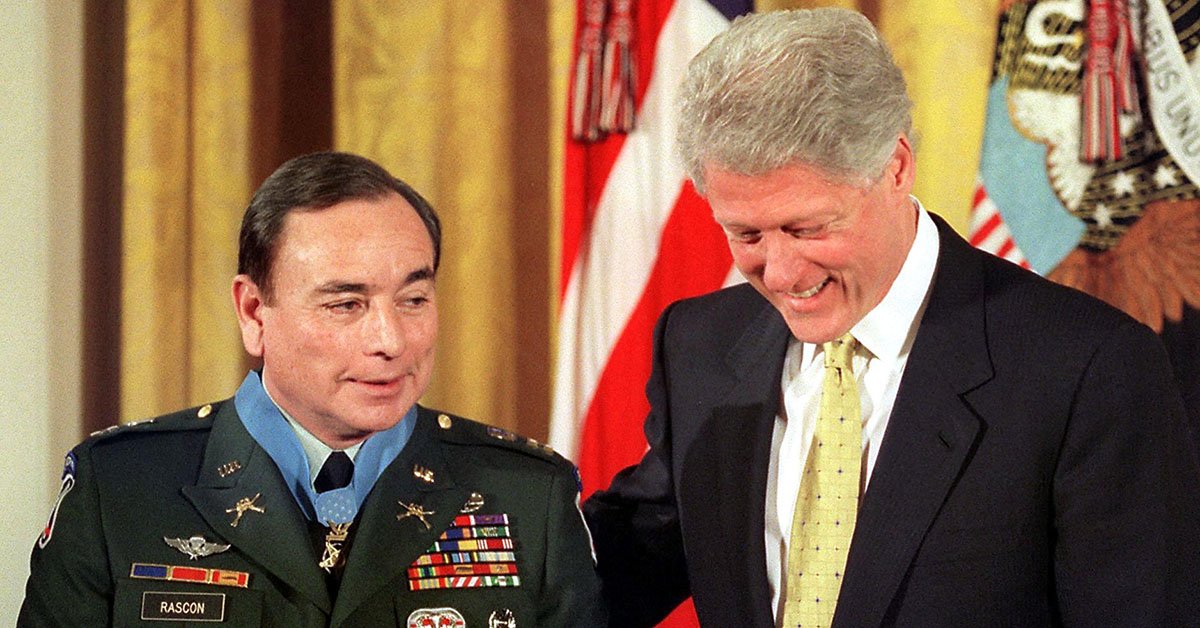
Lt. Col. Alfred Rascon served in the U.S. Army from 1963 to 1984 and again from 2002-2008. His service covered three major conflicts: the Vietnam War, the War in Afghanistan, and the War in Iraq.
He received the Medal of Honor in 2000 for performing “a series of extraordinarily courageous acts” on March 16, 1966, in Vietnam.
Rascon spoke to the Library of Congress for an interview as part of its Veterans History Project. In recognition of Veterans Day on November 11, 2026, We Are The Mighty is running some of those transcribed interviews. WATM edited Rascon’s comments for clarity and brevity.
“I was born in 1945 in Chihuahua, Mexico, probably brought into the states when I was maybe two or three years of age. I was raised in Southern California in a small town called Oxnard, just north of Los Angeles. As a young child, I went out with my dad when he picked lemons at 3 o’clock, 4 o’clock in the morning. I didn’t like that, but probably the good thing about where I lived was the first house, the one that had the extended garage. The area was called Fifth Street. That was a predominant bar area, and you used to have soldiers, sailors, airmen, Marines, Coast Guard individuals that would come to that area to party.
“I was 5, 6, 7 years of age during the Korean War. And these individuals showed up. And we saw them out in the street, and a lot of them went out there and gave you stuff. There also was a secondhand store probably about 50 yards away from where I lived. I went in there and literally rummaged through the military stuff. At times, my mom found me there. I played with the World War II helmets, the aviator leather jackets, which at that time probably was about $15 or something like that, and just enjoyed myself.
“But the most dominant thing was probably the airborne. There were a lot of individuals who came in, and they had this funny-looking hat with a parachute and a glider on it. A lot of them gave me trinkets, and I kept them. And probably when I was 7 years of age, I made my own parachute, jumped from the roof of my house and landed on my head and broke my wrist.
“But yeah, that’s how I got involved with the military.”
Rascon’s Early Time in the Army
“I had made up my mind, once I graduated from high school, I wanted to join the military. My father and mother had to sign a waiver that they were not too happy about. So at the ripe age of 17 in August 1963, I joined the Army.
“The Army was something I wanted to do. I read magazines about the Rangers, about individuals going to the Jungle Warfare Training Center. At that time also, there was an individual or a phase that was going on with Special Forces of the Green Berets. And they were not known at that time, but I wanted to be a Ranger. I wanted to be a paratrooper.
“When I joined the service, they told me I could be a paratrooper, but the situation of being a Green Beret or being somebody that was going to go to the Jungle Warfare Training Center was not there, because you had to be a sergeant. I became a medic, which I had no inclination to be, after basic training. I did not want to be a medic. I simply wanted to be in the infantry.
“I completed jump school in late 1963 and ended up with orders to go to the 101st Airborne, to the medical battalion there. And probably within days after the orders had been cut, we ended up with different orders, stating that a lot of us were going to a unit called the 173rd Airborne Brigade Separate. It was literally a new brigade that was being set up in Southeast Asia that had been formed in late 1963. And it was literally the fire brigade for Southeast Asia. I was assigned to the first battalion to the 503rd, to the medical platoon, and literally went from there to a ship in San Francisco, the USS Breckenridge. It was a troop ship that had been around since World War I.
“Probably 14 or 15 days later, I ended up in Okinawa. But I was on board a ship with literally hundreds of servicemen and also Marines. It was an adventure, because it was something I had never done before. I ended up in Hawaii for a day or two days. They wouldn’t let us get off the ship, and then from there, [we went] to Yokohama, Japan, and from there to Okinawa. And literally when I got to Okinawa, probably in January 1964, I was put in these long trucks called cattle trucks and brought to the first battalion of the 503rd Airborne Infantry. That was my home for the next two years.”
“You’re Not God”
“I ended up in Vietnam in 1965 in May. We had been in Thailand, Taiwan, and the Philippines, and jumped in those areas. We were the first combat unit from the Army to have the M16s, and we had jungle fatigues, which nobody else did. And we also had rucksacks.
“We ended up in-country on May 5, 1965. You’re a 19-year-old individual. Then within days, we were out on the first combat mission. Probably the thing that I didn’t realize was the fact that my life was about to change. All of a sudden, it was going to be a brotherhood of taking care of each other. You’re looking at taking care of either yourself or that person next to you, because if you don’t take care of each other, something drastically is going to happen to your good health, and that’s perish.
“But the first mission was literally days after we got in-country. We ran into a small unit of Viet Cong. We had our first shots in anger and we had some individuals that were injured, but there wasn’t anything emotional to it, other than somebody being injured, nobody being killed. But we did kill two individuals. And that was the first time that I’d ever seen anybody dead, lying before me. And it was literally a Vietnamese who ended up getting the short end of the stick. Then I got on with my life, came back.
“That was the first of 20-something other combat missions that I was to come back and participate on. Some of them were five days, some of them were seven days, and some of them were shorter in duration. The expectations of what I thought I could carry with me as a medic were not what I saw in combat. You start seeing people that are killed and then realize that you’re a 20-year-old or a 19-year-old kid. And you’ve got a medical bag that’s not appropriate to what you’re doing. Then all of a sudden, you’ve got to live by the wits and the skills of your self-teaching and the teachings of others that you’ve got, who are senior medics, and realize that, as a 19-year-old, you’re not God.
“You’re about to see people that were going to get dismembered, disemboweled, and people that were about to die in your arms. And you did not have the choice to come back and say, ‘I don’t want to take care of him.’ You had to. Probably the thing that struck me the most was probably some time in mid-July, we ended up in a big firefight and I came to an individual who was wounded. I thought he was dead. I had no idea who he was. And me taking care of this person literally barfing in my mouth. And as gross as that may sound, it’s callous, but it’s just something that happened. You just got on with your life and took care of the individual. And there he lay, but I had to take care of others.”
“Doc, Get Up to the Front”
“September 20, 1965, was another traumatic day. But even before that, probably in June, we had an individual who was killed by setting off his own booby trap. I stayed with the body for 6½ hours. It was in a plastic bag in a Jeep, and I kept on thinking that the person was moving. In reality, he wasn’t. I was a little spooked. But also that day, a special forces camp had been hit, and we went north, the 173rd did, with the first battalion. And I saw scores of—I never realized whether they were North Vietnamese or whether they were South Vietnamese. But they were literally carted to the end of the runway and put in a pit and just thrown there and buried.
“On September 20, I was wounded for the first time while crossing a rice paddy. And the person was wounded in front of me. But the issue here is the fact that I stayed there. I couldn’t get med-evac’ed. And probably 20 minutes thereafter, we went into the woodline where the bad guys had shot at us. I woke up and somebody was saying, ‘Doc, get up to the front.’ I was already in the front. My ears were bleeding, and my nose was bleeding.
“We had an individual by the name of Larry Pierce, one of our sergeants from the recon platoon. I was assigned to the first 503rd, but a reconnaissance platoon. And I was the only medic from the get-go from the first until the day that I was med-evac’ed on March 16. Pierce became the first noncommissioned Army officer to get the Medal of Honor in Vietnam. He had thrown himself on a land mine and saved the platoon. I was the first medic to take care of Pierce.
“As I came up forward, there were other individuals, one whose arm was missing and another person, I think his leg was gone. And he kept on telling me, ‘Don’t worry about me; worry about Pierce.’ And I kept on saying, ‘Crap, Pierce is no place to be found.’ Literally the trees behind me were gone. Stumps were there and the person had been thrown like 25 feet. We had no idea until later what this person did. And again, this is 1965. We had no idea what type of recommendations to make for individuals. Eventually he was put in for the Medal of Honor, and he got the Medal of Honor 3½ months later.
“Probably three weeks later, I’m hit by my own artillery, which is rather traumatic. I survived that. Then in November 1965, we’re in the Battle of Hill 65. And that day, the first battalion of the 503rd was overrun by a North Vietnam regiment twice, literally swept us. That day, I ended up being with another individual, Lawrence Joel. Joel was an older gentleman who had been with me in Okinawa with the medical platoon and literally shot numerous times. Instead of taking care of himself, he took care of the others and survived a firefight for about 16½ hours. He became the first medic to get the Medal of Honor in Vietnam.”
“It Was a Very Ominous Day”
“Operation Silver City started in an area called Long-xuyen Province in South Vietnam. It was a large operation of the 173rd. Probably within seconds after we got there—not only us, but the other battalion that was with us—there were small skirmishes with the bad guys, which were literally North Vietnamese. We didn’t realize it. I’m in the pecking order at a very low stage, because I’m an E-4. But we’re in an area where they had a North Vietnamese regiment, or two of them. We ran into them. What happened was that the first two or three days, we kept on running into ammunition caches, weapons caches.
“I’d been in firefights, and I had been where death was around you. I had found caches of weapons, but not the way we were finding these things. We’d go into an area and immediately we’d go back the next day, and we’d find our trash being looked at. And once in a while, we’d find a North Vietnamese and go back and run him or try to go after him. And they were just literally chasing us. On March 15 at about 2 o’clock in the afternoon, my reconnaissance platoon ran into another large cache of weapons on the side of this little mountain.
“Everybody had a really, really bad feeling about that area, because we were there by ourselves, and we found thousands of nine-millimeter cartridges. I didn’t realize that nine-millimeters weren’t even around. What we had found were probably 20 or 25 MAT-49 submachine guns. We found mortar rounds and other things, and we had one of our individuals who was wounded that day messing around with a booby trap.
“It was a very ominous day. That evening at about 12 o’clock or 1 o’clock in the morning, which ends up being March 16, we were mortared. Very quickly and it was over with, and probably at about 6 o’clock that morning on March 16, and we heard this horrendous firefight going on about two or three kilometers away from us. We found out that the second battalion, our sister battalion, was surrounded in an area called Landing Zone Zulu Zulu. And the best way to describe this is to put yourself in a mini-football field or a mini-soccer field, and around the soccer field where the stands are, that’s where the North Vietnamese were.
“It was a reinforced regiment of North Vietnamese that had the second battalion literally surrounded. And as the helicopter was about to land at 6 o’clock in the morning, the North Vietnamese shot the helicopter down. If not for them shooting that helicopter down, the second battalion would have sent out its probing patrols and they would have gotten the holy hell kicked out of them. But in reality, they were there. They hunkered down where they’re at, and the firefight starts. Probably at about 1 o’clock in the afternoon, they literally put the other two companies and the reconnaissance platoon, which is us, into the foray, and literally said, ‘Get the recon platoon up in the front and have the other companies follow you and get up to where the firefight’s going on.’
“I knew something was going on in front of us that was quite bad. They had us running at times, and that’s how bad or serious things were to the people up there. I remember going into an area where they’d been that had been napalmed. I remember the soot and the insanity of what your mind is thinking. And probably about 300 meters out from where the second battalion was at, the point squad, Sgt. Ray Compton stopped us and said, ‘I’ve got North Vietnamese to the front. They’re setting up an L-shaped ambush. They’ve got machine guns and AK-47s, automatic weapons, and they’re setting up the ambush.’ We had no idea whether the ambush was being set up for us or whether it was being set up for the second battalion.”
“It Was Total Chaos”
“Probably within seconds a decision was made to take them on. And all I remember was that it was the earth about to break up. I mean, it was total chaos. I had been in firefights before and, you know, some serious ones. But this was so intense, there were literally trees, branches falling. You could hear North Vietnamese yelling. You could hear us yelling. And you could hear the whistles and you could hear bushes. You could hear everything so distinct and so clear. Also you could smell the cordite from the explosions of the hand grenades going off, and also the smell of the gunpowder from our weapons.
“I had no idea what was going on in front of me, other than the fact that somebody said, ‘Hey, Doc, somebody’s wounded.’ I remember getting up to the front, and I remember the platoon sergeant, Jacob R. Cook, telling me, ‘Doc, stay where you are. Don’t move. You’re going to get your ass shot.’ I took off and went forward anyway. Again, as to visual descriptions of what we’re involved with, you’re looking at a one-lane bowling alley. Where the bowling pins are, that’s where the North Vietnamese had set up their machine gun. And the bowling lane ends up being a trail that’s to my left. What I didn’t realize, that somehow during those chaotic first moments when we encountered the North Vietnamese, they had asked for a machine gun to go forward.
“We ended up with two machine guns up in the front. Somehow, one of the machine guns ended up next to the trail. And probably when the firefight started, that individual was cut down. He was lying on the trail, and we had two or three individuals trying to get to him. Nobody could get to him, because where you lay, that’s where you stay. That’s how intense the firefight was. We were literally surrounded in a horseshoe area. I remember seeing when I got up to the front, this individual lying there. I had no idea who it was. Twice or three times, I tried getting up. Every time I tried getting to him, I was taken down by the gunfire.
“I just couldn’t do it. I don’t know what possessed me to do it again, but I literally got up, got in between the individual. And I’m leaning between [Pvt. William] Thompson’s legs, who ends up being the machine gunner. Thompson is lying there, and I’m lying between his legs. As I’m lying there, he’s getting hit and I’m not being touched. I have no idea what’s going on around him. I’m trying to get my hands to him, where I could come back and see what’s wrong with him. I ended up putting my body, and I turned it around and I’m facing him then.
“I’ve got my face to a machine gun, and I got hit. It apparently hit me in the hip, went up my spine, and came out of my collarbone. It stung like hell. I dragged Thompson off the trail. I don’t know how I did it, because Thompson’s about 6-foot-4. I’m not 5-foot-7. Immediately I heard somebody else yelling, ‘I’m out of ammo. I’m out of ammo.’ And when I got there, there’s another individual to my right, and it was another machine gun, Larry Gibson. Gibson’s assistant machine gunner was nowhere to be found.
“I came up to him, found out he was shot in the leg. I’m trying to take care of his leg. He’s telling me, ‘Doc, stay the hell away from me.’ I kept on saying, ‘You’re shot in the leg.’ I ripped his pant leg open, and I patched up his leg. In the meantime, he’s telling me, ‘I need ammo. I’m running out of ammo.’ And apparently this intense conversation goes on and I’m telling him, ‘Oh, yeah, I just took Thompson off the trail. He’s got ammo.’ And I’m thinking Gibson’s going to go get the ammo. He says, ‘Doc, go get the ammo.’ Well, being as dumb as I am, I went after the ammo. I went after Thompson, never got touched. And I took two bandoliers that he had on his person and went back and brought them to Gibson.
“I’m disjointed as to what’s going on. I just remember the fact that someplace along the line, I turned around, and they were throwing a lot of hand grenades that day. And I had just given him the ammo. And as I turned around, a hand grenade went off at some distance. Then another hand grenade went off and it took off my face, or I thought it was my face. It literally ripped my face. It took a couple of inches off the back of my neck and the forehead and the nose. And immediately my face got swollen. I could see the blood literally…”
“Everything Went Literally to Slow Motion”
“When I brought back the bandoliers and stripped them off of Thompson, Thompson was dead. There was nothing I could do for him. I mean, you get on with the living, because the dead are there. And it sounds callous, but I know that that’s the way they feel. That’s the way that I would feel. And if I’m laying there and if I’m dead or something like that, you got to get on and help the rest that are living.
“And I thought of that for a long time, but then I figured out that, ‘Hey, listen, I’m not responsible. I’m not God.’ That’s what I talked about before. I’m a 19-year-old medic, and by that time, I had seen I don’t know how many people got killed, how many people I had held in my arms, how many IVs I had given to somebody.
“All I know is, I brought them back to Gibson, and Gibson put the machine gun back in place. But as I mentioned, nothing happens to me. Then eventually these hand grenades go off. And the one that ripped me through my face and the back of the head and, you know, they’re shrapnel wounds, but they were serious enough where my life had stopped at that moment. I’m already shot in the hip.
“I can’t move around that much. But when I was hit in the face, everything went literally to slow motion.
“I’m grabbing my face, but I can’t feel anything. I’m saying to myself, ‘Jesus, my face is gone. God, you know, my good looks are gone.’ And I didn’t really remember saying that, but I remember later on, I did say that very clearly and distinctly, hyperventilating and lying there. Here I am in the same position that I was three or four other times when I’d been shot at. Everything stopped. My imagination was such that everything stopped turning. I didn’t want to play anymore. I didn’t want to take care of anybody. But then I had to come back and put myself together again and gather my composure.
“I was saturated with blood. I was losing blood from my hip. As I’m lying there, I happen to look up the trail. Then either I lose time and I lose the sequence of events. Going back, all of a sudden, I realize that the M60 machine gun, the spare barrel, and, I don’t know, two or four hundred rounds of ammunition are still lying on the trail.
“The trail is probably no farther than 10 yards away from the North Vietnamese. You could hear them jabbering, and you could hear the whistles going off. And I don’t know why, [but] I just went back and grabbed the M60 machine gun and the ammunition, got back on the trail, grabbed them, took them off the trail and never got touched, gave them to somebody there. I don’t remember who in the heck was there. I just gave them the M60. And during the time that I did get up there, I actually thought of grabbing the M60 and shooting it. And I said, ‘No, that’s not exactly what a medic can do anyway.’
“Again, I didn’t realize I had been shot twice, I think, or three times. But that happens. Then immediately there’s another hand grenade that goes off and goes over my head. I had no idea at the time that the hand grenade hit another individual behind me. His name was Jerry Lewis, carrot top. The hand grenade went off behind me, and I saw this individual trying to get up. He was the furthest up to the North Vietnamese. And it was Neil Haffey, our M79 grenadier. He was a babyface young individual. But again, I’m 19 years old and here I’m making judgment on somebody else. As he got up, he was shot in the back. And I saw –didn’t exactly see the person who shot him, but I saw the weapon and I saw Haffey go down. As I made my way to him, they threw two hand grenades at him, two or three hand grenades at him, off the side of the trail.”
“They’re Going to Kill Us All”
“As I got to him, I threw myself on him, because I thought the hand grenades were going to harm him. I didn’t realize the fact that, ‘Hey, listen, that’s a pretty stupid thing to do, because you’re the one that’s going to get nailed.’ Well, I got nailed. The hand grenades went off, and as Neil says, I saved his life. I don’t think I was saving his life. He just happened to be the person that was there, and I jumped on top of him.
“I made sure he was OK. I didn’t realize this till some 30 years later, when I first ran into him again, he kept on saying, ‘Hey, Doc, you kept on yelling at me.’ And I was yelling, ‘They’re going to get us, and they’re going to kill us all.’ Apparently, I grabbed him, and I was shaking him.
“I kept on telling him to shut up; everything’s going to be all right. And I guess I didn’t have very good bedside manner at that time. And he said, ‘Doc, I saw you there bleeding. Your face was literally bleeding. You’re all red. And you’re there trying to calm me down; tell me that everything was all right. And I think you’re lying out of your butt.’ I said, ‘Stay here. You’re OK.’ He stayed there, and he kept on shooting what you could with his handgun.
“What I didn’t realize was that he wanted to go back to Lewis, who was shot behind him. Later when I read his Medal of Honor statement, on the statement it states, I saw the hand grenade go over Doc’s head. I saw the hand grenade land in front of Lewis. Lewis was my best friend. Lewis and I had plans. And that’s the end of his statement.
“What happened was, he got up to try to go after his friend who he knew was shot. And if I hadn’t taken care of him, I’m sure he would have gotten killed. It was just a fluke situation. I told him, ‘If you lie there, I’ll go back.’ I managed to get back to Lewis and never got touched again. Lewis was gone. There was nothing I could do for him. I thought I might have gone back to take care of two or three people.
“But what happened at that time also, there was another individual who had been shot right after the firefight had started, Compton, Ray Compton, the point squad leader. And I had no idea who this individual was for some 34 years later, right after I got the Medal of Honor in 2000. I knew that I had thrown myself on another person. And all I knew was the fact that all I saw were three stripes, and it was Compton. I saw this person being injured, and I saw this person getting up, and I saw this person about to be nailed with three hand grenades or two hand grenades. I went up, and I threw myself on him. Again, the claim that I saved his life, I just happened to be on top of him by mistake. That’s how I see it.”
“I Was Given My Last Rites”
“Well, we got nailed again. Gibson stated that, ‘Oh, yeah, I saw Doc fly up in the air. I saw him. His rucksack got ripped off, and his helmet got ripped off. We thought he was dead.’ And Compton and I lay there—I don’t know for how long—and came to, and the firefight was still going on. All of a sudden, everything stopped. I could hear our guys going up to the flanks. But everything—the fire fight terminated and it was like a dead still. And I stayed there and took care of those that were injured. About eight of us were wounded.
“I took care of everybody. I didn’t want to have any medication, anything given to me or done to me. It’s the fact that I knew that I was hit in the back. I knew that I couldn’t walk, and I didn’t want somebody else to start sticking morphine into me and get worse. All I remember is that I was dragged and carried to that Landing Zone Zulu Zulu where the second battalion, and I remember going from one end to the other. As I got there, another helicopter had just landed with chaplains on board. I was later to learn that I was given my last rites by a rabbi, a Baptist minister, a Catholic priest, and another minister from another denomination.
“I wasn’t hit that bad, or I didn’t think I was. But I think they covered all bases. They loaded the people who were dead on [a] helicopter, and the helicopter didn’t come for them. So they had to stay there for another six or seven hours. I remember a very bad situation in that there was a person taking photographs of us. His name was Tim Page, a very famous photographer. I thought I was put on a supply ship. The photographs I look at now, I’m loaded onto a medevac, a dust-off. I remember the fact that I’m lying there and just in bad shape.
“I knew that I was going to make it, though, or I thought I did. And I was OK. The helicopter takes off for about 1½ minutes and lands in this battalion area. Literally it’s a clearing area, and they stick on the sawhorses and they start going at it. Literally the doctor is trying to stabilize me, and I remember that I’m lying there in my fatigues, sweaty. This person is trying to find out what’s wrong with my back. And all I care about is my face. Nobody wanted to look at my face. Everybody wanted to look at the injuries that I had in the back of my head and my hip. But nobody gave a darn about my face. My face is still swollen, ripped open.
“The helicopter takes off and lands at the 93rd Field Evac Hospital in Long Bien, just outside of Saigon. I’m taken off the helicopter, put on a stretcher, [and] a sheet is thrown over me. A nurse and two medics come up to me, and they start literally stripping my clothes off. I’m not vain, but I do have my dignity. And I’m about to end up in my birthday suit. I don’t give a damn how bad I’m injured, you’re not going to leave me there in my birthday suit. I guess I started to articulate that point to the nurse. And the nurse ended up telling me something to the effect of, ‘Young man, I think you’ve got other things to worry about.’ They stripped me naked as a jaybird.”
“I don’t know how this happened, [but] I ended up with my M16. We were medics, but all of us had M16s. I put the M16 between my legs, and they took me to the triage area, someplace in the front, not too far to the back. So, I knew I was OK. I woke up the next morning and clean sheets with tubes in my back, IVs in me. And they were playing either ‘California Dreamin’’ or ‘Monday, Monday,’ the Mamas and the Papas. And I said, ‘All right, I’m back in the states until I turned around and the guy next to me was a North Vietnamese [soldier] with 150 IV tubes in him.
“I’m still in country, stayed in Bien Hoa for about four or five days, stabilized. The recon platoon comes back from its mission. And again we talk about the integrity and the dignity of others for each other and how we take care of each other. The recon platoon didn’t get off. They got off where they were at, at the helicopter area in Bien Hoa, literally I guess commandeered a helicopter—I mean, commandeered a Jeep or two or three Jeeps. And they came in force to visit me in the hospital to make sure that I was OK.”
“How Does It Feel to Be a Medal of Honor Recipient?”
“Wearing the medal is a personal thing. It changes with every one of us. My feelings are, it’s a gift to me, but it’s a gift that I carry for all of us. You’re a victim of circumstances in a way, because you did not have the right or the privilege to pick who you’re going to come back [with], as to whether I was going to be a Medal of Honor recipient or not. You’re a 19-, 20-year-old individual who’s basically trying to keep his own ass alive that day. Your peers honor you, and you wear this thing around your neck. You wear it every day of your life, because this is what you have to carry. But you have to carry it for yourself and others. And you represent what America is about. It’s a humbling experience and it’s something that I don’t take lightly.
“About the fifth day when I was in the hospital and the recon platoon came back, there was some mention of the fact that I was put in for the Medal of Honor. I really didn’t care. I was pretty banged up, and I was on my way to Japan. And that was it. I got on with my life, went back, spent three months in the hospital in Japan, went back to school, worked full time, and had a real bad limp.
“I didn’t realize it till 1984, when I was in an airborne reunion, the fact that I was there with members of the recon platoon from my first battalion. And I was told, ‘Hey, Doc, how does it feel to be a Medal of Honor recipient?’ And I said, ‘I don’t know. Why? You’re talking to the wrong person.’ He said, ‘Doc, we put you in for the Medal of Honor in 1966 and wrote you up for the Medal of Honor in 1966.’ I said, ‘Oh, OK.’
“Thereafter was a six- or seven-year journey for them to come back and make what they thought was a wrong a right, not by the fact that anything had happened, but by the fact that something was lost. Once the Army went back and acknowledged the paperwork was lost and it took them a few years to find it…
“President [Bill] Clinton presented the Medal of Honor to me on February 8, 2000. They had seven members of my recon platoon that were still alive there with me that day. Two of them had passed away within a month of the ceremony. And thereafter at a reception at Fort Myer, pretty close to 400 paratroopers showed up all the way from Hawaii, all over the states, just to be there with me.
“The greatest thing that was ever said about me was that somebody mentioned, ‘Why does somebody want to come back and give Rascon the Medal of Honor after so many years?’ And the response from one of the individuals from the recon platoon was that, ‘We don’t want to change history. We just wanted to correct it.’ I think that speaks for itself.”
Don’t Miss the Best of We Are The Mighty • How this Medal of Honor recipient saved fellow Green Berets in Vietnam • How World War I ace Eddie Rickenbacker survived 24 days at sea • James Capers never gave up on his Marines. Marine Corps veterans never gave up on him.
VHP
What this airman did to survive at the Hanoi Hilton during the Vietnam War
How this Marine veteran scrambled to survive after the USS Indianapolis sank
How this Native American veteran honored her tribe by serving in the Air Force
Korean War veteran pinpoints the most important lesson of war
World War II
Kamikaze pilots couldn’t stop this Marine veteran, 104, during World War II