A National Guard unit saw the most combat during World War II
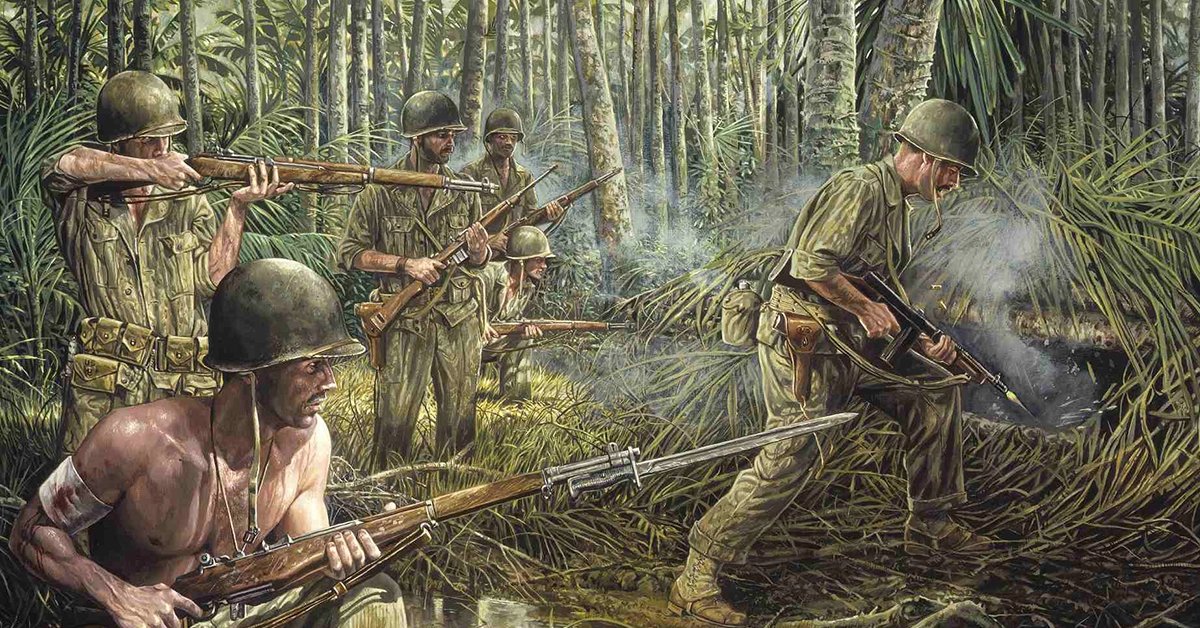
Think about the World War II shows and films that stuck with you, like “Band of Brothers,” “The Pacific,” or “Saving Private Ryan.” Now consider that not one of them is about the division that spent more days in combat than any other American unit in the war.
It’s hard to deny the long-term effects World War II had on the United States. We are sitting close to the 100th anniversary of the Japanese attack on Pearl Harbor, and are still making movies about the events that took place.
And the reason why is no surprise: around millions of Americans served in combat during the war, and that means there are so many stories yet to be told.
“Band of Brothers” follows the real-life Easy Company, 506 Parachute Infantry, of the 101st Airborne. “The Pacific” belongs to the 1st Marine Division. “Saving Private Ryan” opens with Rangers on Omaha Beach. All of them earned screen time, but the units we remember are not necessarily the ones that spent the most time in the fight.
The record for days in combat belongs to National Guard members from Michigan and Wisconsin. The U.S. Army’s 32nd Infantry Division—The Red Arrow—sits alone at the top with 654 days of combat.
Days in combat is only one way to measure a division’s war, though. Before we get to the 32nd, it’s worth looking at a couple of others.
One way to measure is campaign credit. The 3rd Infantry Division holds the distinction of being the only U.S. Army division in World War II to have all 10 official European Theater campaign streamers.
The 3rd came ashore near Casablanca in November 1942 for Operation Torch, fought across North Africa, then landed at Licata during the invasion of Sicily in July 1943. Two months later, it hit the Italian mainland at Salerno. Then Anzio. Then southern France in August 1944, and from there through the Vosges, the Colmar Pocket, and into Germany.
Very few units in any army fought that many separate campaigns without a break. The 3rd ID’s reputation is well earned, and two of its most famous names weren’t typical soldiers. Audie Murphy came out of the 3rd ID as the most decorated American soldier of the war (and of all time). And then there’s Chips.
Chips was a good boy doggo assigned to 3rd ID who broke from his handler in Sicily and charged a machine gun position, taking a scalp wound and powder burns for his trouble. His unit put him in for the Distinguished Service Cross, the Silver Star, and the Purple Heart. He was awarded all three, before the War Department revoked them later that year under a policy against giving official decorations to animals.
Chips didn’t get formal recognition again until 2018, when Britain’s PDSA posthumously awarded him the Dickin Medal, the highest honor an animal can receive for wartime bravery.
Highest Battle Casualties in a Single Theater
Another way to measure is cost. Among American divisions that fought in only one theater, the 4th Infantry Division paid the most, with battle casualties running north of 20,000 over 11 months.
The 4th started that bill on D-Day. Its 8th Infantry Regiment was the first seaborne assault unit ashore at Utah Beach on the morning of June 6, 1944. Utah went about as well as anything did that day—the 4th got ashore for a fraction of the casualties suffered at Omaha, where the 1st and 29th Divisions landed at the same hour.
The real damage came later, in the Hürtgen Forest. Beginning in November 1944, the 4th fed its regiments into a stretch of dense German woodland where artillery burst in the treetops and there was nowhere to take cover. In roughly three weeks, the division took thousands of casualties for a few miles of forest. Rifle companies had to be rebuilt more than once.
That campaign, not Normandy, is where the 4th’s record total comes from.
The 4th also happens to be where two of America’s most famous writers crossed paths. Ernest Hemingway was covering the war as an accredited correspondent for Collier’s and attached himself to the 22nd Infantry Regiment and its commander, Col. Charles “Buck” Lanham.
He got close enough to the fighting that the Army opened an inquiry into whether he’d violated the rules protecting correspondents as noncombatants. J.D. Salinger was in the 12th Infantry, working counterintelligence. The two met in the Hürtgen Forest.
A Combat Day
The count of combat says comes out of unit records, daily journals and after-action reports kept at the division level and tabulated after the war. A combat day was credited when the division was committed and in contact with the enemy. It’s a measure of the unit, not the individual: no single soldier in the 32nd was under fire for 654 straight days,
It’s an interesting comparison for a number of reasons. The first is because we’ll (hopefully) never see “combat days” of these numbers ever again; it’s a testament to the World War II veteran. It’s also interesting because because the same records produced everyone else’s numbers. The 3rd Infantry Division logged around 531 days, the 1st Infantry Division around 443, and the 4th Infantry Division around 299.
The 32nd’s beats them all by a wide margin: 654, the most of any American division.
After France fell to the Nazis in June of 1940, Congress passed the joint resolution authorizing Guard federalization on Aug. 27. Among the 18 National Guard Divisions called up was the 32nd Infantry Division, made up of soldiers from Michigan and Wisconsin, which was called to serve on Oct. 15, 1940.
After Pearl Harbor, the 32nd was pointed at Europe. It moved to Massachusetts to ship off to Northern Ireland. But Japan was moving south fast enough that Australia was under threat of invasion, and the Allies could only pull so many Australian divisions back from the Mediterranean. Somebody had to go, and the 32nd was available.
The orders came with three weeks’ notice, and the 32nd was sent to San Francisco. It shipped out in April 1942 with 3,000 men fresh out of basic training and still 1,800 short of strength. When they got to Australia, they had to build their own camps instead of training. Weeks went by. Everything they had trained for was for a war in Europe, and they were about to fight in the Pacific jungles.
The 32nd’s war started at Buna, on the northern coast of Papua New Guinea, and Buna would be its trial by fire. To get there, some of the division walked a track over 9,000-foot mountains that took them roughly six weeks and left the battalion worn down before it ever saw an enemy soldier. The terrain meant no roads, which meant almost no artillery and no armor, because none of it could be moved forward.
What waited for them at Buna were Japanese bunkers built from coconut logs and packed earth, sited to cover each other, and effectively invisible until they started firing. American infantry attacked them across open ground with rifles, grenades, and not much else. Unsurprisingly, they kept failing.
At the start of December 1942, MacArthur sent Lt. Gen. Robert Eichelberger forward with instructions to take command and take Buna or not come back alive. Eichelberger found men so sick and worn down he later described them as gaunt and ragged. He rebuilt the division’s leadership and started again.
Buna finally fell in January 1943, after roughly two months of fighting—and took heavy losses doing it. Malaria, dengue, scrub typhus, and dysentery moved through the division continuously, and in Papua sick casualties ran far ahead of combat casualties. Across the whole war, the division recorded tens of thousands of non-battle casualties: the total is often cited near 27,000, in a division whose authorized strength was around 15,000.
The 32nd fought on in the Southwest Pacific, because there was no rotation and no replacement division waiting. Units in Europe came off the line. In the Pacific between 1942 and 1945, there was nowhere to go and nobody to hand the job off to. The 32nd went to New Guinea and stayed in the war until Japan surrendered, finishing on Luzon in the Philippines.
In the end, its soldiers suffered over 7,000 total casualties and 32nd Infantry soldiers earned a combined 11 Medals of Honor, 157 Distinguished Service Crosses, 845 Silver Stars, and 1,854 Bronze Stars.
The patch tells you where the name comes from, if you know what you’re looking at: a red arrow shooting downward, with a bar struck through it.
The 32nd earned that in 1918. In France, the division broke through every German line it was sent against, and the French started calling it “Les Terribles.” When the Army approved a shoulder insignia after the war, the division chose an arrow piercing a line: its identity was going through whatever was in front of it. In World War II, the 32nd cemented that identity.
We don’t give National Guard units enough credit. They served alongside active-duty units then, and they do now. The Red Arrow lives on in the 32nd Infantry Brigade Combat Team, and the soldiers wearing that patch today are carrying more history on their shoulder than most people realize.
We don’t often give enough credit to National Guard units, though they often serve alongside active duty units (to this day). Many of the National Guard units that fought in World War I and World War II still exist. The Red Arrow Division continues its legacy through the 32nd Infantry Brigade Combat Team.
The soldiers of the 32nd should feel tremendous pride for the legacy they carry and the heritage of the insignia they wear on their shoulders.
Don’t Miss the Best of We Are The Mighty
• Why the National Guard is a great option for Marines • The Complete Hater’s Guide to the Army National Guard • This National Guard unit fought alongside Marine Raiders in the Pacific
World War II
World War II
A National Guard unit saw the most combat during World War II
World War II
Low river waters in Hungary’s capital reveal World War II dead
World War II
How Paul Newman survived 2 close calls in the Navy during World War II
World War II
This Medal of Honor recipient’s healing hands spelled trouble for the Japanese at Okinawa
World War II
Why it took 2 decades for ‘Patton’ to make it to the big screen
Related Service stories

Yes, I Served in Iraq. But What if People Mistake Me for a Hero?
Illustration by Kim Vo The Department of Motor Vehicles was a good place to lose your identity, not find it, especially 30 minutes before cl
Officers only: New report lays out what a ‘US Cyber Force’ could look like
A new report argues that an independent Cyber Force should be staffed by only commissioned officers and warrant officers to better develop t
Navy researchers find wreck of World War II submarine that vanished 82 years ago
Nearly 82 years to the day after the USS Herring went missing during World War II, the Navy said it had found the wreck of a submarine that