Gruesome ax murders in the Korean DMZ almost started another Korean War
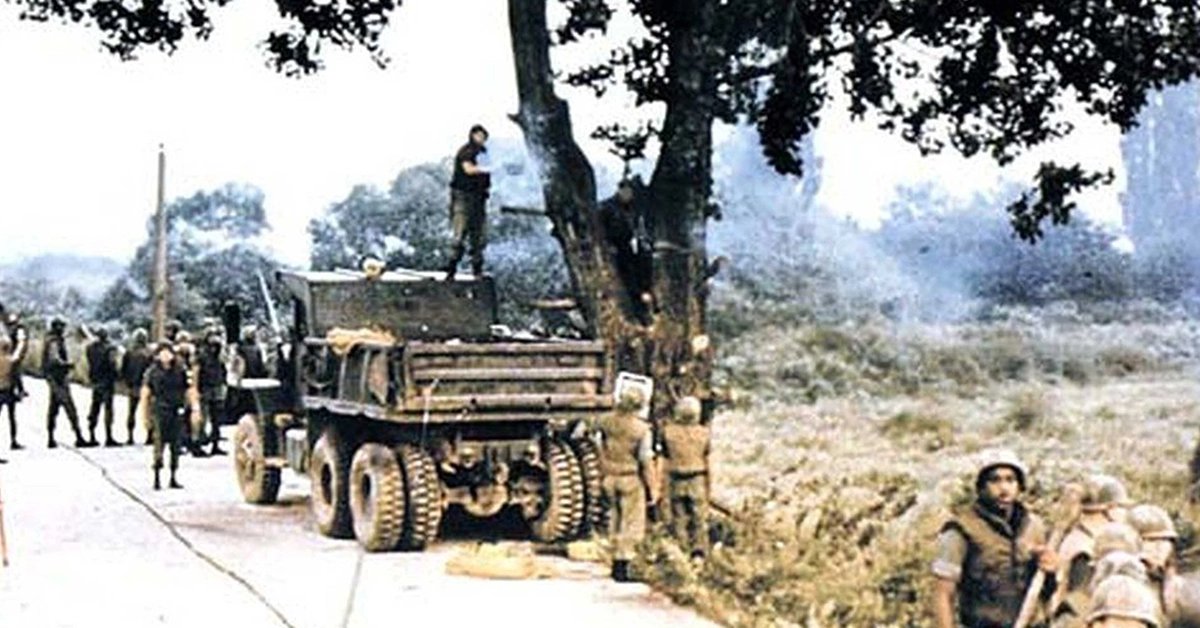
It must have seemed like a relatively harmless work detail, in the way that any detail in the world’s most heavily armed border area can be harmless. When Capt. Arthur Bonifas and Lt. Mark Barrett reported for duty to chop down a tree in the Korean DMZ, they probably never thought they’d be hacked to death by North Korean soldiers.
The two officers were leading a South Korean work detail with a South Korean officer on Aug. 18, 1976. Their target was a 100-foot-tall poplar tree that blocked the view between a UN observation post and UN Command Post No. 3. It wasn’t entirely without its hazards. North Korean soldiers were known to drag unsuspecting United Nations personnel across the border into North Korea.
Bonifas himself once defused a tense situation at the same command post after several Americans were held at gunpoint by North Korean troops.
Captain Bonifas was one of 19 people assigned to help take down the tree that afternoon. He led Lt. Barrett, the South Korean officer, five workers, and 11 enlisted personnel into the joint security area to trim the tree. They did not wear sidearms, as regulations restricted the number of armed people that could be in the area at one time. The workers brought the axes to trim the tree.
As soon as work began, 15 North Korean soldiers appeared, led by a North Korean officer, Lt. Pak Chul, who was known for being confrontational. The North Koreans watch the crew work for roughly 15 minutes before demanding they stop because North Korean President Kim Il-Sung had supposedly planted the tree, something they could have mentioned 15 minutes prior.
Despite the protest, Bonifas ordered the work to continue and then turned his back on the North Koreans. Bad move. That gesture set Lt. Pak “The Bulldog” Chul over the edge.
Pak sent a runner to get 20 more North Korean soldiers, who came carrying clubs and crowbars in the bed of a truck. He then ordered his men to “kill the bastards” (bastards is actually North Korean slang for “Americans” in North Korean propaganda). The communists picked up the axes dropped by the work party and beat Bonifas to death on the spot.
During the grim melee, Barrett jumped over a wall and fell into a ravine across the road. Everyone else in the work party was wounded. The UN Observation Post could not see where Barrett was but only that North Korean guards were taking turns going into the ravine with an axe.
This continued for 90 minutes.
A search team was dispatched. They found Barrett still alive but badly hacked with the axes. He died on the way to a hospital in Seoul. It doesn’t really matter who saw what in the DMZ; the entire incident was recorded on film.
Kim Jong-Il, then known as “Dear Leader” because he was the established successor to Kim Il-Sung, would later address the incident while speaking at a conference of Non-Aligned Nations in Sri Lanka. He denounced the attack as American aggression, claiming North Korean troops were defending themselves from the U.S. and South Korean soldiers.
“Around 10:45 a.m. today, the American imperialist aggressors sent in 14 hoodlums with axes into the Joint Security Area to cut the trees on their own accord, although such a work should be mutually consented beforehand,” Kim said. “Four persons from our side went to the spot to warn them not to continue the work without our consent.”
“Against our persuasion, they attacked our guards en masse and committed a serious provocative act of beating our men,” he continued, “wielding murderous weapons and depending on the fact that they outnumbered us. Our guards could not but resort to self-defense measures under the circumstances of this reckless provocation.”
Meanwhile, U.S. troops went to DEFCON 3 as the Pentagon and South Korean President Park Chung-Hee weighed a military response to the ax murder.
Instead of an assault, the U.S. launched Operation Paul Bunyan. Three days after the ax murders in the Korean DMZ, 23 American and South Korean vehicles drove into the the Joint Security Area without alerting the North. They then dispatched eight two-man teams of engineers with chainsaws to take out the tree.
Two platoons of 30 men each came armed with clubs and were accompanied by South Korean Special Forces armed with axe handles.
The South Koreans also had claymore mines strapped to their chests, detonators in hand, as they walked across the “Bridge of No Return” that separated the two countries. They yelled at the North Korean soldiers, daring the Northerners to cross the bridge and meet them in combat.
Meanwhile, the massive show of force operation also had 20 helicopters in the air in the area, as well as B-52 Stratofortress bombers flying overhead. The bombers were accompanied by F-4 Phantom IIs, South Korean F-5s and F-86s, and a number of F-111 bombers. The USS Midway Task Force was also just offshore.
The United States brought enough firepower to launch a second Korean War.
For its part, North Korea deployed 200 troops to meet the force of more than 800 the U.S. and South Korea fielded. The North Koreans had to sit and watch as the allied forces vandalize their guard posts from some buses. They eventually filed out and set up fire positions, but by then the Americans were on their way out of the JSA and headed home.
After the second, more forceful attempt that brought overwhelming firepower to protect the cutting crew, the tree was gone in 42 minutes.
While North Korean President Kim Il-Sung sent a message of regret over the incident, he never took responsibility. The ax used to kill Bonifas and Barrett is now in the North Korean Peace Museum. Yes, that’s what it’s really called.
In the South, the JSA’s advance camp was renamed Camp Bonifas for the fallen officer. General William Livsey, who commanded the 8th Army at the time, fashioned a “swagger stick” carved from the poplar tree’s wood. He passed it on to his successor, ensuring the ax murders on the Korean Peninsula were not soon forgotten.
Don’t Miss the Best of We Are The Mighty
• Suicide rates in North Korea are so high, Kim Jong Un had to issue a special order • An unrepentant 95-year-old North Korean POW wants to walk back across the DMZ • North Korea has declared war on decadent, Western-style love
Gruesome ax murders in the Korean DMZ almost started another Korean War
2025 saw North Korea push Kim Jong Un’s daughter into ‘successor spotlight’
Jaewoo Park, Radio Free Asia
North Korea celebrated its soldiers who fought with Russia in Ukraine
By Radio Free Asia
Suicide rates in North Korea are so high, Kim Jong Un had to issue a special order
Kim Jieun, Radio Free Asia
North Korea showed off its new intercontinental ballistic missile at a military parade
By Radio Free Asia