How ‘the real Forrest Gump’ got his stolen Medal of Honor back
On July 15, 2005, thieves broke into several cars in the parking lot of a hotel in Indianapolis. The media normally might have given the robbery a brief mention, if that. But in this case, they paid more attention.
News crews and reporters followed this crime, because one of the vehicles that the robbers broke into belonged to retired Army Sgt. Sammy Lee Davis. They took a briefcase that contained his Medal of Honor from his car’s trunk.
Davis earned the U.S. military’s highest award for valor during the Vietnam War when he rescued three wounded soldiers along the Mekong Delta.
Davis, who was in Indiana’s capital to speak at a veterans reunion, pleaded for the return of his medal. It wasn’t just for him, the decorated veteran explained. That medal symbolized the sacrifices of the 31 men in his 42-man unit who didn’t survive the skirmish with the Viet Cong on November 18, 1967.
“It is for 31 of my best friends whose hands I held and whose heads I cradled,” Davis said to WAVE, a television station out of Louisville, Kentucky, at the time. “That medal belongs to them.”
As Davis gave that interview, he fully realized he might never see his Medal of Honor again.
A Vicious Attack
Born in Ohio a year after World War II ended, Davis enlisted in the Army shortly after graduating from high school in Indiana in the mid-1960s. Because he came from a military family, it probably wasn’t an unexpected development. His grandfather served during the Spanish-American War, and his father did the same during WWII, according to a 2024 article from the Defense Department. In addition, the DoD noted, two of Davis’ brothers also fought for their country.
Davis felt that calling as well. He became a cannoneer with Battery C, 2nd Battalion, 4th Artillery, 9th Infantry Division. Eight months after arriving in Vietnam, Davis’ unit was at a fire support base along the Mekong Delta when enemy forces attacked.
That was only the beginning. About 1,500 Viet Cong troops then initiated a ferocious ground advance, with only a small river between them and the base where Davis and his fellow soldiers were. Davis sprang into action, grabbing a machine gun and attempting to protect his comrades as they fired a howitzer at the enemy, his Medal of Honor citation read.
That lasted until the North Vietnamese hit the howitzer directly with a round from a recoilless rifle. The blast set the howitzer on fire and blew Davis into a nearby foxhole. He sustained significant injuries to his back and legs and was temporarily unconscious.
“Don’t Shoot. I’m a GI!”
Shortly after Davis awoke, he incurred more wounds after U.S. soldiers inadvertently hit him with friendly fire, the DoD’s account showed. Somehow, Davis managed to get back onto his feet.
In his weakened state, Davis fired the howitzer several times at great personal risk. One time, a recoil from the artillery weapon knocked him to the ground again. In another instance, an enemy mortar shell exploded in close proximity to Davis, injuring him even further, the DoD article recounted.
Despite the loud noise that the howitzer produced, Davis recalled hearing a voice from the other side of the river.
“Don’t shoot. I’m a GI!” the soldier cried out.
“Well, somebody’s gotta go get him,” Davis told an Indianapolis TV outlet in 2021. “At this point, I didn’t know who was alive and who was dead. I knew I had to go get him. So I asked the one above to give me the strength to get my brother.”
Davis, who competed on his high school diving team, couldn’t swim because of his myriad injuries. How was he going to cross the water? He retrieved an air mattress, got on top, and waded his way for the short, albeit extremely dangerous, distance. As he did, Davis could feel the spray from bullets striking the river’s surface, he told chef and entrepreneur Robert Irvine.
When Davis made it to the other side, he discovered soldier Jim Deister with wounds to his head and chest and near death. Davis also saw two other troops, Billy Ray Crawford and Gwendell Holloway, who needed assistance.
Davis Kept on Fighting
Davis loaded Deister onto his shoulders. The injuries to Crawford and Holloway were not as severe, and they partly supported themselves as Davis led them toward the air mattress, Irvine’s website reported.
As Davis attempted to get the other injured service members back to the fire support base, he had to stop wading at times to fire at the enemy, the DoD said. Once Davis got Deister, Crawford, and Holloway to safety, he again showed no regard for his own safety and joined another howitzer crew until the Viet Cong retreated.
“In combat, you learn to do for your brother what you hope they do for you,” Davis told Irvine, who served in the British Royal Navy. “I did for those three men across the river what I knew in my heart they would do for me. How could I not do that?”
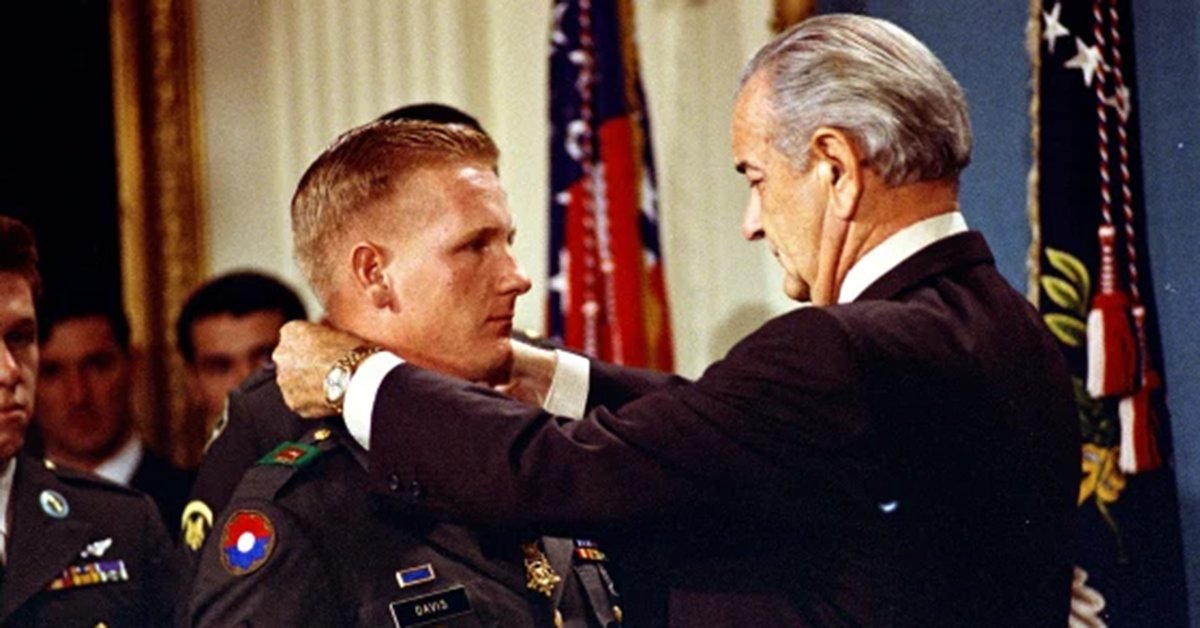
President Lyndon B. Johnson presented Davis with the Medal of Honor at the White House on November 19, 1968. The producers of “Forrest Gump” used video from that ceremony in the movie when LBJ presents the Medal of Honor to Tom Hanks’ character. They just replaced Davis’ face with Hanks’.
That decision led people to refer to Davis as “the real Forrest Gump.”
Back Where the Medal Belongs
Davis possessed the Medal of Honor for 3½ decades before thieves unknowingly swiped it. Thankfully it wasn’t lost for long. Divers from the Indianapolis Fire Department retrieved Davis’ briefcase a few days later from the bottom of a river.
The city held a ceremony in July 2005 to formally return the Medal of Honor to Davis. As he has expressed several times over the years, Davis said the medal represented more than individual recognition.
“Most people know I earned this medal on the banks of a river,” Davis told Indianapolis’ NBC affiliate. “When President Johnson put this around my neck, I would have liked to have had those men with me that had been my brothers that night. But they could not be here. They were a part of this, they are a part of this…, [and] they will always be a part of this.”
Davis was so appreciative that he offered to sweep the city’s office floors. The city respectfully declined. It was the least it could do.
Don’t Miss the Best of We Are The Mighty
• What happened when North Vietnam attacked a Special Forces base • Inside Operation Frequent Wind and the scramble to get US military out of Vietnam • A Medal of Honor recipient explains what being an American means
Medal of Honor
How ‘the real Forrest Gump’ got his stolen Medal of Honor back
Medal of Honor
How this Medal of Honor recipient finally came home from the Korean War
Medal of Honor
This Medal of Honor recipient’s healing hands spelled trouble for the Japanese at Okinawa
Medal of Honor
The ‘Purple Heart Battalion’ fought Nazis abroad and injustice at home
Medal of Honor
A Medal of Honor recipient explains what being an American means