How this little-known battle became ‘the Gettysburg of the Korean War’
Eliseo Garcia celebrated his 20th birthday on February 13, 1951.
Well, it wasn’t as though Garcia blew out candles and opened gifts at a party. There was no time for that. Garcia, who retired from the U.S. Army as a command sergeant major in 1972, was fighting in the Battle of Chipyong-Ni, one of the most pivotal skirmishes during the Korean War.
“A lot of us were young guys,” Garcia later reflected. “… Some of the guys were teasing me that I was getting some unwanted guests for my birthday.”
Thousands of them, in fact. Garcia served as a squad leader in Company L, 3rd Battalion, 23rd Infantry Regiment of the 2nd Infantry Division. Military leaders tasked the regiment with keeping Chipyong-Ni, a small but strategically important town about 40 miles east of Seoul, out of Chinese and North Korean hands.
The only problem (well, maybe not the only one) was that the opposing forces far outnumbered the roughly 5,000 service members in the United Nations contingent there to protect Chipyong-Ni. For two days, they bravely fought, sometimes bending but never breaking. When the last shot of the three-day engagement was fired, the communist forces retreated in an important victory for the UN forces.
Chipyong-Ni was such a crucial battle that it later became known as “the Gettysburg of the Korean War.”
Ridgway’s Pivotal Call
Now called Jipyeong-ri, Chipyong-Ni represented a small town that measured only a half mile long and several blocks wide. Located in a valley, it claimed a single-track railroad, but more than half of the town’s buildings had already been knocked down during the war.
More combat was to come. On February 11, 1951, an imposing total of 135,000 Chinese and North Korean soldiers began a major offensive. One of their goals was to seize control of Chipyong-Ni.
Since the conflict began June 25, 1950, the South Koreans and their allies sustained defeats that deflated their morale. The nonprofit Army Heritage Center Foundation described the situation as grim, with U.S. soldiers harboring thoughts “of the Chinese as unstoppable.” It was against that backdrop that Gen. Matthew Ridgway, who led the Eighth Army in Korea after commanding the XVIII Airborne Corps during World War II, saw no other choice.
His troops had to defend Chipyong-Ni if they had any chance of reversing their fortunes.
Close-Range Fighting
Under the command of Col. Paul L. Freeman, the 23rd Infantry Regiment reached Chipyong-Ni in early February. That gave the service members an adequate amount of time to prepare for the difficult challenge ahead.
They did daily reconnaissance missions, scouring the surrounding area for any signs of the enemy. None of those patrols erased the simple mathematical dilemma that the 23rd faced; by almost any measure, the Chinese held the advantage, especially in manpower.
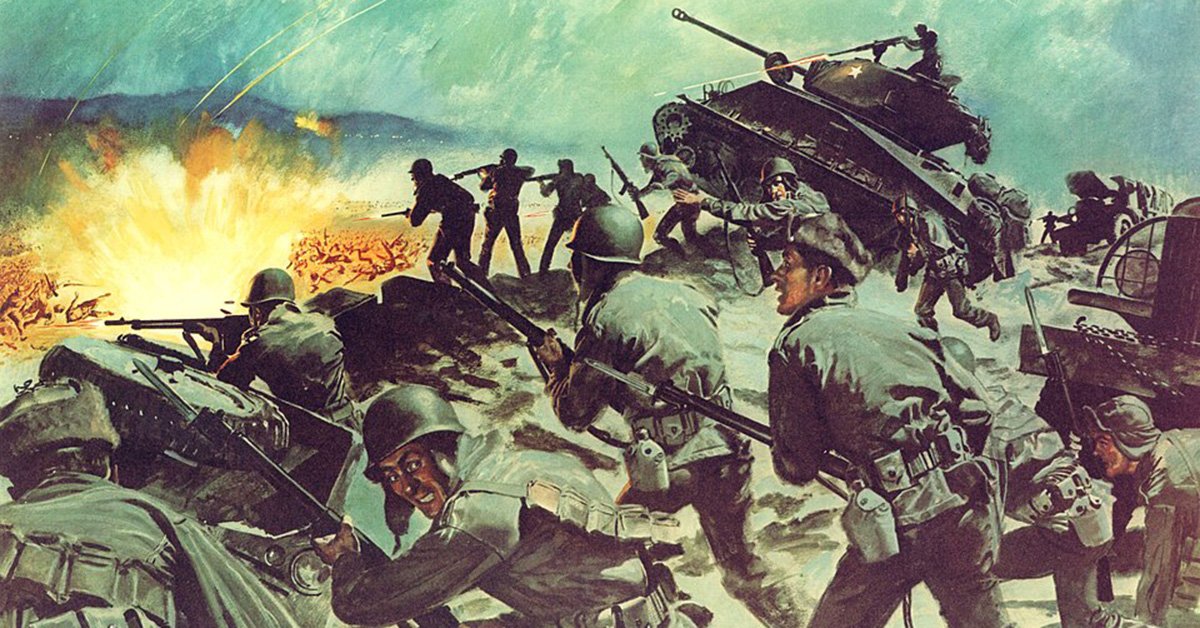
On February 13—when the fighting at Chipyong-Ni began—five divisions of Communist Chinese Forces pinned the 23rd in the village. The perimeter was a mile deep and 1½ miles wide. Within that confined space, three battalions of the 23rd Infantry Regiment and one French battalion found themselves fighting for space with artillery and more than a hundred of their own vehicles.
That’s not including the opposing forces trying to defeat them. They engaged in extremely close quarters in the frigid conditions, so close that it was easy to look directly into the enemy’s eyes. Freeman directed his men to fight shoulder to shoulder, with the objective of leaving no room through which the communist fighters could penetrate.
Judging from the Chinese’s modus operandi through the war’s first several months, the 23rd anticipated its adversary’s strategy. Freeman figured they would attempt to squeeze the American, South Korean, and French troops from the front and behind.
The UN forces were prepared this time.
Rebuffing the Chinese Forces
During the night of February 13, the Chinese advanced for the first time on Chipyong-Ni with mortars and then “human waves numbering upward of 1,000 communist soldiers.” The U.S. and French units withstood that enough to cause the Chinese to fall back.
The communist forces successfully penetrated the perimeter the following night, causing one company of the 2nd Battalion to retreat. The Chinese remained the aggressors until the UN forces received help from above, namely from American air support. It dropped napalm on the enemy, paving the way for the U.S. to stage a counterattack on the morning of February 15.
According to a 2009 story from the Army’s official website, the regimental reserve pushed three times in bids to reclaim the captured positions from the Chinese. None proved successful. Their fourth attempt resulted in a different outcome, with four tanks, along with close air support sorties and a relief column, aiding the 23rd Infantry Regiment’s effort.
The Chinese retreated late on February 15. Chipyong-Ni remained out of the communists’ control.
“Wow. Could I Do That This Day?”
During the Battle of Chipyong-Ni, more than 7,000 communist fighters died, according to the Army article. The battle resulted in the loss of 52 American lives, with 259 others wounded and 42 others missing. Fifty-one sustained non-battle injuries, per the Army.
One death is too many, but what the 23rd Infantry Regiment accomplished at Chipyong-Ni was remarkable. Garcia, whose book “Youth in War” came out in 2007, was fortunate to be a part of the regiment.
“I served with a lot of other units…, but this is my regiment,” said Garcia, who died in 2013. “[Of] all the units I’ve ever been in, this is the regiment that I belong to because of the closeness. To me, that’s still my unit. It always will be.”
The Battle of Chipyong-Ni continues to inspire generations of future U.S. service members. Lt. Col. Chuck Hodges commanded the 1st Battalion, 23rd Infantry Regiment in 2009 when the Army held a remembrance of what happened at Chipyong-Ni.
“It’s important for those guys to hear [what those guys went through and think], ‘Holy crap, 30 below zero surrounded by 30,000 Chinese on a hill with an M-1 Carbine and limited ammunition. Wow. Could I do that this day?’” Hodges said.
Don’t Miss the Best of We Are The Mighty • How this Medal of Honor recipient finally came home from the Korean War • That time Neil Armstrong survived ejecting from his fighter jet in Korea • What John Glenn did to save his famous wingman’s life in Korea
How this little-known battle became ‘the Gettysburg of the Korean War’
Korean War veteran pinpoints the most important lesson of war
How an airman, the ‘Schindler of the Korean War,’ rescued a thousand orphans
5 battles the side with all the numbers still lost—against all odds
How this Medal of Honor recipient finally came home from the Korean War