How trailblazer Grace Hopper taught the US military all about computers
How trailblazer Grace Hopper taught the US military all about computers When we think of military innovation, we think weapons, up-armored vehicles, mortar rounds, and combat zones. But what if not every battle is physical? What if not every military innovation and revolution begins with weapons?
Related: The Navy initially denied Grace Hopper’s enlistment. Then she revolutionized computers. Some of the most significant military innovations, contributions, and transformations have happened behind desks.
In code, to be precise. And one woman helped the United States military learn the language behind it all. The language of computers, one that many men at that time could not break.
Grace Hopper prepared our military for the future. She pushed the limits of codebreaking, making it possible to modernize military technology through computer communication. Technology Not Seen as Strategic During WWII Grace Hopper’s computer knowledge helped the United States military become more technologically advanced.
(U. S. Naval Institute) Let’s take it back to World War II , a time when computers were mechanical and their capabilities limited.
Early computers required specific programming. Most military leaders of that time did not fully comprehend machine language or what these machines could become for our military. Technology during World War II was seen in a supportive role, not a strategic one.
While the military valued hierarchy and tradition, Hopper was on her way to becoming a beacon for intellectual boldness. A mathematician turned naval officer, Hopper was born on December 9, 1906, in New York City. She taught mathematics at her alma mater, Vassar College in New York, before joining the U.
S. Navy in 1943. Hoping to be part of the war efforts, she was assigned to the Bureau of Ordnance Computation Project at Harvard University.
A History-Making Computer Programmer President Ronald Reagan congratulates Grace Hopper on her promotion from captain to commodore, a title later redesignated as rear admiral (lower half), at the White House on Dec. 15, 1983. (Defense Department/Pete Souza) This is where Hopper began her groundbreaking work in computer programming with the Mark I.
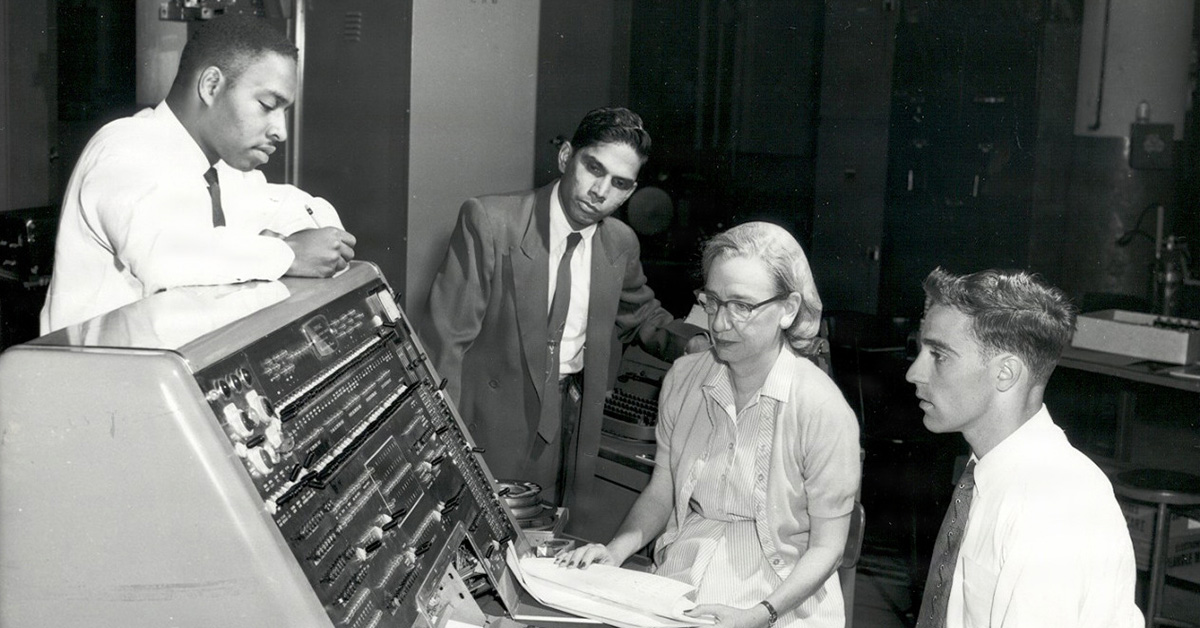
The Harvard Mark I, or Mark I, was a massive electromechanical computer that the Navy used during World War II to perform complex calculations. Programs were fed into the system, and this allowed the Navy to begin automating calculations that supported military planning and technological development. By 1946, Hopper was a faculty member at Harvard and continued her programming work with Mark II and Mark III computers.
In 1949, she joined the Eckert-Mauchly Computer Corporation (later the Sperry Corporation), where she worked on the UNIVAC I . In 1952, Hopper created the first compiler, a program that translates human-written instructions into code a computer can read. Hopper believed computers should be easier for people to use.
She later developed the FLOW-MATIC programming language and helped pioneer COBOL (Common Business-Oriented Language), which would become widely used in government, military, and business systems. Her work helped transform computing from a specialized tool into a system that could support large organizations, including the modern U. S.
military. Because of her work, the military could process logistics, payroll, personnel systems and operations data a hundred times more efficiently. Hopper’s innovations made computing understandable and usable for far more people within the military.
How Hopper Won over Military Leaders It wouldn’t be real change without resistance. At the time, many leaders pushed back on new ideas, and computers were still seen as experimental tools. Skepticism was constant.
Rather than backing down, Hopper focused on educating her peers and demonstrating real results. She regularly explained computing concepts in simple terms and encouraged officers and engineers to experiment with new systems. She framed computer programming as a way to modernize the military and strengthen long-term readiness.
By encouraging leaders to look beyond the moment and think about the future of technology, she helped shift how the military approached innovation. Front-line military service is visible; however, the behind-the-scenes infrastructure and innovation are invisible. Modern warfare depends on data, cybersecurity, and communications.
The modern military approaches and tools now trace back to early computer pioneers such as Hopper. Seeing Technology as an Operational Necessity When Grace Hopper retired from the U. S.
Navy in 1986, she was 79 years old. (U. S.
Navy) Hopper’s work helped establish a new way for the military to think about technology, not as experimental but as an operational necessity. Behind many of the digital programming and systems supporting national defense is the same principle Hopper, who retired from the Navy in 1986, was so driven to champion. Technology designed to help people work faster, smarter, and user friendly.
Her story also allows us to challenge how we see military service and how someone’s work is diminished if they are not in a combat role. The work Hopper tackled behind a desk was transformative. She opened the door to generations of programmers and engineers, people who shape modern defense systems today because of her work.
Hopper’s legacy reminds us that the future of national security is not only shaped on battlefields. Her determination to make computers more accessible helped shift the military toward a future of innovative performance and operations. By creating compilers and human-readable programming languages, she transformed computers from mysterious machines into practical tools for military planning, logistics, and operations.
Hopper, who died in 1992 at the age of 85, changed the language of computing and, in doing so, the future of the military. Don’t Miss the Best of We Are The Mighty • The military spends millions to not upgrade computers • The oldest computer program around is still in use at the Pentagon • The Marine Corps used ‘Doom II’ to train Marines to work together Featured Mighty MilSpouse How trailblazer Grace Hopper taught the US military all about computers By Daniella Horne Mighty MilSpouse A 4-step action plan for milspouses to reclaim their own ambitions By Sara Jane Ginn Military News Grim Reaper dead after trying to take Chuck Norris By Shannon Corbeil History The Iranian general whose intel might have stopped the US from going to war in 2007 By Stephen Ruiz Iraq War RED Friday returns as combat deployments ramp up By Adam Gramegna The post How trailblazer Grace Hopper taught the US military all about computers appeared first on We Are The Mighty .