Last of the F-14 Tomcats could fly again under Maverick Act
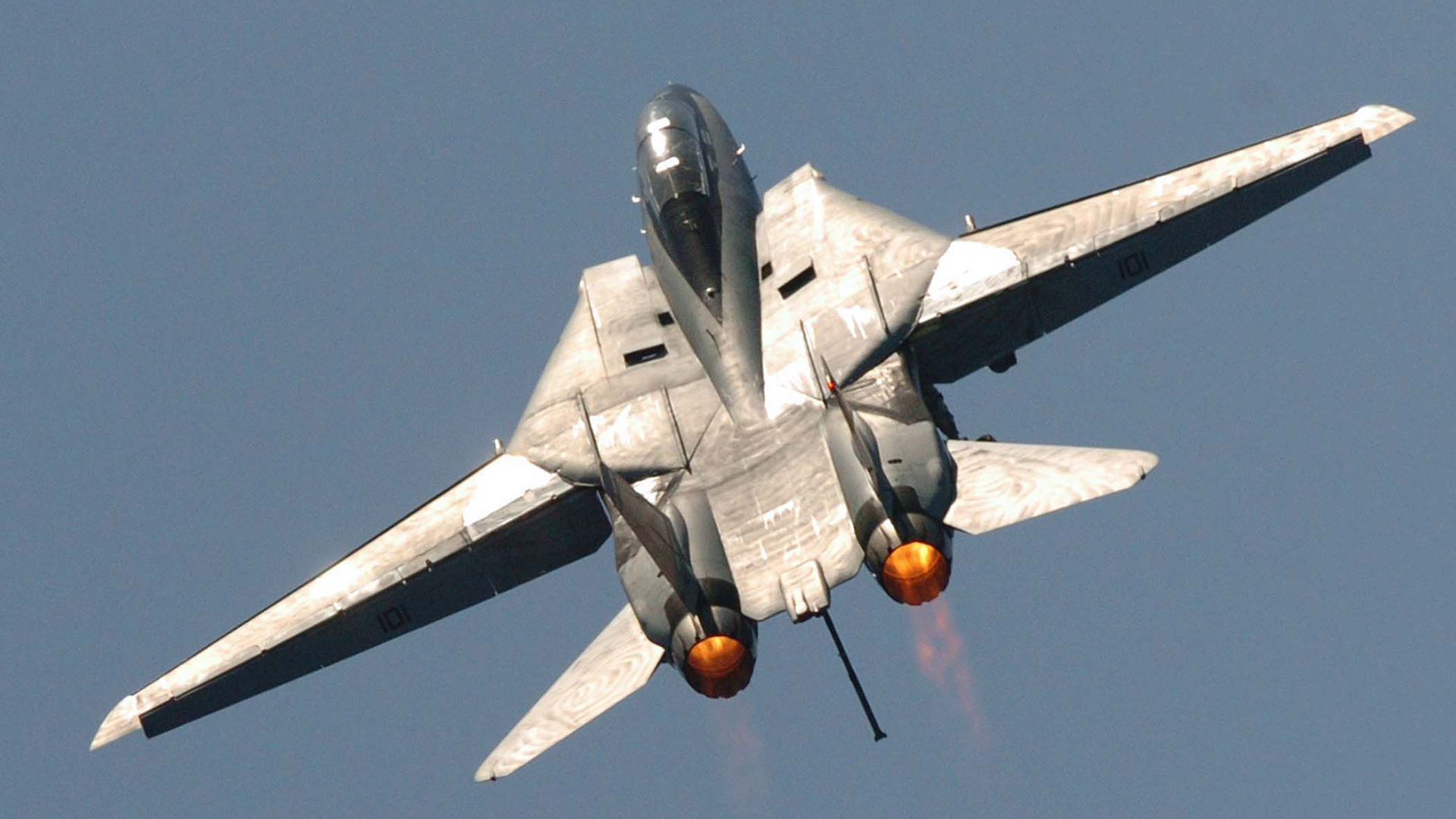
The Navy retired the F-14 Tomcat from active duty in 2006, but lawmakers are once again feeling the need for speed.
The Senate recently passed the Maverick Act, which would send three retired Navy F-14 Tomcats to a museum in Alabama for preservation, with at least the ambition of getting one back in the air.
Sponsored by Sen Tim Sheehy (R-Mont.), the bill would authorize the Navy Secretary to transfer three of the Navy’s last surplus Tomcats to the U.S. Space and Rocket Center in Huntsville.
All three of the F-14s specified in the bill, according to Air Force records, are long retired and currently mothballed at the Air Force’s 309th Aerospace Maintenance and Regeneration Group at Davis–Monthan Air Force Base, Arizona, the sprawling storage depot known as the “boneyard.”
Nearly all retired F-14s were ordered systematically destroyed after reports emerged in 2006 that Iran was acquiring used parts for its small F-14 fleet. As of 2024, only eight of the planes remained at Davis-Monthan (for comparison, the facility holds almost 300 retired F-15s).
But the Maverick Act would pull three surviving jets out for preservation, and one line in the bill implies that at least one of the aircraft could be made airworthy.
“The Secretary shall provide excess spare parts to make one of the F–14D aircraft flyable or able to complete a static display,” the bill says.
Senators passed the “Maverick Act’ on May 1. The bill is currently in the House of Representatives, where it was introduced last month by Rep. Abraham Hamadeh (R-Ariz.).
“As a young man, I was inspired by the popular Tom Cruise movie Top Gun, which featured the F-14, one of the most iconic aircraft ever flown,” Hamadeh said in an April 17 news release. “As a former U.S. Army officer, I know that many of the men and women I served with felt the same way. That is why I proudly introduced this legislation.”
Released in 1986, “Top Gun” made the Tomcat a household name, and an F-14 also played an important role in the 2022 sequel “Top Gun: Maverick.”
In 2024, the Navy presented Cruise with the Distinguished Public Service award for his support for the Navy and Marine Corps, including his roles in both “Top Gun” movies. Cruise’s award citation noted that the original ”Top Gun” boosted the recruitment of Navy pilots in the late 1980s and early 1990s.
Two Tomcats hold spots in naval aviation history
At least two of the F-14s specified in the Maverick Act for preservation hold notable spots in naval aviation history.
One of the planes specified in the bill by its serial number — known in the Navy as a bureau number or “BuNo” — was one of two F-14s to score a rare air-to-air kill in a 1989 dogfight with two Libyan Mig-23s.
Another of the Maverick Act jets was successfully landed as an impromptu convertible after its canopy was inadvertently jettisoned mid-flight outside Naval Air Station Fallon, Nevada. In that case, the captain of a Navy cruiser was in the Tomcat’s rear seat for a “familiarization” flight and accidentally triggered his ejection seat.
Developed during the Cold War, the F-14 served as a Navy carrier-based fighter for three decades. The two-seat aircraft was first delivered to the Navy in 1972, and it made its combat debut in 1981 when a pair of F-14s downed two Libyan Su-22 fighters over the Gulf of Sidra after being fired upon. The F-14 went on to see combat in the first Persian Gulf War along with the Iraq and Afghanistan wars.
The United States sold 80 F-14s to Iran in the 1970s before the country’s ruler was overthrown in a 1979 revolution. The U.S.military destroyed some of those F-14s after launching military operations against Iran starting on Feb. 28.
Related Service stories

Yes, I Served in Iraq. But What if People Mistake Me for a Hero?
Illustration by Kim Vo The Department of Motor Vehicles was a good place to lose your identity, not find it, especially 30 minutes before cl
Officers only: New report lays out what a ‘US Cyber Force’ could look like
A new report argues that an independent Cyber Force should be staffed by only commissioned officers and warrant officers to better develop t
Navy researchers find wreck of World War II submarine that vanished 82 years ago
Nearly 82 years to the day after the USS Herring went missing during World War II, the Navy said it had found the wreck of a submarine that