The ‘Maverick Act’ could see an American F-14 Tomcat in the sky once more
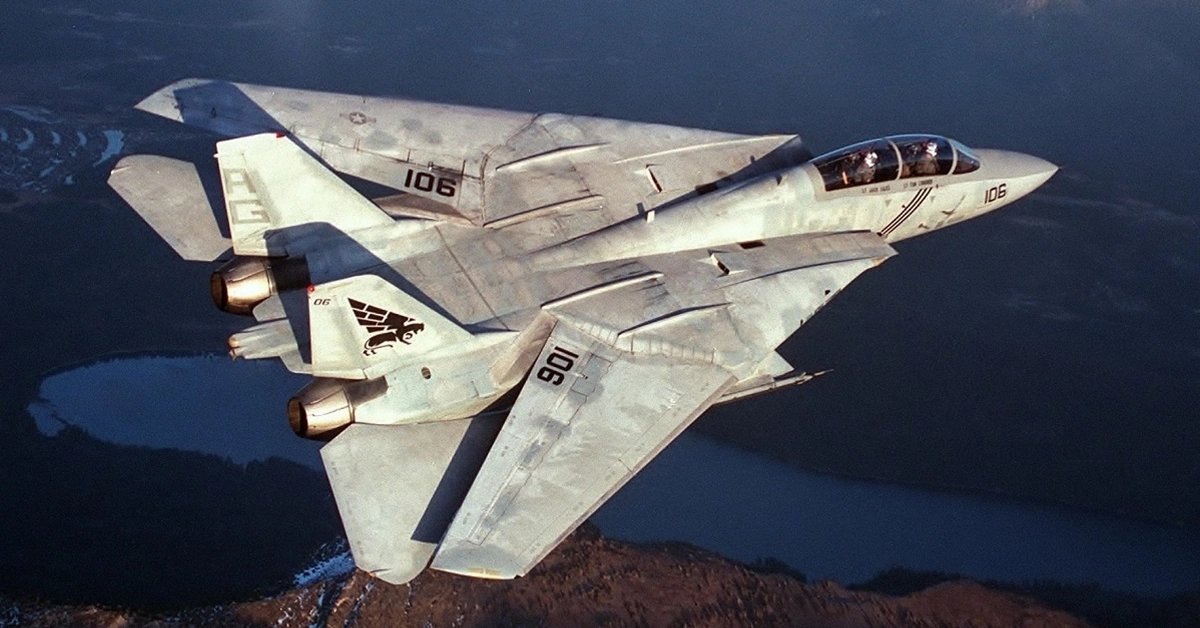
You loved them in “Top Gun.” You mourned them in Midnight Hammer. It’s been 20 years since the F-14 officially retired from American service, leaving the operational Tomcats solely on Iranian airfields.
Because the Islamic Republic of Iran Air Force (IRIAF) is the F-14’s sole user, the United States has been notoriously stingy about Tomcat parts, airframes, or other components, for fear that they might end up smuggled to Iran.
No longer.
Senate bill S.4161, also known as the “Maverick Act,” would authorize the Secretary of the Navy to transfer three F-14D Tomcats to the U.S. Space and Rocket Center Commission in Huntsville, Alabama. It would even authorize the planes to be restored to flying condition (if that’s even possible).
The bill still needs to pass the House, but it was introduced by Republican Sen. Tim Sheehy, co-sponsored by Democratic Sen. Mark Kelly, and passed the Senate in an unanimous vote.
Although the aircraft have to meet a list of set conditions, the Navy won’t have to repair the Tomcats before the transfer under the Maverick Act. It only has to supply manuals and excess spare parts, which is a huge concession, given the U.S. military’s history protecting Tomcat-related material from Iran—a history that one might describe as almost petty.
Shah Mohammad Reza Pahlavi ordered a total of 80 F-14 Tomcats for his air force to counter Soviet MiG-25s. Only 79 were delivered before the Islamic Revolution of 1979. They came with only 10 years of spare parts.
After Americans were taken hostage at the U.S. embassy in Tehran, President Jimmy Carter set sanctions on Iran, severely limiting its access to replacement parts. Since the Islamic Republic was the only other country to fly the F-14, it could only get those parts from its worst enemy.
Iran’s decade-long war with Iraq put a strain on its F-14’s operational capabilities. Its engineers had to figure out how to reverse-engineer key components. It even turned to international brokers to procure parts stolen from the USS Kitty Hawk. The U.S. has been mindful of its Tomcat pieces ever since.
Rather than put its remaining F-14s out to Davis-Monthan Air Force Base’s desert “Boneyard,” the Department of Defense literally shredded most of them into two-foot square bits.
The handful of Tomcats that remain have a wing carry through structure made of titanium, which can only be re-welded under specific conditions.
Making a Tomcat flyable again will be a feat. A feat that is, apparently, not impossible, according to the Maverick Act.
“The Secretary shall provide excess spare parts to make one of the F–14D aircraft flyable or able to complete a static display, provided that any part transferred is from existing Navy stock, with no items being procured on behalf of the Commission.”
Anyone who feels the need for speed might find it at an airshow in Alabama in the not-too-distant future.
Don’t Miss the Best of We Are The Mighty
• Northrop Grumman teases first look at next-gen Navy fighter • The F-14 Tomcat was designed around its engines, radar and missiles • This is what happened to all the old US F-14 Tomcats
Trailblazing Vietnam veteran helped reveal how humans came to be
Northrop Grumman teases first look at next-gen Navy fighter
How these Navy submariners worked to save themselves after their sub sank
It’s official: ‘Top Gun 3’ is in development
The ‘Gray Ghosts’ of the Cuban Missile Crisis
By Daniel Tobias Flint
Related Service stories

Yes, I Served in Iraq. But What if People Mistake Me for a Hero?
Illustration by Kim Vo The Department of Motor Vehicles was a good place to lose your identity, not find it, especially 30 minutes before cl
Officers only: New report lays out what a ‘US Cyber Force’ could look like
A new report argues that an independent Cyber Force should be staffed by only commissioned officers and warrant officers to better develop t
Navy researchers find wreck of World War II submarine that vanished 82 years ago
Nearly 82 years to the day after the USS Herring went missing during World War II, the Navy said it had found the wreck of a submarine that