Marine, actor, spy: ‘Ortiz’s War’ depicts pursuits of World War II commando
For journalist Katie S. Sanders, her foray into World War II family lore came to her, like many others, “tucked in the attic.”
Her grandfather, Lt. Murray Simon, seldom spoke of wartime experiences, let alone the details regarding being shot down in a B-24 on a secret mission one month prior to D-Day.
All that was left was a piece of that downed plane — an antenna cover loop — painted black to blend into the cover of darkness.
Still, that and a shoebox full of military medals was all “just a little bit of mythology to me,” Sanders told Military Times.
But in 2016, the thread of Simon’s war years started to come undone thanks to Sanders’ persistence and a 1949 recording of the TV hit “This Is Your Life.”
The series, which ran from 1950 to 1990, lured unsuspecting guests onto the show and then surprised them with loved ones or those whose lives they had touched.
The guest of honor for one episode featured, according to its host Ralph Edwards, “a Marine whose life has been packed with enough adventure, thrills, hair-raising escapes, raw courage, and excitement to make half a dozen movies.”
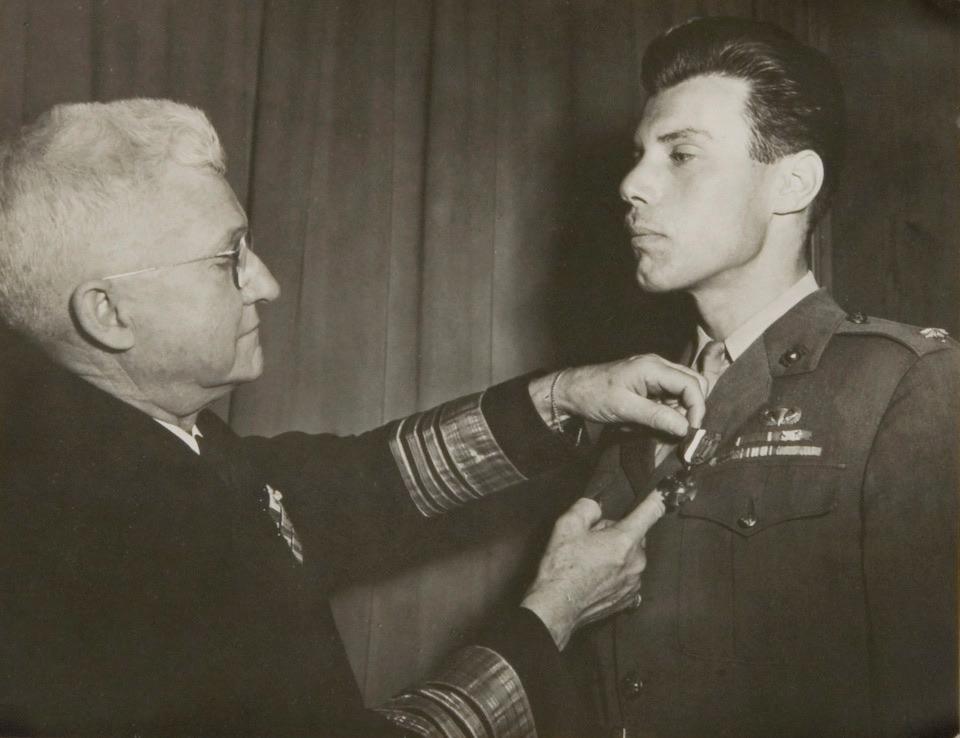
The guest, Peter Ortiz, a lanky man with thick brunette hair and a neatly trimmed mustache, strolled onto stage only to be surprised by Sanders’ grandfather a short while after.
Sanders sought to unravel the ties that bound these two inexplicably together.
“Who was this multilingual, Hollywood-handsome figure who had parachuted behind enemy lines with bags of cash and ammunition for the Maquis, who he was at work training, between blowing up Wehrmacht railcars and eavesdropping on off-duty Nazis at pubs?” Sanders pondered, adding, “How was this not already a Netflix series?”
The full picture of Ortiz, a Marine Corps officer and Office of Strategic Services legend, quickly took shape, resulting in “Ortiz’s War,” written by Sanders and her co-author, retired Marine and CIA officer Nicholas Reynolds.
The book, published Tuesday, weaves the tale of the most battle-decorated member of the OSS who lived a multitude of lives before his death in 1988: as a French Legionnaire, a POW, a U.S. Marine, a spy and, to cap off his career, an actor.
While the OSS, created in 1942 as the first independent U.S. intelligence agency, was short-lived, the exploits of some of its legendary “glorious amateurs” such as William “Wild Bill” Donovan, Julia Child and Mo Berg live on within the American lexicon.
Ortiz, however, despite his many hair-raising adventures and numerous accolades, has lurked in the classified shadows for decades.
Something Sanders and Reynolds hope to rectify in “Ortiz’s War.”
“Even within this sort of very fascinating subset of American operatives, he really stood out,” Sanders said.
One of only 80 Marine Corps officers to serve in the OSS during the war, Ortiz was originally tasked with evaluating the strength and capabilities of the local resistance movement in the Vercors area in southeastern France. He then organized and armed the Maquis in preparation for the long-awaited D-Day assault, according to the CIA.
While operating in France, Ortiz often donned his U.S. Marine uniform — a unique sight, even after June 6, 1944.
“Ortiz felt that entering occupied France at a time when doing so was incredibly dangerous — and there weren’t many allies around — that the actual impact of that gesture on the resistance” was meant to boost morale when the promises of the liberation of France seemed more like a whisper of hope rather than reality, Sanders said.
“He was very symbolic, very literary in a lot of ways,” she continued. “He was there to arm, assess, and mobilize the resistance. So here he was coming in the middle of occupied France and he looks the part.”
That, Sanders said, was very much deliberate.
It was there, while he was operating in France, that Sanders’ personal family story intertwines with Ortiz’s.
Shot down in May 1944, Simon had hurled himself out his burning plane before being rescued by members of the French Underground. Initially hidden by a French Army doctor, Sanders recounts that after the war the doctor, tongue in cheek, demanded “two eggs” from the U.S. government because he had given Simon his last two.
Details like that, Sanders noted, while researching the book, “were very humanizing.”
From there, Simon was disguised as a deaf-mute Frenchman and transported to Valence, France, where he was introduced to the American commando.
Ortiz, codenamed “Chambellan” or ”Jean-Pierre" was the “person who, in my grandfather’s case, you would pray to be intercepted by when you’re a Jewish kid from Queens, New York, shot down over Nazi-occupied France,” Sanders said.
Simon’s encounter with Ortiz, who eventually led him to safety over the Pyrenees, was just one small deed in a series of larger sacrifices, however.
Following the success of Operation Overlord, Ortiz was directed to engage in acts of violent sabotage to prevent the retreating Germans from destroying key installations throughout the region.
During fighting near Albertville, France, in early August 1944, Ortiz, commanding five Marines, a Free French officer and an Army Air Forces captain, was soon overrun by several hundred troops of the German 157th Alpine Reserve Division.
Ortiz surrendered rather than risk German reprisals on the French village.
The commando made numerous escape attempts before being liberated by the British 7th Guards Armored Division on April 29, 1945. By October of that year, with the OSS disbanded Ortiz set his cap on Hollywood.
As for Simon, he “lived and died very grateful,” Sanders said.
“Ortiz’s War” by Nicholas Reynolds and Katie S. Sanders is out now.