One of military history’s most lopsided beatdowns didn’t need to happen
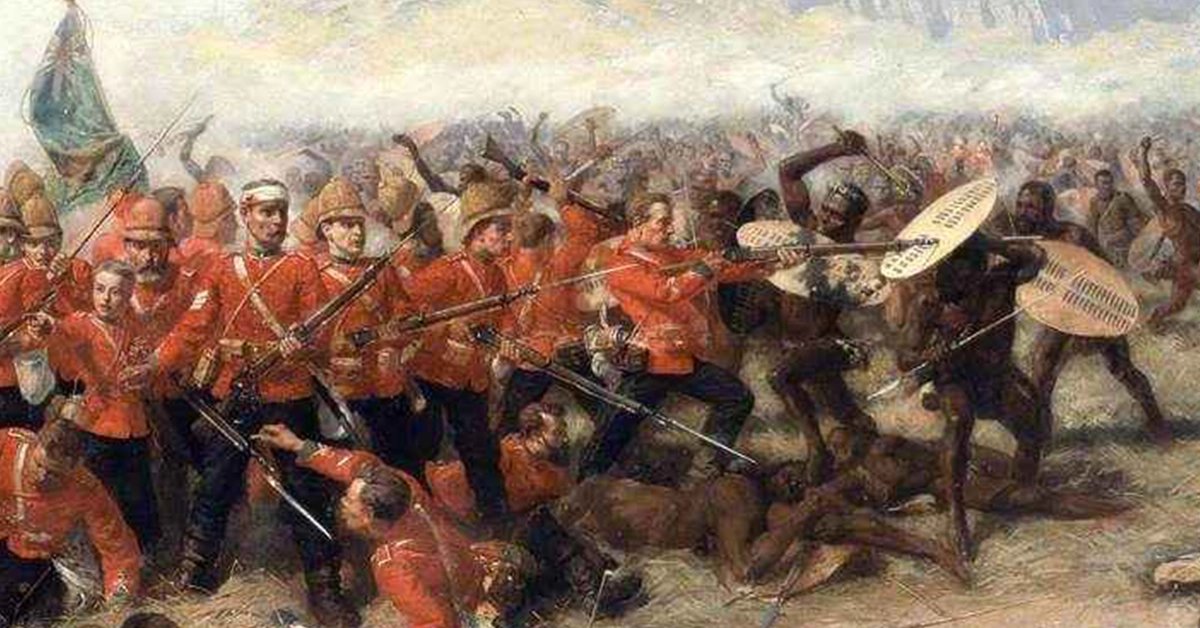
It was a war no one in London asked for, to kick off a plan everyone tried to reject, and the first battle was an absolute disaster. But the British Army was sent to Isandlwana anyway, by one British High Commissioner who was going to reorganize southern Africa by any means necessary.
There was just one problem: Britain didn’t actually control all of southern Africa.
We’ve all (hopefully) seen “Zulu,” the 1964 Michael Caine movie that depicted the 1879 Battle of Rorke’s Drift, pitting fewer than 150 British regulars against a few thousand Zulu Impi. It doesn’t matter (for the purposes of this piece) exactly how many thousand—the Redcoats were horrendously outnumbered.
The fighting at Rorke’s Drift would last 12 hours, set the record for the largest number of Victoria Crosses awarded for a single action by one regiment, and spawn one of the greatest war movies ever.
Most importantly, the British not only avoided getting wiped out at Rorke’s Drift, they actually won. And while that makes for a great story, the stand they made there was also completely avoidable and unnecessary.
The garrison that barely survived Rorke’s Drift was actually part of a larger force that invaded Zululand without authorization from London, whose focus was busy elsewhere fighting a land war in Asia on multiple fronts. But back in Africa, the High Commissioner for Southern Africa, Henry Bartle Frere, had his own personal ambitions: Specifically, he wanted to be the first Governor-General of Confederation of South African colonies.
These were colonies that very specifically didn’t want to be part of that confederation. Or any confederation. This is why London rejected the entire idea of a confederation 20 years before Frere arrived.
There were those who worried that merging the Boer Republics with the Cape Colony would disenfranchise the Cape’s black citizens (spoiler alert: it did. In a huge way. You might have heard about Apartheid South Africa).
But things like that never stopped an empire.
To get started, Frere first needed to conquer the areas not under British control (like the Zulu Kingdom) without starting the war himself. To do that, he would make Zulu King Cetshwayo an offer he would have to refuse.
He essentially told the Zulus that the British Empire demanded Cetshwayo disband the Zulu army. Cetshwayo would not comply (because he couldn’t), the deadline lapsed, and Frere used the rejection as a casus belli to invade Zululand on Jan. 11, 1879. Eleven days later, the two sides would meet at Isandlwana.
Leading the British was Lt. Gen. Frederic Augustus Thesiger, Lord Chelmsford. He was a veteran of the Crimean War, the 1857 Indian Rebellion, and the more recent Xhosa Wars in Southern Africa. An experienced officer, his military record to that point was impressive on paper, but in reality, he was mostly a skilled administrator.
It turns out that running the day-to-day operations of the Army in India isn’t the same as holding overall command and starting an illegal war. Chelmsford’s first overall command came against the Xhosa the previous year, and he was unimpressed by his experience. It led him to become fairly complacent and to make some of the dumbest possible mistakes in his war with the Zulus.
Probably his most critical mistake was that he knew there was a large army out there, he just didn’t know where it was—and once committed to an invasion, time would not be on the Redcoats’ side.
The Zulu were able to move an average of 10 miles per day, compared to one mile for the British. The slow, ambling British needed to force the much more agile, fast-moving Zulus into a decisive fight that could end all resistance.
So Chelmsford divided his force of 16,800 British regulars, volunteers, and native soldiers into three columns, and made a beeline toward the Zulu capital of Ulundi.
If dividing his force seemed like a bad a idea, you’re not wrong. But the British had no idea where the main Zulu were and Chelmsford needed to find the Zulu army before he could fight it. Moreover, it was not only expensive to keep the army in the field, but it left settler farms (and everything else) exposed. By dividing he’d hoped to be able to screen more of the border along the way. But his aggressive plan required either speed or protection.
He ended up with neither.
Maybe it was this sense of urgency that led him to another critical error: leaving right away. January was the rainy season and the British oxcarts were not headed for paved roads. Or even good roads. Or any roads at all.
While Chelmsford was so concerned with not letting the Zulus escape, he didn’t consider what would happen to any part of his force if the Zulu’s 24,000 warriors found them while they were unprepared. Isandlwana would be the proof. It’s where he made his second critical error: complacency.
The British force made camp at Isandlwana on Jan. 20. They made no entrenchments and failed to at least even circle their wagons. Entrenching, laagering the wagons, and maintaining a tight firing line was the doctrine for fighting the Zulu, but Chelmsford’s total lack of respect for his enemy meant he didn’t even do that.
He believed superior weapons and European training could overcome anything an African force threw at him and thus they failed to create even the most basic kind of fortifications at Isandlwana. Superior weapons and European training could overcome a lot, but not if you ignore everything else you’ve ever learned about fighting the Zulu.
It never seems to have occurred to him that an army that can hide 24,000 people and cross a battlefield faster than his men could reload might be something he should prepare for.
What the British did do was send out scouts who encountered a force of Zulu skirmishers, which he believed was part of the main Zulu army. He then divided his forces even further, leaving 1,300 men (525 more would arrive later) to guard the camp, under the command of an officer with no combat command experience.
While Chelmsford was off chasing the decoy, the Zulu army moved around his entire detachment at Isandlwana and were just seven miles from the lightly defended camp.
Around 11 a.m. on Jan. 22, British scouts found the entire force of 24,000 Zulus hiding in a valley near Ngwebeni. This is what sparked the attack—the Zulu did not want to lose the element of surprise. They quickly moved into an offensive battle formation, forcing the scouts to fight their way back to the camp.
The 1,800 defenders at Isandlwana quickly discovered they were outnumbered, with 24,000 enemy warriors moving to outflank or encircle them.
The Zulu Impi line of battle is shaped like the head of a buffalo: The two horns encircled the British at Isandlwana and cut off their retreat. The British fought hard, but were too spread out to make a real massed volley. The center of the defense held for a long time (the longest, actually), but when the flanks tried to fall back and tighten the firing line, the Zulus surged. The left horn rolled over the defenders and resistance crumbled.
Firepower no longer mattered, and the fight devolved into Zulu short spears versus British bayonets and rifles used as clubs.
The British regulars were slaughtered, losing more than 800 officers and men. The African natives who fought alongside the British were executed as traitors by the Zulus if they were captured. A few hundred tried to escape, cutting their way out toward Fugitives’ Drift, but they were mostly run down and killed, too. Chelmsford’s invasion collapsed after British supplies, ammunition, and draft animals were captured.
It was one of the worst defeats a British army ever suffered at the hands of an indigenous force, and one of the worst defeats the British suffered during the Victorian Era.
Reactions to the defeat resounded throughout the British Empire. Despite all his underhanded scheming to start an unnecessary war, Sir Henry Bartle Frere got to keep his post. The fallout would eventually reach London, as Prime Minister Benjamin Disraeli’s Conservative government lost the next elections.
Chelmsford should have been relieved of command, but saved his reputation by scapegoating the (conveniently dead) Col. Anthony Durnford. He blamed Durnford for failing to build defenses in the camp at Isandlwana, despite his having only arrived at the camp on the day of the battle. Chelmsford probably forgot to mention that he was in camp for 36 hours before chasing the Zulu decoy.
Instead of rethinking the entire scheme, support for the conquest of Zululand only increased in the Empire. Desperate not to show weakness, another force was shipped to South Africa for another invasion. And there’s no better proof to show how dumb the Battle of Isandlwana was than the second British invasion of Zululand, when the British invaded again with the same commander.
In July 1879, Chelmsford opened his playbook and chose to run pretty much the exact same play. Except this time he would not divide his force, and he would use a tight firing line in a square formation that would resist the Zulu horn attack.
Chelmsford may have salvaged what was left of his reputation with the capture of Ulundi, but he would never receive another field command. Bartle Frere would go on to enact policies that led to the First Boer War and the Basotho Gun War, which were both disasters for the British Army. He was finally recalled to London in 1880.
Don’t Miss the Best of We Are The Mighty
• Why the US military uses 24-hour ‘Military Time’ • 5 of the most famous military victories achieved against all odds • 8 reasons why everyone knows you were in the military
When Hurricane Sandy sank the ship from ‘Mutiny on the Bounty’
How the last survivor of 9/11 made it out alive after the Twin Towers fell
Why the US military resorted to bombing a volcano in Hawaii after it erupted
Navy awards $76.6B in contracts for new Columbia-class nuclear submarines
World War II
How Paul Newman survived 2 close calls in the Navy during World War II
Related Legacy stories
This American flag survived D-Day, then was returned to the US 75 years later
When Howard Vander Beek died in 2014 at the age of 97, he left behind a distinct reminder of his World War II service. Vander Beek, a lieute
Medal of Honor recipient and legendary Vietnam War helicopter pilot ‘Old Snake’ has died
Retired Army Col. Bruce Perry Crandall, the legendary helicopter pilot who was awarded the U.S. military’s highest decoration for valor for
Air Force crew honors WWII-era Flying Tigers with A-10 paint job
It started as a routine transfer. Following an asset transfer from Korea, maintainers at Moody Air Force Base, Georgia, accepted and process