Preparation prevails at 2026 DAV Mid-Winter Conference
A light but disruptive snow fell over Washington, D.C., on a Sunday evening in February, dusting monuments and muting the usual hum of the nation’s capital. By morning, it had shuttered congressional offices, scrambled schedules and forced DAV members to rethink carefully laid-out plans.
It was an untimely inconvenience for the hundreds of advocates and supporters gathered at the 2026 DAV Mid-Winter Conference in Arlington, Virginia, but it also turned out to be a perfect encapsulation of the adage “success is where preparation and opportunity meet.”
In a week defined by regulatory whiplash and high-stakes testimony, DAV demonstrated exactly what readiness looks like in practice.
THE FIGHT BEFORE THE FIRST GAVEL
A defining moment of the week occurred before attendees even checked in to their hotel rooms.
Days before the conference, the Department of Veterans Affairs published an interim final rule that would have reduced disability compensation for certain disabled veterans who rely on medication to manage their service-connected conditions.
Within hours of the new rule’s release, DAV was the first major veterans organization to issue a public statement challenging it. Others soon followed, and as word spread online, the veteran community became incensed, with thousands adding their voices via comments on the Federal Register website.
The result was swift and decisive.
Within 48 hours, the VA halted implementation of the rule, which has since been completely rescinded.
For many conference attendees, the reversal served as a powerful reminder that effective advocacy is rarely spontaneous. It is built on vigilance and expertise.
Preparation turned a regulatory threat into a victory for veterans.
A DIRECT CONVERSATION WITH VA LEADERSHIP
When the conference formally opened that Sunday morning, Feb. 22, VA Deputy Secretary Paul Lawrence addressed a ballroom filled with members and supporters who had witnessed DAV’s advocacy in action.
He began by recognizing veterans’ concerns with what had transpired the week before and said the experience showed the VA that it needed to improve its communication efforts with veterans and organizations like DAV. He said the department had no intention of ever talking about it again.
He also spoke of the importance of relationships and voiced his disappointment with those who argued that the VA was trying to reduce veterans benefits, emphasizing that both he and VA Secretary Doug Collins stated during their confirmation hearings that they would never do so.
“We value your partnership,” Lawrence said. “We welcome where you disagree with us, in part because we know you are special partners and we agree on so much together. So please, don’t speculate on our position about cutting benefits when our actions are so clear.”
He went on to outline the VA’s technological modernization efforts, structural reform, expansion of community care, and grassroots mobilization to combat homelessness and veteran suicide.
National Adjutant Barry Jesinoski then took to the lectern and affirmed with Lawrence that “we’re never going to talk about [the rule] again.” He also thanked Lawrence for acknowledging the need for better communication between DAV and the department.
“Grandstanding is not our gig. Advocating for those that we serve is,” Jesinoski said to rousing applause from the crowd. “And when you have the ball, and we don’t know where it’s coming out, sometimes we’re going to have to respond.”
Jesinoski addressed the deputy secretary’s comments from a foundation grounded in the lived realities of disabled veterans navigating the VA system and fighting for their earned benefits.
The moment embodied the purpose of the conference: The opportunity to speak candidly to senior leadership is valuable. Being prepared to do so with authority and precision is what makes it effective.
WHEN THE SNOW FELL
DAV staff choreographed this advocacy week in Washington carefully. Departments put their delegations in place. Attendees scheduled meetings with their Congress members weeks in advance. Leaders engrained their talking points.
Then the snow arrived.
The Sunday evening snowfall that swept across the region created travel challenges and prompted a cascade of cancellations. By Monday morning, many scheduled meetings between DAV members and their elected representatives had been called off as offices adjusted to the weather’s impact.
There was disappointment for members who had traveled from across the country to engage lawmakers face-to-face.
But preparation once again proved decisive. Teams pivoted quickly, rescheduling where possible, shifting to virtual formats and coordinating follow-up conversations for later in the week.
Tuesday introduced another obstacle. The State of the Union prompted closures at offices within the House of Representatives, further limiting in-person access on Capitol Hill.
Despite the disruptions, DAV members conducted more than 100 meetings with elected officials during the three-day conference. Advocates educated lawmakers and staff about the organization’s critical policy goals and put human faces to the issues.
The schedule compressed. Windows narrowed. Yet the message didn’t waver.
COMMANDER’S CULMINATING TESTIMONY
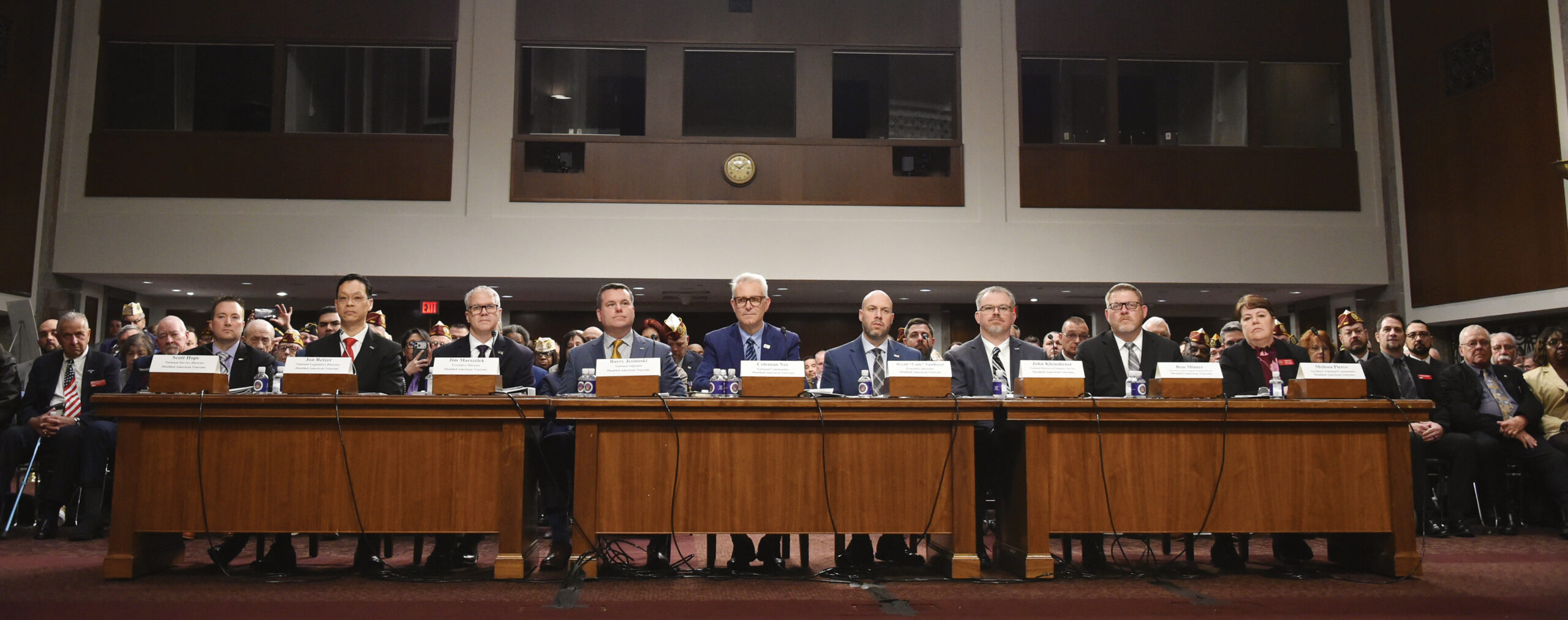
The week culminated with DAV National Commander Coleman Nee delivering testimony before the Joint Committee on Veterans’ Affairs.
Nee framed his remarks around a stark reality: The VA stands at a defining crossroads.
“On one path lies the dismantling, fragmentation and gradual erosion of a system that was built to serve veterans,” he said during his prepared remarks. “On the other lies a principled effort to modernize, strengthen and safeguard the VA for future generations who will answer the call to serve.”
He noted that the VA’s mission is singular in American governance—to serve a population defined not by age, income or geography but by service and sacrifice.
“Private health care systems are not designed around military service,” Nee added. “They don’t specialize in combat trauma or polytrauma rehabilitation. They don’t take into account the lifelong consequences of military toxic exposures. And they are not accountable to veterans in the same way a public institution is accountable to the people it serves.”
Nee warned that the gradual dismantling of the VA runs counter to the benefits of preserving the department with seriousness and resolve.
“The choice before us is not between reform or stagnation. It is between responsibility or retreat,” he said.
“History will judge which path we choose. What lies beyond it is not merely an institutional outcome but a statement of national character. Let us choose preservation. Let us choose reform. And above all, let us choose to keep the promise to those who have always kept faith with us.”
Nee’s testimony wasn’t rhetorical flourish. It reflected disciplined policy analysis, consultation with members, and careful review of emerging legislative and regulatory proposals. The opportunity to address lawmakers carried institutional weight. The preparation ensured that weight translated into influence.
LESSONS LEARNED
By the time the conference drew to a close, the snow had already melted. The State of the Union had wrapped. Schedules began to normalize.
But the lessons of the week remained.
Success didn’t manifest as a single speech or meeting. It appeared in the rapid halting of a harmful rule. It showed in substantive dialogue with VA leadership. It endured through canceled appointments and compressed calendars. And it resonated in testimony that articulated a clear vision for the VA’s future.
Preparation is often invisible. It happens in policy memos and in quiet conversations with staff. Opportunity, by contrast, is visible and often fleeting—a regulatory notice, a public hearing, a scheduled meeting on Capitol Hill.
The 2026 DAV Mid-Winter Conference demonstrated what happens when the two converge.
In an environment marked by complexity and uncertainty, veterans require disciplined, informed and agile advocates. They require organizations like DAV that are capable of not only reacting to change but also shaping it.
Snowstorms will come and go. Legislative calendars will shift. Regulatory surprises will surface.
But when preparation meets opportunity, even a week of disruptions can become a showcase of effective advocacy and a reaffirmation of a promise kept to America’s veterans and their families, caregivers and survivors.
To learn how you can support DAV’s advocacy efforts, go to davcan.org.