The fight to recognize Doris Miller’s valor at Pearl Harbor
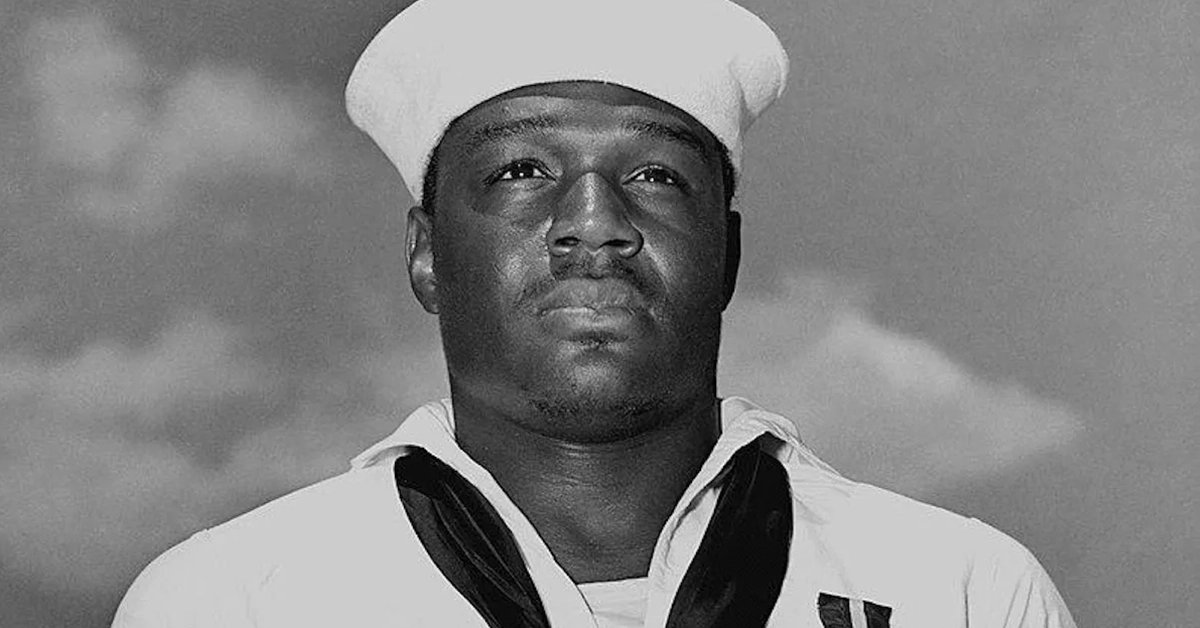
A U.S. Navy messman, Doris “Dorie” Miller, was a Black 22-year-old sharecropper’s son from Waco, Texas. Because of his rating, he was restricted from handling any weapons. His duties included serving the officers’ mess, collecting laundry, and shining shoes. Despite the institutional racism built into the Navy at the time, Miller found success as the boxing champion of his ship, the battleship USS West Virginia.
That didn’t change the fact that he was Black, and as a result, he was segregated from his white shipmates in both his duties and berthing. But Miller and the Navy would soon learn that hostile fire doesn’t discriminate.
On Dec. 7, 1941, Miller woke at 0600 to serve the breakfast mess. He then proceeded to collect laundry. At 0757, a torpedo dropped by Lt. Cdr. Shigeharu Murata of the Japanese aircraft carrier Akagi struck the West Virginia. It was the first of nine that would eventually sink the mighty battleship.
General Quarters was sounded and Miller made his way to his battle station, an anti-aircraft battery magazine located amidships. Upon finding the position destroyed, Miller proceeded to “Times Square,” a central location where the fore-to-aft and port-to-starboard passageways crossed, to report himself available for other duty.
The COMMO, Lt. Cmdr. Doir Johnson, recognized Miller’s powerful boxer build and ordered Miller to accompany him to the bridge to help him move the ship’s skipper, Capt. Mervyn Bennion, who had taken a piece of shrapnel to the abdomen. They moved him to a sheltered spot behind the conning tower. Bennion refused to abandon his post and continued to fight the ship, issuing orders and receiving reports from his officers.
After moving the captain, Miller was ordered to accompany Lt. Frederic White and Ens. Victor Delano to load the number 1 and 2 M2 .50-caliber anti-aircraft machine guns (which sat unmanned) aft of the conning tower. Since he had no training on the weapon system, White and Delano instructed Miller on how to load and man the guns.
Expecting Miller to feed ammunition to the gun, Delano was surprised to turn around and see Miller firing one of the guns. White loaded ammunition into the guns and Miller continued to fire until the ammunition was expended. Miller’s actions with the captain and the machine gun have become well-known thanks to their depiction in Hollywood films; most notably, “Pearl Harbor: where Miller was portrayed by Cuba Gooding Jr.
What is less known are Miller’s actions after he ran out of ammo. Lieutenant Claude Ricketts ordered Miller to help him carry the captain, then only semi-conscious and bleeding heavily, up to the navigation bridge and out of the thick oily smoke that had begun to engulf the ship. Captain Bennion succumbed to his wounds and died soon afterwards.
For his actions, he was posthumously awarded the Medal of Honor. Miller proceeded to pull injured sailors out of the burning mix of oil and water and was one of the last men to abandon West Virginia as she sank. He continued to rescue his fellow sailors from the water and move them to safety as the attack continued and after it finally ended.
While it’s unfortunate that Miller’s actions after his gun ran out of ammo are lesser known, it’s tragic that Miller’s actions during the attack initially went unrecognized. An official Navy commendation list of outstanding actions during the attack did not bear Miller’s name and only listed “an unknown Negro sailor.”
The Pittsburgh Courier, one of the leading Black newspapers at the time, didn’t think this was enough.
“It made two lines in the newspaper,” said Frank Bolden, war correspondent for the Courier, in an interview before his death in 2003. “The Courier thought he should be recognized and honored. We sent not a reporter, we sent our executive editor to the naval department. They said, ‘We don’t know the name of the messman. There are so many of them.'”
The Navy’s apathy didn’t deter the Courier.
Hoping to undermine the stereotype that African-Americans couldn’t perform well in combat, the Courier was determined to identify the unnamed Black sailor and properly recognize him for his actions.
“The publisher of the paper said, ‘Keep after it’,” Bolden said. “We spent $7,000 working to find out who Dorie Miller was. And we made Dorie Miller a hero.”
After Miller was identified, the African-American community swelled with pride. Amidst the shock and sorrow that gripped the country following Pearl Harbor, they had a war hero that represented them. Initially, however, the Navy only awarded Miller a letter of commendation. It took a campaign by the Black press and a proposal from Adm. Chester Nimitz, Commander of the Pacific fleet, to President Roosevelt for the commendation to be upgraded to the Navy Cross, the third highest honor for valor at the time.
Miller continued to serve in the fleet aboard the USS Indianapolis and was promoted to Messman First Class in June 1942. Later that month, the Courier started a campaign for him to return home for a war bond tour alongside white war heroes.
As part of the campaign, the paper published a photo of Miller next to a photo of a Sgt. Joseph Lockard receiving an officer’s commission for sounding a warning that went unheeded before the attack on Pearl Harbor. The photos were captioned, “He Warned… Gets Commission. He Fought… Keeps Mop,” highlighting the disparity in the treatment of white and colored servicemen.
The campaign succeeded and Miller returned to Pearl Harbor in November. He went on a war bond tour that included Oakland, Dallas, and his hometown of Waco until he reported to Puget Sound in May 1943.
He was advanced to Cook First Class on June 1 and reported to the escort carrier Liscome Bay. That year, Miller was featured on a Navy recruiting poster called “Above and beyond the call of duty.”
At the Battle of Makin, the Liscome Bay was sunk by a Japanese submarine on Nov. 24, 1943. Miller and two-thirds of the crew were listed as presumed dead. His body was never recovered.
Since his death, Miller has had schools, streets, community centers, and a foundation named after him. A memorial in his hometown of Waco, Texas features a nine-foot bronze statue of Miller. While the Navy named a Knox-class frigate after him, the remainder of Miller’s naval dedications are quarters, galleys, and a housing community—until now.
On Jan. 19, 2020, the Navy announced that CVN-81, a future Gerald R. Ford-class aircraft carrier, would be named the USS Doris Miller. The Doris Miller was to be laid down January 2026, launched October 2029, and commissioned in 2030.
She will be the first supercarrier to be named for an enlisted sailor and the first to be named after an African American.
The fight to honor Miller continues, however. Since the Navy announced that a carrier would bear his name, efforts to upgrade Miller’s Navy Cross to a Medal of Honor have been renewed. There are even rumors the Navy is considering scrapping the name altogether to rename the ship for President Trump.
The man who was told he could not handle a weapon but still defended his ship and rescued his shipmates should have his name on one of the Navy’s—the world’s—mightiest vessels. Doris Miller will be listed alongside names like Gerald R. Ford and John F. Kennedy. If he is posthumously awarded the Medal of Honor, it will mark the final victory in the fight to properly recognize Miller for his courage, valor, and dedication to duty.
Don’t Miss the Best of We Are The Mighty
• A National Guard unit saw the most combat during World War II • The new Jimmy Stewart biopic depicts his World War II service • How Paul Newman survived 2 close calls in the Navy during World War II
World War II
The fight to recognize Doris Miller’s valor at Pearl Harbor
The weird engineering that links old ships of the line and the SR-71 Blackbird
World War II
A National Guard unit saw the most combat during World War II
Why 11.5 is the best AR barrel length for most shooters
The Civil War started and ended at the same guy’s house
Related Legacy stories
This American flag survived D-Day, then was returned to the US 75 years later
When Howard Vander Beek died in 2014 at the age of 97, he left behind a distinct reminder of his World War II service. Vander Beek, a lieute
Medal of Honor recipient and legendary Vietnam War helicopter pilot ‘Old Snake’ has died
Retired Army Col. Bruce Perry Crandall, the legendary helicopter pilot who was awarded the U.S. military’s highest decoration for valor for
Air Force crew honors WWII-era Flying Tigers with A-10 paint job
It started as a routine transfer. Following an asset transfer from Korea, maintainers at Moody Air Force Base, Georgia, accepted and process