The Marines Created a Warrior. But I Forgot How to Be a Woman

Photo by Cpl. Joseph Jacob, Marine Corps Recruit Depot, Parris Island /> I secured my M-16 to my rack after a long, scorching day on the rifle range and touched my stomach. Cramps should be arriving any day—but they weren’t. How many weeks had it been? Where was my period? Where was everyone else’s?
I had seen “Full Metal Jacket” and expected the experience it depicted: the drill instructors, the breaking down, the building back up for battle. What I didn’t expect was my womanhood being interrupted. That the military would make me stronger but different. And that it would take me years to make peace with the new Shayla.
In the mid-1990s, I told everyone I joined the Marines because I liked their uniforms best. That was true, but the part I hid from the world, even from my recruiter, was that I wanted out of my childhood home.
Shayla Sullivan had her hair braided for her high school graduation photo, but had to lose her braids once she joined the Marine Corps. (Photo courtesy of the author) alt="" class="wp-image-43945" title="" srcset="https://i0.wp.com/thewarhorse.org/wp-content/uploads/2026/07/null-15.jpeg?resize=773%2C1030&ssl=1 773w, https://i0.wp.com/thewarhorse.org/wp-content/uploads/2026/07/null-15.jpeg?resize=300%2C400&ssl=1 300w, https://i0.wp.com/thewarhorse.org/wp-content/uploads/2026/07/null-15.jpeg?resize=768%2C1024&ssl=1 768w, https://i0.wp.com/thewarhorse.org/wp-content/uploads/2026/07/null-15.jpeg?resize=1152%2C1536&ssl=1 1152w, https://i0.wp.com/thewarhorse.org/wp-content/uploads/2026/07/null-15.jpeg?resize=1536%2C2048&ssl=1 1536w, https://i0.wp.com/thewarhorse.org/wp-content/uploads/2026/07/null-15.jpeg?resize=900%2C1200&ssl=1 900w, https://i0.wp.com/thewarhorse.org/wp-content/uploads/2026/07/null-15.jpeg?resize=600%2C800&ssl=1 600w, https://i0.wp.com/thewarhorse.org/wp-content/uploads/2026/07/null-15.jpeg?resize=450%2C600&ssl=1 450w, https://i0.wp.com/thewarhorse.org/wp-content/uploads/2026/07/null-15.jpeg?resize=150%2C200&ssl=1 150w, https://i0.wp.com/thewarhorse.org/wp-content/uploads/2026/07/null-15.jpeg?resize=1200%2C1600&ssl=1 1200w, https://i0.wp.com/thewarhorse.org/wp-content/uploads/2026/07/null-15.jpeg?resize=780%2C1040&ssl=1 780w, https://i0.wp.com/thewarhorse.org/wp-content/uploads/2026/07/null-15.jpeg?resize=400%2C533&ssl=1 400w, https://i0.wp.com/thewarhorse.org/wp-content/uploads/2026/07/null-15.jpeg?resize=706%2C941&ssl=1 706w, https://i0.wp.com/thewarhorse.org/wp-content/uploads/2026/07/null-15.jpeg?w=1875&ssl=1 1875w, https://i0.wp.com/thewarhorse.org/wp-content/uploads/2026/07/null-15-773x1030.jpeg?w=370&ssl=1 370w" sizes="(max-width: 773px) 100vw, 773px" />
Growing up, my mother used her eyes to convey “the rules” if she felt my hips swayed too much at family get-togethers or when my clothes fit too tight in high school. I learned quickly: hips straight, nothing tight, completely conservative. I wanted to be far away from the rules I had absorbed so deeply that I could no longer tell which ones were hers and which ones were mine.
Ironically, I ran straight toward the strictest institution in the country: the United States Marine Corps. It didn’t free me from discipline or the narrow confines of femininity. It just changed who enforced those expectations.
The lines at the processing stations told me everything. “The few” was for real: The Marine Corps’ line was the shortest. I moved through the crowded hallways that morning, swinging my Poetic Justice braids, going from doctor to doctor while recruiters and liaisons nodded. Most pointed me toward the Army, the Navy, and the Air Force lines.
“Marine Corps,” I said.
A pause. Then a nod. I was getting used to that pause. Looking back, I wonder what the people behind those pauses and nods already knew.
Men filled most of the line for the Marines. Only a handful of women were among them. Even fewer were Black.
Women had long been a small minority in the Marine Corps, expected to serve alongside the men and be just as strong and brave. We had to become “hard,” as they referred to it. We needed to prove that we belonged.
At the 4th Battalion, the all-female recruit battalion at Parris Island in the 1990s, we instinctively understood that we shouldn’t make it harder for the women who would come after us. Mistakes could be costly for our reputation and would confirm what some already believed, that the front line was not meant for us.
In boot camp, I was trained to talk differently. “I” became “this recruit,” and now I was “dark green” instead of Black. I spoke naval terminology as second nature, because that was what Marines did.
“This recruit requests permission …”
“This recruit understands …”
Like my braids, gone was the natural softness and femininity in my voice.
I stood “at attention,” with my feet at a 45-degree angle. My steps were robotic; I only dropped my heels and toes in step with the rest of my platoon. Everything had to be deliberate and precise.
In the beginning, the drill instructors had to tell me every single time without fail: “Stop swaying” and “shoulders back.”
The author’s boot camp graduation photo. (Photo courtesy of Shayla Sullivan) alt="" class="wp-image-38066" title="" srcset="https://i0.wp.com/thewarhorse.org/wp-content/uploads/2025/05/Sullivan-graduation-photo-web.jpg?w=600&ssl=1 600w, https://i0.wp.com/thewarhorse.org/wp-content/uploads/2025/05/Sullivan-graduation-photo-web.jpg?resize=300%2C400&ssl=1 300w, https://i0.wp.com/thewarhorse.org/wp-content/uploads/2025/05/Sullivan-graduation-photo-web.jpg?resize=529%2C705&ssl=1 529w, https://i0.wp.com/thewarhorse.org/wp-content/uploads/2025/05/Sullivan-graduation-photo-web.jpg?w=370&ssl=1 370w, https://i0.wp.com/thewarhorse.org/wp-content/uploads/2025/05/Sullivan-graduation-photo-web.jpg?w=400&ssl=1 400w" sizes="(max-width: 600px) 100vw, 600px" />
This new walk made it easier to carry an M-16 steadily. It also made it easier for us women to blend in with the men.
Building Up Stronger, Harder
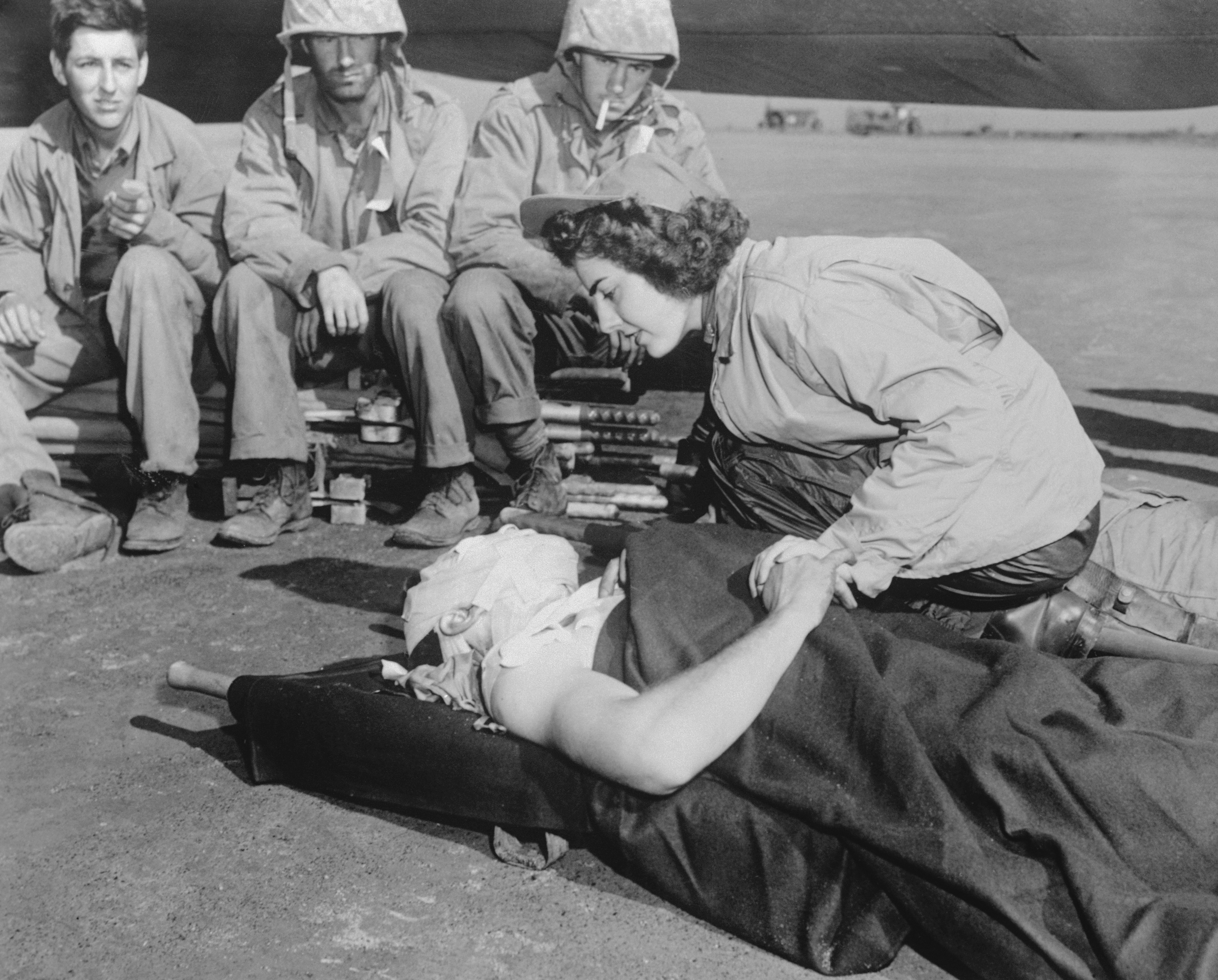
I was terrified of swim qualification. I had never learned to swim, but water survival was required to become a Marine. I can still remember feeling the eyes of the male swim instructors on me while I climbed the tower to “abandon ship.”
Up on that tower, everything stopped. I closed my eyes. I needed to be brave not only for myself but also for the rest of the women who made up less than 5% of the Corps. I squeezed my eyes even tighter, shaking as I made it to the end of the diving platform. I opened them only to stare down into 13 feet of water. I stepped forward…and jumped.
My body naturally floated up until the water was out of my ears and I could hear the swim instructor beside me, encouraging me to stay calm and keep moving, which qualified me.
I felt invincible.
Just a month ago in high school, I was learning the latest dance moves, sneaking makeup, and smoothing my hair down before walking into class.
Somewhere on the rifle range, those things stopped mattering. Now, I could load my weapon with speed, just as the marksmanship instructors had taught me.
I yelled cadence at the top of my lungs in polished boots that shone like glass. I went to bed with an M-16. And the closer we women got to graduation, the more indistinguishable we were from the male battalions across the island.
A physical transformation also happened inside of me. The stress, the exhaustion, the constant demand to push my body and mind further than I could ever imagine began shutting things down. My menstrual cycle had completely stopped, the very thing that had biologically marked me as female. But I was here for a change, right? So, I didn’t question its absence. The changes felt necessary, like part of what it meant to become a Marine.
For graduation photos, they brought out the makeup. Not a lot—just enough to soften our faces for the cameras, enough to assure the world that we were still women. Lipstick. A little blush. Lots of eye shadow. After the camera flashed, it was back to bare faces, boots, and the version of ourselves the Marine Corps had spent 13 weeks building.
Were we being hardened? Strengthened? Or made less visible?
Discipline, uniformity, and toughness are necessary to survive combat. But for a woman Marine, they could also help us survive the fleet. The jokes made it clear where we stood. Overseas, male Marines spoke openly about sexual encounters with local women, whom they called “stupid” and “useful.” They ranked women’s bodies out loud, dismissed the flat-chested ones, and lusted after the others.
The same belief ran underneath the comments: Women didn’t belong in the Marine Corps.
The toughness Parris Island built didn’t protect me from any of that. What it did give me, however, was mental armor; the ability to keep my face still as I searched for a nimble exit.
The Corps’ sisterhood never openly discussed it, but we learned quickly what to ignore—a joke about our bodies, a comment that crossed the line.
We ignored it because women who didn’t were called “slut” or “liar.” If we didn’t, punishment might come in the form of “protection.” Mess duty. A transfer to a new duty station, uprooting whatever stability you had. A move to a different barracks. They moved us, not the men. We were the problem. We learned very quickly that speaking up could cost you more than staying quiet.
The culture was that women should be “tough,” and that tough meant that you were one of the “good ones” who could take a joke. But once you proved “cool enough,” the invitations would follow. A sergeant suggesting that you hang out after hours in the noncommissioned officers’ barracks. A young captain offering you a “special scribe” position—permission to leave the regular office and work privately in his. It was framed as an honor, like being chosen. The way a teacher picks a favorite. But every woman in that building knew exactly what was being offered, and that silence was expected in return.
The Marine Corps gave me things I wouldn’t trade. Discipline. Toughness. The knowledge that I could push past what I thought was my limit and find more on the other side. I jumped into 13 feet of water, shaking, but didn’t drown. I fired that rifle until my shots hit the bull’s-eye every time.
I earned the title of Marine.
But it also asked me to get smaller, to take up less space. To make myself easy to overlook, only to call that “discipline.”
After leaving the Marines, the author spent years integrating the military and feminine sides of her personality. (Photo courtesy of Shayla Sullivan) alt="" class="wp-image-43947" title="" srcset="https://i0.wp.com/thewarhorse.org/wp-content/uploads/2026/07/null-17.jpeg?resize=773%2C1030&ssl=1 773w, https://i0.wp.com/thewarhorse.org/wp-content/uploads/2026/07/null-17.jpeg?resize=300%2C400&ssl=1 300w, https://i0.wp.com/thewarhorse.org/wp-content/uploads/2026/07/null-17.jpeg?resize=768%2C1024&ssl=1 768w, https://i0.wp.com/thewarhorse.org/wp-content/uploads/2026/07/null-17.jpeg?resize=1152%2C1536&ssl=1 1152w, https://i0.wp.com/thewarhorse.org/wp-content/uploads/2026/07/null-17.jpeg?resize=1536%2C2048&ssl=1 1536w, https://i0.wp.com/thewarhorse.org/wp-content/uploads/2026/07/null-17.jpeg?resize=900%2C1200&ssl=1 900w, https://i0.wp.com/thewarhorse.org/wp-content/uploads/2026/07/null-17.jpeg?resize=600%2C800&ssl=1 600w, https://i0.wp.com/thewarhorse.org/wp-content/uploads/2026/07/null-17.jpeg?resize=450%2C600&ssl=1 450w, https://i0.wp.com/thewarhorse.org/wp-content/uploads/2026/07/null-17.jpeg?resize=150%2C200&ssl=1 150w, https://i0.wp.com/thewarhorse.org/wp-content/uploads/2026/07/null-17.jpeg?resize=1200%2C1600&ssl=1 1200w, https://i0.wp.com/thewarhorse.org/wp-content/uploads/2026/07/null-17.jpeg?resize=780%2C1040&ssl=1 780w, https://i0.wp.com/thewarhorse.org/wp-content/uploads/2026/07/null-17.jpeg?resize=400%2C533&ssl=1 400w, https://i0.wp.com/thewarhorse.org/wp-content/uploads/2026/07/null-17.jpeg?resize=706%2C941&ssl=1 706w, https://i0.wp.com/thewarhorse.org/wp-content/uploads/2026/07/null-17.jpeg?w=1875&ssl=1 1875w, https://i0.wp.com/thewarhorse.org/wp-content/uploads/2026/07/null-17-773x1030.jpeg?w=370&ssl=1 370w" sizes="auto, (max-width: 773px) 100vw, 773px" />
For a long time after I left the fleet, I didn’t question these new habits. I just kept moving through rooms the way I’d been trained to—quiet, controlled, always scanning. I reached for items that were like my jungle camouflage—clothes that covered me, that flattened my chest, that didn’t draw attention.
The habit of not being seen had settled into me without my permission. It took longer than I expected to want to be seen again.
Boot camp taught me how to shed my femininity, but no one taught me how to be comfortable again in it. Standing in front of the mirror on a Saturday night, I would wonder: Where does the eyeliner go? How loose can my hair be before it feels wrong?
I softened my voice and let my guard down in small doses until it felt natural again.
It took years to reintegrate these parts of my identity. But I found my way back to Shayla, who is a Marine and also a woman.
This War Horse Reflection was edited by Kim Vo, fact-checked by Jess Rohan, and copy-edited by Mollie Turnbull.