The story behind the World War II aircraft that started Air Force One
After Franklin D. Roosevelt returned from his meeting with British Prime Minister Winston Churchill in Casablanca in January 1943, Hap Arnold knew something had to change.
Arnold, the legendary general who led the U.S. Army Air Forces during World War II, didn’t like that FDR flew to Morocco on a civilian plane. Believing it was the military’s job to transport the commander in chief, he ordered that a transport version of the B-24 bomber be converted for the president’s use.
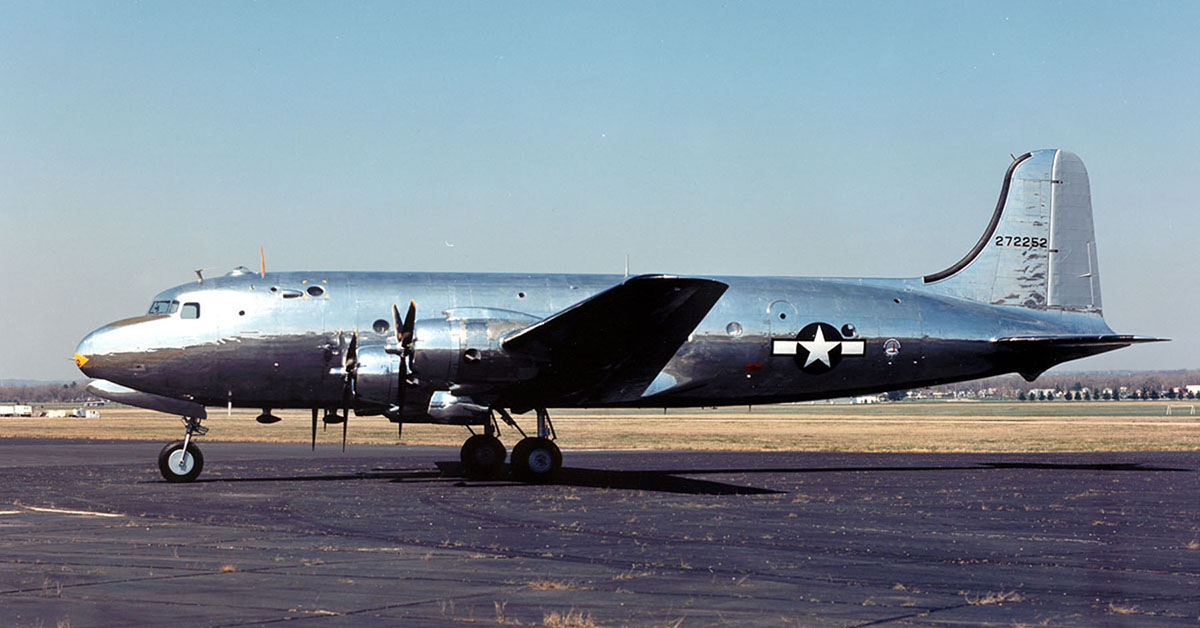
The modifications, including an elevator to allow the wheelchair-bound FDR to board more easily, took some time. Once they were completed, the Douglas VC-54C Skymaster carried Roosevelt and others to the Yalta Conference on the Crimean Peninsula in 1945.
While formally considered the Flying White House, the plane was more commonly known as the Sacred Cow. In a historical context, the plane whose moniker reflected its most precious cargo began a lineage of aircraft that we know today as Air Force One.
One Time Aboard the Sacred Cow
FDR holds the distinction of being the first sitting president to fly in an airplane. He was not the first president to take flight, though. In 1910, a year after leaving office, Theodore Roosevelt, was a VIP on a three-minute flight near St. Louis. The plane didn’t achieve an altitude higher than 200 feet, but Roosevelt walked away as effusive as can be.
“[It’s] the bulliest experience I ever had,” the former president enthused, according to a 2008 article in Smithsonian magazine.
That’s saying something for the former Rough Rider with an unquenchable thirst for adventure. FDR was more reserved after traveling on the Sacred Cow. The trip to Yalta unfortunately was the only instance in which FDR flew aboard the then-innovative aircraft. Two months after the end of Roosevelt’s talks with Churchill and Soviet ruler Joseph Stalin, he died of a cerebral hemorrhage on April 12, 1945.
Roosevelt’s Oval Office successor, Harry Truman, inherited the Sacred Cow.
Part of Air Force History
True to his Midwestern roots, Truman evoked the image of an everyman despite his lofty status. For two years, the United States’ 33rd president boarded the Sacred Cow frequently. When he did, the engaging Truman made it a point to approach the crew, sometimes enticing them to play a game of poker—one of his favorite pastimes.
Truman became good friends with the Sacred Cow’s pilot, Col. Henry Myers. Their relationship was so close, in fact, that when Myers once considered becoming a commercial pilot, Truman didn’t want to see him go. He offered Myers a general’s star and a chance to become one of his advisers to stay, per the Smithsonian magazine. Myers politely refused.
The Sacred Cow continued transporting Truman until 1947, when a version of the DC-6 aircraft replaced it. That presidential aircraft was branded the Douglas VC-118 Independence, named after Truman’s hometown in Missouri.
Compared to the Boeing 747-200B jumbo jets that serve as Air Force One today, the Sacred Cow was nothing special. Not counting a seven-person crew, it had room for only 15 passengers, its engines produced only 1,450 horsepower each, and it achieved a maximum speed of just 300 mph.
Say one thing for the Sacred Cow: It was the first. And when Truman signed the National Security Act of 1947—establishing the Air Force as a stand-alone military branch—he did so aboard the Sacred Cow.
Preserving the Sacred Cow
Americans did not start referring to presidential aircraft as Air Force One until 1953, when Dwight D. Eisenhower resided in the White House. Eisenhower thus became the first U.S. president to travel by jet.
During that period, the Air Force continued using the Sacred Cow before the service retired it in 1961. After that, the historic aircraft faced an uncertain future. It easily could have faded away, a footnote in military aviation but with nothing that future generations can see and touch.
That was not the Sacred Cow’s fate.
Beginning in 1983, the National Museum of the United States Air Force spent a decade exhaustively preserving the Sacred Cow. The project was a success, and the Sacred Cow now holds a special place at the museum, allowing visitors to see the same things as FDR did during his journey to Yalta.
Replacing Air Force One
Today, Air Force One achieves speeds twice as fast, reaches altitudes twice as high, and holds five times as many people as the Sacred Cow.
Boeing will replace the aircraft currently in the presidential fleet in 2028, The Associated Press reported in May 2026. Until then, beginning this summer, President Donald Trump is expected to use the modified Boeing 747 jet that Qatar donated last year.
Air Force One was the scene of several memorable moments. Some were somber, such as when Vice President Lyndon B. Johnson took the oath of office onboard after President John Kennedy’s assassination in 1963. Some were ceremonial, like when President Ronald Reagan officially started a NASCAR race while in midflight on July 4, 1984.
Eight decades ago, the Sacred Cow began it all.
Don’t Miss the Best of We Are The Mighty
• Mike Vining on Vietnam, Delta Force, and the sardines he never ate • The Chief of Staff’s Bible is one of the least-known Air Force traditions • Before 3 tours in Vietnam, this fighter pilot dropped nearly 20 miles from high above
The story behind the World War II aircraft that started Air Force One
9/11 hero Welles Crowther to receive Presidential Medal of Freedom
World War II
AUSA graphic novel spotlights ex-NFL player who earned the Medal of Honor
Family & MilSpouse
Why military kids overseas have to outwork everyone to get recruited
Mighty MilSpouse
‘The Weight He Carried:’ Memorial Day and the battle at home