The tragic case of the real-life Marine connected to ‘A Few Good Men’
David Cox firmly believed he did nothing wrong.
Cox didn’t dispute that he and nine other Marines hazed Private 1st Class William Alvarado at Naval Station Guantanamo Bay in Cuba in 1986. They targeted Alvarado after he reported outside of the chain of command that they were involved in illegal fence-line shootings at Cuban soldiers.
“Our platoon commander pulled us aside and said, ‘Don’t take him up to the roof and throw him off and kill him, but if he were to fall down the stairs in the middle of the night, oh, well,” Cox told the Natick Bulletin, his hometown newspaper in Massachusetts, in 1993.
Instead, the Marines blindfolded Alvarado, tied him up, and shoved a pillowcase into his mouth. They began to shave off Alvarado’s hair when Cox noticed the Marine wasn’t breathing, per reporting from Boston.com. They ended the hazing, informally known as a Code Red among Marines, immediately and Alvarado received medical attention.
Thankfully, he survived.
Meanwhile, the Marines involved in the incident faced a court-martial for their actions. While seven of the 10 agreed to plea deals, Cox and two other Marines maintained their innocence. They were prepared to let a jury decide their fates.
Writing ‘A Few Good Men’ on Napkins
Aaron Sorkin (“The West Wing,” “Charlie Wilson’s War”) was trying to break through in the entertainment industry in the late 1980s. He was working as a bartender on Broadway in New York City and had written a couple of plays that didn’t attract much attention.
His sister, Deborah, was a lawyer in the Navy Judge Advocate General’s (JAG) Corps and represented one of the Marines charged in the Code Red incident. She told Aaron the details of the case, and that inspired him to obtain the court-martial transcripts. During his downtime tending bar, Sorkin told National Public Radio’s “Wait Wait… Don’t Tell Me!” in 2019 that he wrote out what became “A Few Good Men” on cocktail napkins.
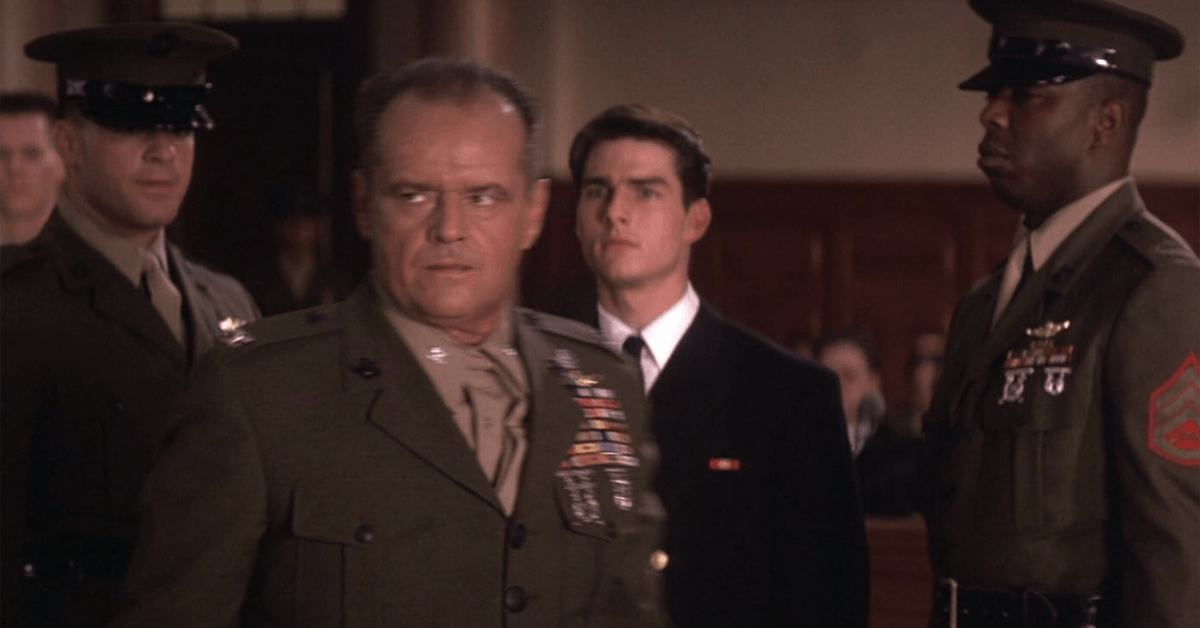
“A Few Good Men” became a hit on the stage before Sorkin wrote the screenplay for the movie version. In the on-screen version, the target of the Code Red died, and the Marine commander who ordered it—-Col. Nathan Jessep (Jack Nicholson)—admitted his guilt during a climactic courtroom scene. In real life, Alvarado did not die from his injuries, and Col. Samuel Adams, who allegedly gave the order, denied he ever did.
“He said it must have been a mistake,” Donald Marcari, who represented Cox, told The Virginian-Pilot newspaper. “He said he didn’t realize Code Reds were still going on. But they were. They were very prevalent. We were trying to show there was an implied order. That Marines are so gung-ho, they must follow any order, even if it’s an implied order.”
Receiving an Honorable Discharge
Like Tom Cruise’s character, Lt. Daniel Kaffee, in “A Few Good Men,” Marcari was extremely early in his career in military justice. He was barely out of law school when he represented Cox, but he overcame his inexperience and did a commendable job.
The jury found Cox guilty of simple assault, a misdemeanor, but cleared him of a more serious charge, aggravated battery. He remained in uniform before he left the Marines with an honorable discharge in 1989.
Five years later, he went missing.
On January 5, 1994, Cox was alone in the apartment he shared with his girlfriend. He then was working part time at UPS, hopeful the position would become more permanent. That day, UPS called to inform him it was hiring him full time, but Cox never got the message. When his girlfriend returned home, he wasn’t there.
According to a 1996 episode of “Unsolved Mysteries,” Cox’s girlfriend, Elaine Tinsley, came home and discovered his truck in the driveway. The keys were in the ignition.
“When I came into the house that night after work, I realized right away that the doors to all the rooms were open, and our rabbit, who we usually just kept in the kitchen, was hopping all over the place,” Tinsley recalled to “Unsolved Mysteries.” “… As the days went on and there was no news from him, we checked his bank account. There was no activity on his bank account. You start to believe that, you know, maybe something did happen, but why?”
Cox hardly ever wore his camouflage Marine Corps jacket, Tinsley said, but it too was missing.
Three months later, friends and family received the answer they never wanted to hear about what happened to Cox. In April 1994, a stranger discovered Cox’s body along the Charles River five miles away in Medfield, Massachusetts. Law enforcement officials revealed Cox sustained one gunshot wound in the back of his neck and three more in his torso. He was 27 years old.
“It was definitely an execution-style shooting,” Cox’s brother Steve told Boston.com.
Based on the evidence, investigators theorized Cox knew his killer. They did not find any indications that Cox put up a struggle for his life. When his body was discovered, he was wearing jeans, a black Marine sniper school hoodie, and his camouflage jacket.
Speculation abounded about the motive behind Cox’s murder. “Unsolved Mysteries” delved into a few theories. Some, like Marcari, wondered whether it was tied to Cox’s time in the Marines at Guantanamo Bay. Cox’s mother expressed it might be linked to an explosive radio interview that her son gave regarding the Marines’ activities in Cuba. And Steve Cox mentioned that before his death, his brother told him of “some suspicious—and potentially illegal—activity” involving UPS.
The true motive remains unknown more than three decades later, as does the identity of Cox’s killer (or killers). As of last year, the case remains open. Anyone with information is asked to call the Norfolk District Attorney’s Office at 781-830-4800.
Don’t Miss the Best of We Are The Mighty • ‘The Fix’ is an action movie for the post-War on Terror world • The Navy said her son died by suicide. This mother pushed back fiercely for the truth • A Marine Corps general led a fictional Iran against the US military—and won
Movies and TV
The tragic case of the real-life Marine connected to ‘A Few Good Men’
Why grave robbing Confederate Civil War dead is big business
Army investigators doggedly worked to solve a soldier’s murder 3 decades later
The US military can legally invade The Hague to free Americans from the ICC
World War II
How ‘Axis Sally’ became the first woman convicted of treason against the US