The US military’s drinking water was the worst water you’ve ever loved
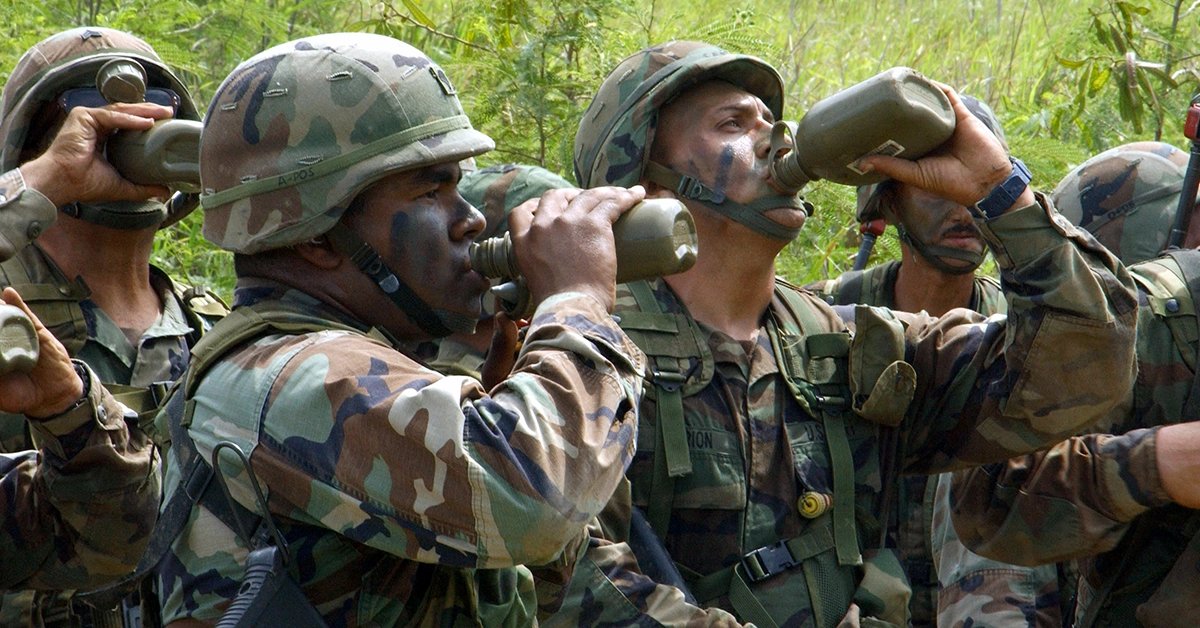
Nobody ever warns you about the Army’s drinkable water. There’s no pamphlet at the recruitment office, no orientation slide at MEPS (Military Entrance Processing Station). One day, you’re a civilian, sipping the finest of faucet water, the next, you’re filling a canteen from an old container that smells like it was last cleaned during Desert Storm.
The United States military can put a munition through a window from 30 miles away, but it has never once, in its illustrious history, managed to make water that doesn’t taste like it was filtered through a mop head. This is the story of that water, and why every veteran just tasted it in the back of their throat.
If you served in any way that involved going out to “the field,” you will know the Water Buffalo well. The M149 Water Trailer, a 400-gallon beast made of a steel tank bolted to a trailer frame, was designed to drag drinkable water to locations where plumbing hadn’t been invented yet.
The Buffalo’s design is elegant in its indifference to your happiness. The interior quality entirely depended on the mood of whichever Private was last tasked with cleaning it. This type of attention usually results in cleanliness levels ranging from “kinda scrubbed” to “new life has formed in there, and they’re asking for better water.”
Over time, the linings in older models would begin to peel, adding to the always-present dirt and dead bugs that you learned to ignore. Calcium would build up like cities inside a tank that hadn’t seen a proper scrub since Grenada. And the spigots, always dripping, always having a 50/50 chance of producing something regrettable.
Enter chlorine: the garnish you never wanted, but were lucky to have. American military field sanitation manuals require water handlers to maintain a minimum chlorine balance. In plain English, this means a salty specialist with a DFAC spoon full of “pool shock” would dump it in, stir with their finger, test, and repeat until the readings were close to whatever their NCO told them they should be.
The result was water that was legally safe to drink.
The Buffalo’s great-grandfather deserves a moment of silence. The Lyster Bag, named after Army Maj. William J. Lyster, who developed the calcium hypochlorite water treatment around 1910, was a 36-gallon canvas sack hung from a wooden tripod. It served as the primary water source for American troops from before World War I through Vietnam, issued at roughly one per 100 personnel.
Somewhere around 2003, the military discovered that you could just buy water. Pallets of commercial bottled water began appearing on forward operating bases (FOBs) across Iraq and Afghanistan like care packages from the Gods. This should have been a victory. Oh, what could have been.
Those pallets sat on sun-scorched tarmacs and staging areas where ground temperatures could crack 150 degrees. The plastic bottles, never designed to double as ovens, would bake for hours, sometimes days, before a convoy delivered them to troops who had been dreaming about something cold since their last shower, which was also a distant memory.
The result was water that was technically room temperature, if your room was the inside of an engine block. Global War on Terror veteran and water connoisseur Spc. David (MilH20) Miller, U.S. Army Infantry, swore the heat made it taste “thicker, almost slimy.”
But this is not technically accurate. What Miller felt was a sensory trick caused by elevated temperatures, altering the way your mouth perceives alkalinity. It didn’t matter. We all drank it because the alternative was the Buffalo, or nothing, and the devil you knew was somehow worse than the devil that was 140 degrees.
Here’s the thing nobody tells you about military water: you get used to it. Not in the way you “get used to” a neighbor’s dog barking. More in the way a prisoner “gets used to” the walls and calling out going number 1 or number 2 to the cell block. It just takes time.
Day One, you’ll take a sip from the Buffalo and look around to see if anyone else tastes the chlorine. They do. Nobody says anything. Day Five, you stop tasting the chlorine. Your palate has surrendered. Day 10, someone hands you a warm bottle from a pallet, and you drink it like it’s a 30-pack of Coors you got on sale at the Class Six, because at least it doesn’t have floaties. By day 30, you catch yourself filling your canteen from the Buffalo without checking the color first.
MRE beverage base powders were perfect for that “ignorance is bliss” mental gymnastics we loved so dearly. Those packets of grape or orange “drink mix” became currency, taking your mind off what is in the water because they look and taste so good. When mixed with warm Buffalo water, the powder never fully dissolves, leaving a neon-colored silt at the bottom of your canteen that looks like it could cause intestinal issues. You drank it anyway.
You drank it fast. In later years, commercial drink mixes like Mio and Liquid IV replaced the MRE packets as the preferred method of making the undrinkable less unpleasant, becoming some of the most shared commodities in the field. And then, once in a deployment, a miracle. Someone finds a cold bottle. Not cool. Not lukewarm. Cold. Condensation on the plastic. It might have come from a refrigerated connex that was briefly operational, or from the bottom of someone’s care package.
It doesn’t matter where it came from. You hold it against your chest before you drink it, because the sensation of something cold against your skin has become a peak experience. You remember what water is supposed to taste like, until you don’t again.
You Might Be Eligible for Compensation
For decades, the water we drank was more of a joke than a serious matter. It was a bonding experience or shared punchline that connected a Vietnam-era door gunner to a GWOT-era comms specialist. But the punchline has been getting dark. Over 700 military installations in the United States have confirmed contamination from PFAS, and other substances known as “forever chemicals.”
AFFF firefighting foam, used on bases since the 1960s to combat fuel fires, was found to be the main problem.
Enough evidence was coming to light that it sparked an internal Department of Defense study from 2022, which found that more than 175,000 service members at two dozen installations were served drinking water containing unsafe levels of PFOA and PFOS, and advocacy organizations estimate that the true number of exposed personnel and family members may exceed 600,000.
Most famous could be the Camp Lejeune debacle, a cautionary tale that finally became a federal law. From 1953 to 1987, Marines and their families at the North Carolina base drank and bathed in water contaminated with industrial solvents at concentrations up to 3,400 times the levels now considered safe.
One study done by the Centers for Disease Control found that those who resided at Lejeune had significantly elevated risks of kidney cancer, liver cancer, and Lou Gehrig’s disease, compared to those stationed elsewhere.
Some have estimated the cost to clean up PFAS contamination across all military sites has spiked to nearly $39 billion, and is rising. The Pentagon’s cleanup budget hasn’t come close to keeping pace with this inflation. It’s conceivable that some contaminated sites may not be fully cleaned for another fifty years.
Our military’s unofficial answer to every problem has always been the same: take Ibuprofen, drink water. Turns out, the water was sometimes the problem, and the people who drank it without question deserve better.
The odd water isn’t going anywhere, folks. Future generations of smiling service members will fill their canteens from whatever alien technology eventually replaces the Buffalo, wince at the first sip, and learn to stop caring like the rest of us. That’s the cycle. That’s the shared commonality from the first human to throw a stone at another’s head, to the last one fighting the Venusian lizard armies.
If you know, you possibly still carry it all with you: the chlorine, the unidentifiable floating objects, the hot plastic, the grape drink, and that one cold sip on the hottest day. You drank what they gave you when they gave it to you, because there was a job to do.
So raise a glass of whatever beverage you’re privileged to have now, then give a toast to military water and the brave souls who gleefully chugged it. Technically potable. Possibly toxic. Never forgotten.
Until the next drop, stand easy.
Don’t Miss the Best of We Are The Mighty
• A salute to assistant gunners and ammo bearers: the invisible half of every gun • The US Army’s ‘Cattle Truck’ was the worst ride you’ll never forget • The M113 armored personnel carrier was supposed to be obsolete
The US military’s drinking water was the worst water you’ve ever loved
The history of Rip It, the beverage that fueled the War on Terror
World War II
This is why the 1st Marine Division ships out to ‘Waltzing Matilda’
Why the National Guard should embrace its illustrious history
The 3 best ways an officer can earn the trust of their NCOs
Related Service stories

Yes, I Served in Iraq. But What if People Mistake Me for a Hero?
Illustration by Kim Vo The Department of Motor Vehicles was a good place to lose your identity, not find it, especially 30 minutes before cl
Officers only: New report lays out what a ‘US Cyber Force’ could look like
A new report argues that an independent Cyber Force should be staffed by only commissioned officers and warrant officers to better develop t
Navy researchers find wreck of World War II submarine that vanished 82 years ago
Nearly 82 years to the day after the USS Herring went missing during World War II, the Navy said it had found the wreck of a submarine that