The veterans fighting military sexual assault as a Shield of Sisters
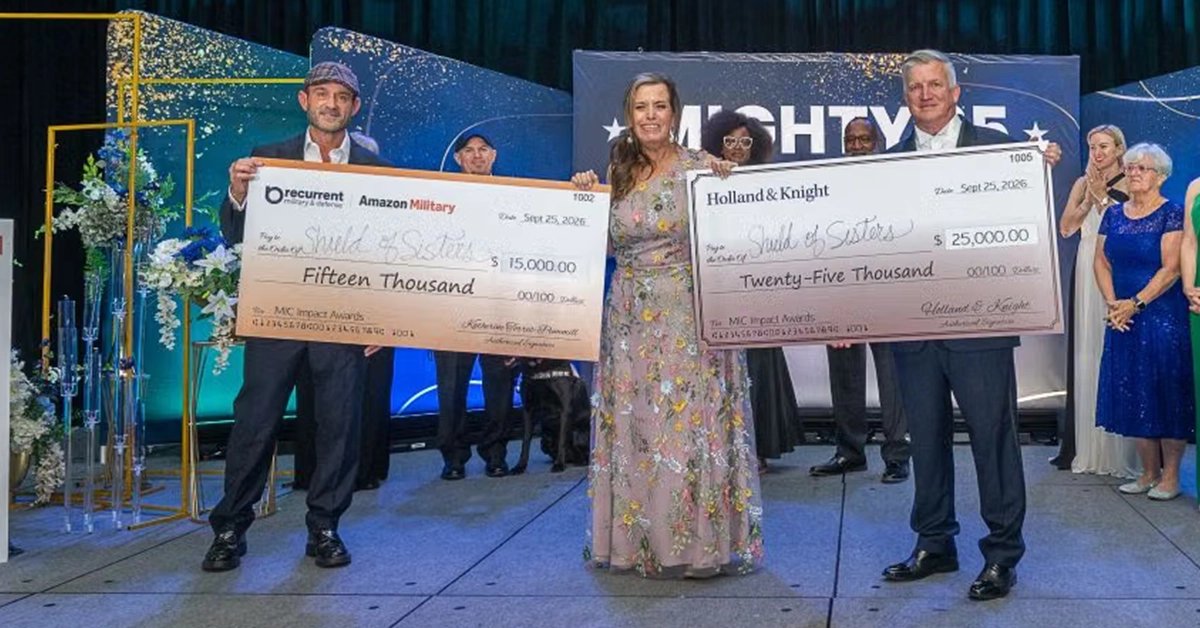
This story celebrates a nonprofit that works with military and veteran survivors of sexual assault. Survivors can access resources through their website or by calling 920-951-1244 for immediate support. Their website includes a red button that closes the site near the top of every page for survivors who may need information while still in an unsafe situation.
Like the leaders of other nonprofits selected for the 2026 MIC Impact Awards grants, Shannon Hough runs an organization that serves the military or veterans and can prove its impact with hard data.
“We have, through Equitable Analytics and Face the Fight, a survey program for mental health and client satisfaction, and 100% of our women recommend Shield of Sisters to others,” she said. “And we are becoming the nation’s go-to for military sexual trauma. And it’s humbling, but it’s also sad because we’re so needed.”
Shield of Sisters Was Founded by a Survivor
For veterans like Hough, sexual assault in the military is not just anecdotes and data, it’s a lived trauma that created a cascade of consequences in her life and the lives of tens of thousands of veterans, disproportionately women, who have suffered unwanted sexual contact in the 30 years since her attack.
For decades, she suffered military health issues. After she learned that her own struggles were common among survivors, she started a network where they could support each other, retreats for healing, and now a quick response group where new survivors can have a mentor with them during the initial reporting process.
“ I created what I needed because I wasn’t getting help, and I was tired of living the way I was,” she said. “And that’s where Shield of Sisters started, it was just needing something and feeling so alone, but then realizing now I have thousands and thousands of sisters, and it’s remarkable to work with them.”
The Need for Survivor Support Networks
Shield Of Sisters has thousands of people who could newly need their services every year, with the Department of Defense’s annual survey showing 4.3 percent of women and 1.0 percent of men in the military experienced unwanted sexual contact in FY 2025.
With over 225,000 women in the military and 2.5 million men (counting Reserve forces), that would indicate almost 10,000 women and 25,000 men suffer unwanted sexual contact every year. Shield of Sisters, and their newly formed Shield of Brothers, are networks for survivors to bond and heal with no pressure to define themselves by their attacks or even share any of the details.
Their main program is a retreat where the programming focuses on healing and adaption strategies without leaning into counseling and medication that the participants can typically already get through the Department of Veterans Affairs or Department of Defense.
“The retreats we do, we, we use a lot of holistic modalities, so they don’t feel like, you know, ‘Here’s another counseling program,’ ‘Here’s more medication,’ because we try to steer away from that,” she said.
“When you go to the VA, it’s ‘Tell your story,’ ‘Tell your story,’ ‘Tell your story,’ and you’ve told it a million times, and you don’t wanna tell your story,” she said. “You don’t wanna keep reliving it. I think that’s one of the significant things that helps them is that they know they don’t ever have to tell their story, we just believe them.”
What Makes Shield of Sisters Different for Military Sexual Trauma Survivors
Instead of sharing sessions and counseling, Shield of Sisters uses a different approach.
“We have pillars of wellness and show them that there are so many things to stay around for and so many ways to heal,” she said of the retreats, which typically take place at an Airbnb or similar lodging over a weekend.
“The whole weekend they carry around a weight in a bag, they have it on their shoulders,” she continued. “Every once in a while, we’ll tell them to put it down. And say ‘Isn’t it so much easier to do things, you know, like go to the bathroom without this 10-pound bag of weight on you?’ ‘Isn’t it so much easier to go to bed without this 10-pound bag of weight on you?’ It shows how trauma can really affect your life and cause you to sag and not be a healthy, vibrant person. We teach them how to do that.”
“It’s hard to explain, but usually on the second day, there’s this specific moment, and you see an unbelievable change in their life. The rest of the retreat, they’re like, ‘Do we have to keep carrying this?’ And I’m like, ‘I don’t know. Do you?’”
The Shield Finds New Sisters Through Referrals
The weekends have proven effective, and Hough says that one of their main ways of finding survivors is through referrals. A survivor has a good experience at a retreat and immediately tells other survivors who are eligible and can use the services.
“ We literally had a retreat in June, and one of the ladies, as she was driving back, called another sister and told her about it,” Hough said. “She was at the very next retreat three weeks later. She was like, ‘I’m coming, I’m coming from Wyoming; I’m gonna be there.’ And now she’s actually already coming back, and she’s going to be our hostess for our next retreat, and she’s bringing another sister with her.”
The Battle Angel Program lets Shield of Sisters Reach Survivors Immediately
The successes with networking and the retreats has led to a new mission, the Battle Angel Program, that Hough said was her “big romantic dream” when she started Shield of Sisters.
“ We actually have a unit out of Fort Hood that calls us as soon as they know they have a survivor,” she said. “They call us and say, ‘Hey, can you get to them?’ And we’ve gone to the military police with them. We’ve gone to doctors with them and sat with them.”
She hopes to see the Battle Angel Program growing much larger, which funding can help with.
“We’re sitting there with them when they’re giving their reports, sitting with them when they’re at the doctor or in front of their command or at a court martial,” she said.
“That way they’re never alone, and they know that someone who has walked that walk can sit there and say, ‘You’ve got this. You’re strong. I’ve done it. You can do it.’ And so, five to 10 years from now, I think we’ll be military-wide doing that. Right now we’re just out of Fort Hood doing that.”
While the mission of Hough and Shield of Sisters is big and often dark, Hough sees light in the future, including through Congress.
“ This is going on in our ranks, and it’s time to end,” she said. “We need people to contact Congress. There’s numerous pieces of legislation going through right now that would make a huge difference.”
One potential change involves the Feres Doctrine, which prevents service members from suing the government for personal injuries or wrongful death.
“One runs a plow through the Feres Doctrine, where we can actually sue the government if they’re negligent in providing services and negligent in preventing assaults. And so we really want that to go through. Then the other, we often don’t file claims right away because we’re afraid of retribution, and this other one would actually allow our claims to go back to the day we got out of the military.
“And so people like me who waited 30 years, because we didn’t know 30 years ago we could file, or we were still terrified because we were threatened, and so that 30 years of pain, alcohol abuse, eating disorders, all of the things that we tend to pick up, it would allow us to file for that, too.”
Don’t Miss the Best of We Are The Mighty
• 7 incredible stories of heroism on 9/11 • How the most incredible Coast Guard cold-water rescue ever unfolded • The controversial Marine grenade hero of Fallujah that Washington still argues about
The veterans fighting military sexual assault as a Shield of Sisters
Meet Project R3CON, they’re helping heal special operator TBIs
Prince Harry reveals what he was running from when he joined the military
How this Marine veteran scrambled to survive after the USS Indianapolis sank
Why this retired Marine colonel and cancer survivor runs 50 marathons a year