What happened when North Vietnam attacked a Special Forces base
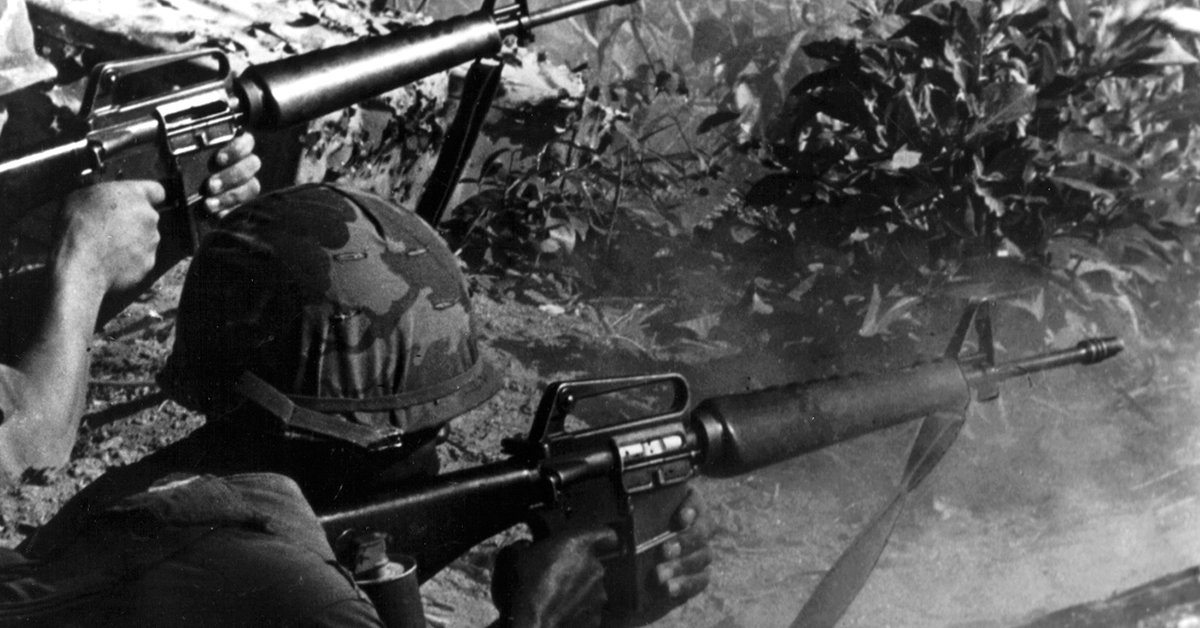
Loc Ninh was a small airbase on the border with Cambodia. It bordered a town of 6,000 that survived on the proceeds of local rubber plantations. The airbase was guarded by a few hundred South Vietnamese regulars supported by 11 U.S. Army Special Forces soldiers. But it would host a 10-day battle that killed hundreds of North Vietnamese while the tiny defense force held its ground.
The small town and airbase were important for two reasons. First, the airbase was a logistical hub for American military and espionage operations; something communist forces were keen to excise. But the town was also the district capital. With a new president awaiting inauguration in South Vietnam, the North Vietnamese wanted to embarrass him before he took office.
Hanoi was looking for a tasty target.
In late 1967, North Vietnamese Senior Col. Hoang Cam was a new commander with a new staff, who needed to test the People’s Army of Vietnam (PAVN) 9th Infantry Division in the field and build up its combat proficiency ahead of larger, corps-level offensives. Cam gave orders to get his regiments in position and supply them for an attack on the base at Loc Ninh.
One of his key units ran into an immediate problem, however. The Americans were working to repair and secure a key highway, Highway 13, and clear out communist forces that could threaten it. U.S. troops had just swept through an area where his top regiment was hiding. That regiment was able to set an ambush just in time and killed 56 Americans, but they also suffered heavy losses and were forced to flee to Cambodia.
So Cam was down a regiment before the battle even started. Still, the numbers were on his side: His men were facing 11 U.S. Special Forces soldiers, 400 Civilian Irregular Defense Group (CIDG) soldiers, and about 200 South Vietnamese regulars. The largest weapons on the base were a few mortars and machine guns. Even after taking heavy losses, Cam had thousands of troops at the ready.
But the North Vietnamese forces failed to hide their buildup. South Vietnamese and U.S. forces intercepted radio traffic, discovered a field hospital under construction, and found elements of a specific unit typically employed in major offensives, the 84A Artillery Regiment. It was clear to the Americans that something was about to happen at Loc Ninh
Even U.S. Gen. William Westmoreland was savvy enough to recognize all this evidence. He suspended some operations and ordered his subordinates to plan for a major defensive operation in that part of Vietnam, especially the district capitals at Loc Ninh and Song Be.
On Oct. 27, 1967, just five days after Westmoreland issued his warning to subordinates, Cam launched the North Vietnamese attack on Song Be. His division attacked a South Korean division but was rebuffed, partially thanks to American artillery and air power. Before South Vietnamese Rangers and American infantry joined the fight the next day, Cam pulled his men back.
As the Rangers looked for the enemy near Song Be, Cam launched a new attack. This time, he struck at Loc Ninh and fully committed to the fight.
Rockets and mortars flew into the base with no warning. The town itself caught on fire, and the South Vietnamese soldiers, with their Special Forces allies, rushed to send their own mortar rounds.
Before reinforcements could arrive, North Vietnamese sappers blew through a wire obstacle and forced the defenders into the southern part of the compound. With the American and South Vietnamese defense collapsing, the Army rushed in UH-1Bs with machine guns mounted, and the Air Force sent in an AC-47 Spooky gunship that rained metal into the jungle.
The helicopters were able to put some fire on the attackers within the compound, but the AC-47 couldn’t strike there without threatening the defenders. Eventually, that became a moot point, as the South Vietnamese called artillery strikes onto the compound.
The Americans specifically called for proximity fuses, detonating the rounds a little above the surface to maximize shrapnel damage—the call you make to shred humans behind light cover. Most, if not all, the defenders were in bunkers that would hold back the shrapnel, but the North Vietnamese, especially those out in the open, were shredded.
The Viet Cong in the jungle finally withdrew under aerial bombing, but attackers remained in the conquered bunkers of the northern part of the compound. The South Vietnamese were forced to clear these bunkers one-by-one with LAWs, light anti-tank weapons.
The allies found 135 North Vietnamese bodies. They suffered eight dead and 33 wounded.
But the U.S. knew it had nearly lost the district that night, and it wasn’t willing to go round two with the same setup. So it not only watched the South Vietnamese clear those bunkers, it flew in two artillery batteries and another infantry battalion. Those infantrymen dug into the jungle and established light bunkers of their own.
The U.S. and South Vietnamese alliance struck back hard, rooting out platoons in the rubber plantations. In one case, an impatient South Vietnamese soldier grabbed a U.S. officer’s pistol from him and used it to attack a North Vietnamese machine gunner. When he couldn’t chamber a round in the pistol, he used it to pistol-whip the machine gunner instead.
This back and forth continued for days. On Oct. 30, the North Vietnamese sent additional forces to threaten other cities and positions, potentially trying to draw away some of the American defenders. But the allies knew the fight for Loc Ninh wasn’t over and sent other forces to protect Song Be and elsewhere.
Just after midnight on Oct. 31, another rain of mortars and rockets flew into Loc Ninh. But this time, the fire was more accurate, and North Vietnamese forces used anti-aircraft fire the moment the helicopters and AC-47 showed up. But artillery rounds proximity fuses were again used to slaughter North Vietnamese attackers.
At least 110 North Vietnamese were killed while the allies lost nine killed and 59 wounded.
The next night, artillery and machine gun fire rained onto the air base, but then the main thrust came at the new infantry base in the jungle. Observers posted in the jungle detonated claymores to blunt the attack but then had to melt away as the communist attackers pressed their assault. The U.S. infantry pushed the attack back in just 30 minutes of concentrated machine gun fire and claymore use.
One U.S. soldier was killed and eight wounded. Over 260 enemy bodies were found, and there were signs that even more had been lost.
Additional forces were flown in, and the U.S. commanders were finally able to go on the attack. The attacks did not go perfectly, however. On Nov. 7, an American battalion moving down a dirt road moved into the jungle and came under a furious assault. An RPG took out most of its command team, including the commander.
One soldier in that fight was Spc. Robert Stryker, who stopped one attack with a well-aimed M79 grenade launcher round, but then died after diving on a grenade to save others. He’s one of the two Medal of Honor recipients for whom the Stryker vehicle is named.
But the 9th Division was finally force to withdraw, ending the First Battle of Loc Ninh. The U.S. lost 50 dead and hundreds wounded, but the North Vietnamese lost somewhere over 850 dead and failed in its objectives to take either Loc Ninh or Song Be.
For the PAVN, the most important reason for the Battle of Loc Ninh wasn’t really taking the area, it was training and preparation. North Vietnam’s Gen. Vo Nguyen Giáp was testing regional capitals to see if he could draw the Americans and South Vietnamese away from major urban areas in time for his next big attack: the Tet Offensive.
Don’t Miss the Best of We Are The Mighty
• Finland beat the Russians so hard we’re still cheering for them 80 years later • That time MacArthur promised to capture a hill or die on it • ‘Ramage’s Rampage’ saw a World War II sub sink 5 ships in 40 minutes
What happened when North Vietnam attacked a Special Forces base
Inside Operation Frequent Wind and the scramble to get US military out of Vietnam
6 songs that will always remind America of the Vietnam War
Green Beret ‘Hatchet Forces’ terrorized the communists during the Vietnam War
A Medal of Honor recipient explains what being an American means
Related Legacy stories
This American flag survived D-Day, then was returned to the US 75 years later
When Howard Vander Beek died in 2014 at the age of 97, he left behind a distinct reminder of his World War II service. Vander Beek, a lieute
Medal of Honor recipient and legendary Vietnam War helicopter pilot ‘Old Snake’ has died
Retired Army Col. Bruce Perry Crandall, the legendary helicopter pilot who was awarded the U.S. military’s highest decoration for valor for
Air Force crew honors WWII-era Flying Tigers with A-10 paint job
It started as a routine transfer. Following an asset transfer from Korea, maintainers at Moody Air Force Base, Georgia, accepted and process