First in VA to receive cutting-edge epilepsy treatment

A groundbreaking laser procedure offers a safer option for epilepsy treatment
Back in 1980, when Robert Lindemann decided to enlist in the Army National Guard at just 17 years old, he was following a proud family tradition.
His father and stepfather had both served in World War II, and for Lindemann, service in the military seemed like a calling. That calling carried him through nearly 33 years in uniform, rising from enlisted soldier to officer before retiring in Texas. But in the years that followed, a quiet battle began brewing, one he didn’t even fully recognize at first.
“I started having episodes where I would lose chunks of time and feel disconnected from what had happened around me,” Lindemann shared. “I thought it might be sleepwalking or exhaustion, but looking back now, those moments were early warning signs that something neurological was happening. At the time I had no idea what was causing them.”
Then, about five or six years ago, the situation became impossible to ignore. Lindemann had a major seizure and was diagnosed with focal epilepsy. He tried numerous medications, but he kept suffering seizures. After years of failed treatment, he was referred to the epilepsy center of excellence at Michael E. DeBakey VA Medical Center in Houston. He underwent numerous tests, including implantation of electrodes into his brain to determine where his seizures were coming from. The seizures were originating from deep in his right temporal lobe. The normal surgical solution for this would be a craniotomy to remove a large amount of his right temporal lobe.
“That’s a scary procedure,” he said. Understandably, Lindemann was not eager to have brain surgery that would remove a significant portion of his brain.
New option, new hope
Everything changed when Dr. Garrett Banks, a neurosurgeon at the Houston VA, approached Lindemann with a different path forward.
Banks told him he was an ideal candidate for a far less invasive procedure using a newer technology, Visualase. This technology has been used at a limited number of leading academic epilepsy centers but has never been used at any VA facility.
Last week, Lindemann became the first patient in the VA system to undergo the procedure, with Dr. Banks and Houston VA’s neurosurgery, neurology and radiology teams working together to make history alongside him.
The Visualase V2 system delivers an extremely precise laser ablation through a slender fiber optic catheter placed through a 3.2mm hole in the skull, a hole smaller than a pencil eraser. Real-time MRI guidance allows surgeons to monitor tissue temperatures moment by moment, making immediate adjustments to protect surrounding brain structures while precisely targeting the problem tissue.
“This minimally invasive procedure isn’t just about small incisions or faster recovery,” Banks said. “It’s about preserving the cognitive abilities, dignity and well-being of the Veteran patient. The Visualase system can treat focal epilepsy with very little trauma, allowing people to return to their lives with less pain, fewer complications and greater confidence.”
First-rate care, first-rate doctors
Two days after the procedure, Lindemann was discharged home, and four days after the procedure, he reported feeling great.
“At the Houston VA, I got first-rate care, by first-rate doctors, with the latest and greatest technology,” he said. “You can’t beat that.”
The contrast with what he had expected—the lengthy recovery and significant risks of open brain surgery—was striking. The tiny incision, the shorter hospital stay, and the speed of his recovery all reflected exactly what the Visualase System was designed to deliver.
Expanding care for Veterans across the VA
Houston VA’s successful first use of the Visualase V2 opens a new chapter in VA’s neurosurgical capabilities, bringing a gentler but powerfully effective alternative to open surgery to the men and women who have served our country. “This is an expansion of what VA can offer to Veterans living with focal epilepsy, deep brain tumors and radiation necrosis across the country,” Banks added. “We are thrilled to be able to offer Veterans this amazing technology and dramatically improve their quality of life.”
For Lindemann, a soldier, an officer, a Veteran, and now a medical pioneer, it’s one more mission accomplished.
Related Health stories
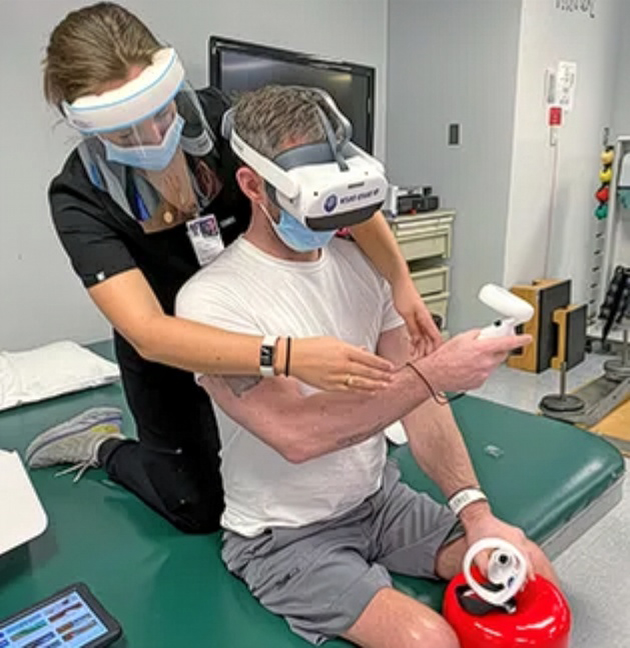
Virtual reality pain treatment expands for veterans
The Department of Veterans Affairs is expanding access to a U.S. Food and Drug Administration-authorized virtual reality (VR) therapy design

Live Whole Health #320: You deserve a break
Do you spend hours jumping between screens, messages and tasks during the day? Over time, this can make your mind tired and your body stiff.

Learn how to make this your day 1 for quitting tobacco
World No Tobacco Day is a great time to reclaim control of your health Quitting tobacco starts with a single decision: choosing your Day 1 f