The Red Star Banner gives families of veteran suicide a new name and national community
Marine Corps veteran and entrepreneur Jerry Shaffer was attending a veterans’ social in Clearwater, Florida. Among the dozens of people at the event was Michelle, a woman from the Bronx, who told him that her husband spent 24 years in the Army and retired in nearby Tampa. Four years later, he took his own life, leaving her alone with twins.
Five years after his suicide, she still hadn’t talked to anyone about it.
Michelle didn’t know what benefits she or her children might be entitled to. What she wished for was simple: something like America’s Gold Star Families, a nonprofit that provided benefits information, resources, and a connection for military families grieving over their lost service members.
She needed an organization that knew how to take care of its own.
“‘There’s got to be one’” Shaffer told her. “Veteran suicide is the biggest crisis we’ve ever had in the veteran community. There has to be an organization that is focused on these families.”
There was not.
Shaffer went home and spent two days scrubbing the internet, looking not only for ways to help the widow, but for the organization she sought. He found TAPS, which does important work across many tragedies and spends roughly a third of its effort on suicide. But nothing existed that was built specifically to create a peer-to-peer network for the families left behind after a veteran or first responder suicide.
The numbers he did pull together stopped him cold. Combat deaths since Korea totaled around 102,000 over 76 years. Veteran suicides since tracking began in 2001 already run far higher, using the 22-per-day VA figure common at the time, roughly 150,000 in 25 years.
Then there are the underreported figures pushing the toll even higher. America’s Warrior Partnership and Operation Deep Dive recrunched the numbers in 2025, finding that the actual number of veterans is more than twice what the VA reports, around 44 per day.
The numbers don’t stop there.
“I was looking at how many people are impacted,” Shaffer said. “And that number is 135. So you have 135 people impacted for every single suicide, and you multiply that by the 16,000 veteran suicides a year; that’s 2.1 million people who are impacted by veteran suicide annually who have no support system for them.”
Family members who lose someone to suicide face three times the risk of suicide themselves, setting off secondary losses and, too often, generational ones.
“That’s why you have secondary suicide; another death because of the pain and grief,” Shaffer said. “And then you’ll have generational suicide where it continues to happen over and over again within a family.”
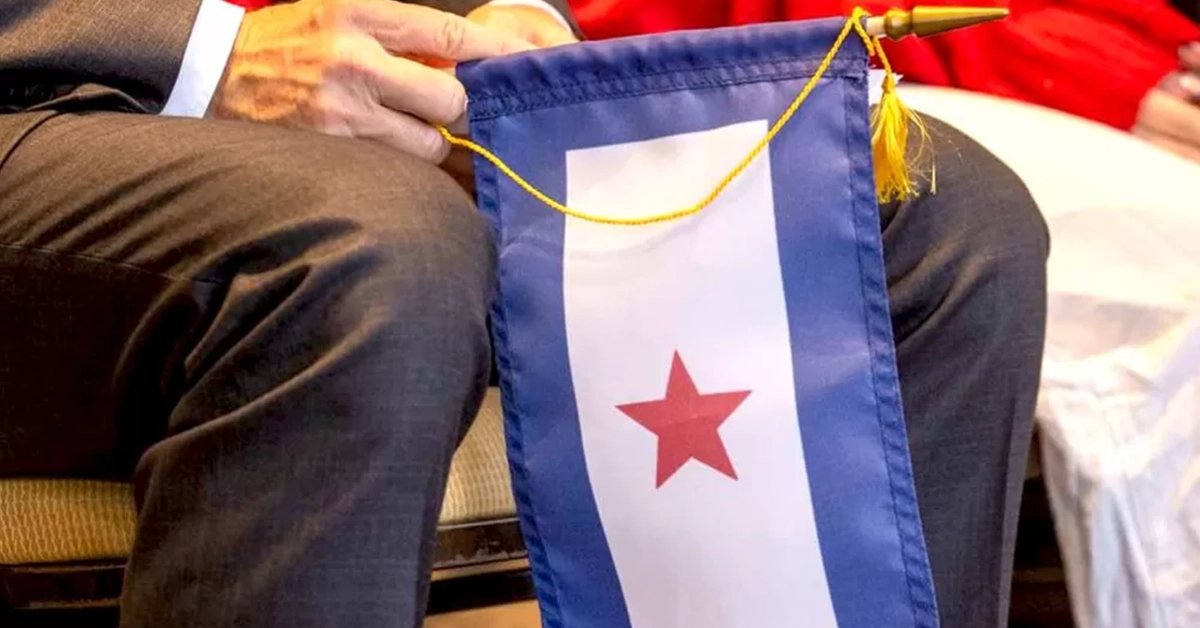
He decided these families needed a community of their own. He decided to start building that community with a symbol they could rally around; a banner that remembers the fallen while raising awareness of the issue: the Red Star Banner.
Shaffer began with the familiar, traditional star banner military families display on their homes: A star on a white field, surrounded by a red border. The star is blue when the military member is deployed, and gold represents a military member who was killed.
After working with the colors, he decided the Red Star Banner for families affected by veteran suicide would feature a red star on a white field, bordered in blue. An inversion of the Blue Star Banner.
Understand: Jerry Shaffer is a savvy guy. He grew up and joined the Marines during the Cold War. He understood that a red star was a communist symbol, and that the name “Red Star Banner” gave a distinctly communist vibe. He worked with other colors for the star, but no other color presented the same patriotism or the same energy as red.
He decided red was the appropriate color. It would be one more thing American troops took back from the communists. This inversion was intentional; emphatic. More service members and veterans have died by suicide in the modern era than from enemy action in many periods. The thought itself was inverted, so the banner should be too.
The Red Star flips the colors for a different kind of loss that has carried far too much silence and shame. We think of fallen service members as killed by the enemy, but more troops have died from suicide than from the enemy in modern warfare. The thought is inverted, so why not make the banner inverted?
“Everything we are doing is very unique,” Shaffer said. “We have the potential and the ability to change the narrative of that Red Star. Where people once thought of it as communist, they now they can think of it as an American staple.”
The banner program is the visible heart of Red Star Foundation. Families receive the flag and a distinctive 3D service pin free if they are next of kin of a current military, veteran or first responder who died by suicide.
Others can request one with a $25 donation that covers production and shipping, along with a letter explaining what the banner represents. And what it represents is the real weight.
“Up until we started this banner, these families have been known as ‘suicide loss survivors,’” Shaffer said. “Now they’re Red Star family members. That’s huge. We’ve had so many families come up to us and say, ‘You don’t know how much better I feel not being called a ‘suicide loss survivor.’ It gave them a whole new identity, a whole new label. That also helps bring the stigma down for the whole community.”
The banner is meant to deliver three things: hope, connection, and recognition. The person who died should be remembered for their service to their country and community. They should not be defined by their last act. It’s an idea that even Congress agreed on.
Led by Michigan Rep. Jack Bergman, a bipartisan group of Representatives introduced H.R. 7815, the Red Star Service Banner Act, in March 2026. It’s a simple bill that establishes the Red Star Service Banner as an officially recognized service banner to remember “the service members and veterans of the United States who have died by suicide… and the enduring sacrifices of their families.
Connections are already starting on the ground in the Tampa area, where the Red Star Foundation will pilot its peer-to-peer network, with the intention of scaling nationally. Although the pilot is encouraging, Jerry Shaffer has already seen the network in action.
“We shot a video two weeks ago,” he recalled. “I invited two Red Star family members; mothers that had never met one another. We’re at the Sarasota National Cemetery with a camera crew. It’s 95 degrees out. When I introduced these families, these two mothers together, they just hit it off, telling stories about their sons… I told the videographer to let them talk. Let them say whatever they want to say, for as long as it takes.”
The first time they met, these two mothers spent an hour talking in the Florida heat, completely forgetting the commercial video crew standing around them.
The Red Star Voices program is building a library of these stories (with at least 100 already planned), including family members, veterans who have lived with ideation or attempts, and others whose lives were touched by suicide in the military, veteran, and first responder communities.
“We’ve shown one Red Star Voices video that we’ve published,” he recalled. “We’ve had two people in a year contact us and say that they were going to take their lives, and after watching that video, they changed their minds.”
Shaffer brings an unusual perspective to the work. He calls himself “a unicorn in the space.” Over two years of attending every local meeting and studying the landscape, he realized most people running suicide-focused organizations have lost someone very close. He has not. That distance, he believes, gives him a clearer analytical and corporate view of what it will take to scale something this big.
Considering the staggering numbers of people affected by veteran and first responder suicide, the Red Star Foundation’s mission to create a support network for them might seem a Herculean task. One Shaffer’s own path prepared him for.
He joined the Marine Corps in 1989 straight out of high school as an 0311 infantryman with a secondary in security forces, guarding nuclear weapons in New Jersey. After his honorable discharge, he played college football at Indiana University of Pennsylvania, who reachedthe 1993 Division II national championship game.
He taught elementary school, then in 2001 founded Leatherneck.com, one of the first online Marine Corps communities. After 25 years of building veteran networks, companies, and nonprofits, including relationships that now reach deep into Congress and major veteran organizations, the foundation and supporting Red Star Families is a unique calling.
“Everybody’s so afraid of suicide, talking about it, bringing it up, mentioning it, that it’s not something that they want to get involved with,” he said. “Local efforts existed, but nothing built a national peer infrastructure focused on these families.”
The Red Star Foundation is trying to change that. The banner is the symbol that families can fly. The peer network and Voices program are the lifelines. Jerry Shaffer’s long-term vision includes education, advocacy, outreach, and partnerships that treat the crisis with the seriousness and scale it demands.
For families still carrying the weight, Shaffer’s message is straightforward:
“They don’t have to suffer in silence… because that’s what’s happened all of these years,” he said. “Stigma has forced a lot of these families not to talk about it, not bring it up. There’s a lot of shame, a lot of guilt, a lot of embarrassment. There are literally millions of other people who are in the same shoes that have been there, done that, suffered the same type of loss.”
The Red Star Banner stands for hope, recognition, and connection; proof that service and sacrifice are still honored, even when the battle ended far from any battlefield.
Families who have lost a veteran or first responder to suicide can request a banner and pin through the Red Star Foundation website.
Don’t Miss the Best of We Are The Mighty
• 6 songs that will always remind America of the Vietnam War • Chinese farmers built a road up an impassible mountain to bring home American airmen from World War II • Military families need more than awareness to address spouse suicides
The Red Star Banner gives families of veteran suicide a new name and national community
A veteran business’ hard-learned lessons on building—and rebuilding—a brand
A former soldier with a TBI found his purpose in helping other veterans
These were the last surviving veterans of every major American war through World War I
Navy veteran David Ayer honors fellow sailor in “Heart of the Beast”
Related Health stories
Virtual reality pain treatment expands for veterans
The Department of Veterans Affairs is expanding access to a U.S. Food and Drug Administration-authorized virtual reality (VR) therapy design

Live Whole Health #320: You deserve a break
Do you spend hours jumping between screens, messages and tasks during the day? Over time, this can make your mind tired and your body stiff.

First in VA to receive cutting-edge epilepsy treatment
A groundbreaking laser procedure offers a safer option for epilepsy treatment Back in 1980, when Robert Lindemann decided to enlist in the A