‘Pressure’ is a D-Day film unlike any other before it
You might have heard about how the weather almost capsized the Allied invasion on D-Day (literally). We’ve told this story. We’ve even shared the incredible planning documents used across branches and nations to plan the attack. Maybe you even know that D-Day was originally planned for June 5, 1944.
So what exactly happened to change the date to June 6, 1944? It was not just a date change—it was an entire logistical campaign adjustment. We are talking an estimated 130,000 to 160,000 troops and 17,000 amphibious vehicles in the first 48 hours alone with over a million troops by July, 1,900,000 tons of supplies via Transatlantic shipments, and 23,400 airborne troops from 822 aircraft and gliders, not to mention a complex deception campaign designed to reinforce the German belief that the Allied landings would be in Pas-de-Calais instead of Normandy.
Years of planning. A tiny window of opportunity. A ticking clock before the Germans discovered the ruse and focused their weapons on Normandy.
And just hours before June 5, an unprecedented—and nearly untraceable—storm threatened to destroy it all, and spell out certain doom for the Allies in World War II.
It all came down to one man, a meteorologist with 1940s resources and a backbone of iron: Captain James Stagg.
“Pressure” is a D-Day film unlike any other. “Saving Private Ryan” and “Band of Brothers” brought the carnage to the screen, but “Pressure” focuses on the tension and decision-making that made Operation Overlord possible.
In the tense 72 hours before D-Day, and with the fate of the free world hanging in the balance,
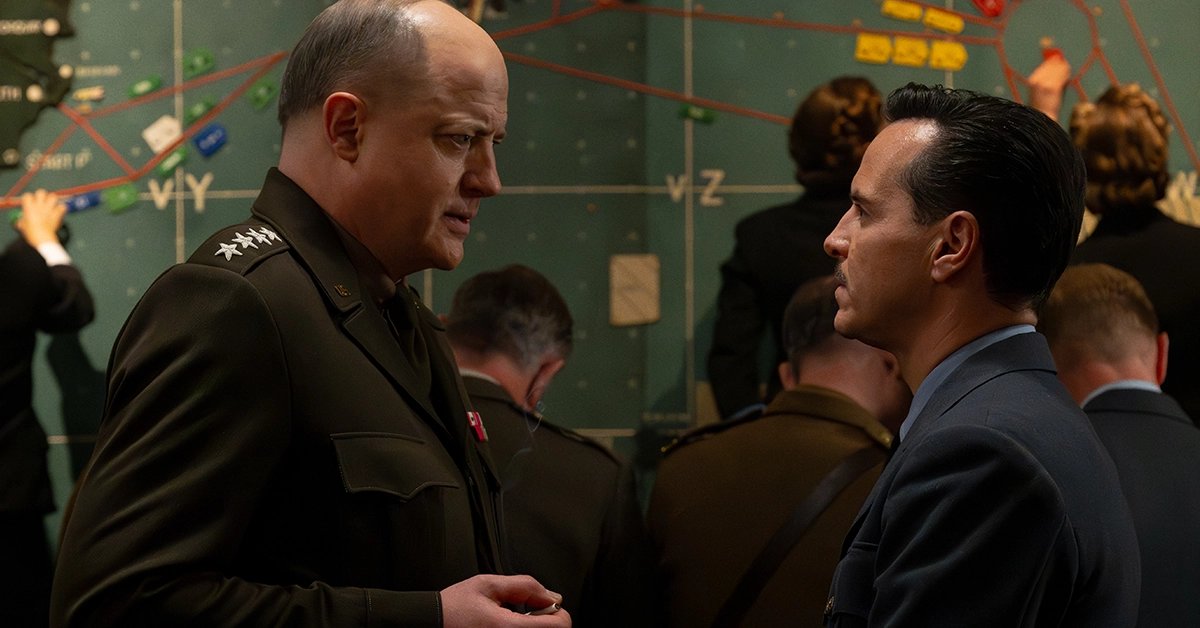
“Pressure” follows Gen. Dwight D. Eisenhower (Brendan Fraser, “The Mummy”) and Capt. James Stagg (Andrew Scott, “1917”) as they face an impossible choice—launch the largest and most dangerous seaborne invasion in history during an unparalleled storm or risk losing the war altogether.
Military films so often focus on valor in combat; it’s rare to see what it is like to make decisions that will mean life and death for the people you are responsible for. Aptly named “Pressure,” the film hones in on the pressure that military commanders are under to choose correctly, to take the information they have and execute a plan under duress—and in this case, under the barometric pressure of unforgiving Atlantic weather.
I had the opportunity to connect with Fraser, who unsurprisingly took the responsibility of playing Gen. Dwight D. Eisenhower—Ike—to heart.
“Ike never fired a shot in anger in his whole career,” Fraser said. “He was promoted and promoted again in his career for many reasons, namely because he was an excellent diplomat and strategist, and, from what I could see, an all around good guy. He cared for the troops intensely, deeply, and I could tell they cared for him too. That respect was earned—not commanded—it was earned. And I like to think that respect itself became a secret weapon against that enemy.”
And Fraser brings that heart to the screen, as he does for all of his projects. General Eisenhower, the Supreme Commander of the Allied Expeditionary Forces in Europe, held the fate of the world in his hands. His choices would determine history.
It’s easy looking back to feel that his victory was inevitable, but it was not. He was a man choosing when to send hundreds of thousands of men to their deaths.
In my interview, I stated that everyone knows General Eisenhower, but that not many people know Ike. He’s not Patton. He’s not Sherman. If you’re expecting ruthlessness, you won’t find it in Ike. But Fraser brings a thundering presence to the character as well as the humanity of a man. A general, yes, but a man, who knew the cost in blood if he erred.
It’s utterly gripping.
“Pressure” began as a play at the Edinburgh Fringe Festival written by and starring David Haig, who also wrote the screenplay for the film. He chose as his hero Dr. James Stagg, a meteorologist from Scotland, who had to go toe-to-toe against Eisenhower to determine the fate of D-Day.
“I’ve been fascinated by James Stagg, his family, and his achievements for the last twelve years,” Haig stated in the official press release for the film. “I was so convinced that it would also be a good film that I wrote the first draft of the screenplay in parallel with the stage play.”
Haig slowly developed the screenplay over many drafts, but it wasn’t until filmmaker Anthony Maras joined in to co-write, direct, and edit the film that the project took flight.
When I spoke with Maras, he told me that while co-writing the screenplay, he became invested in the lessons in leadership he learned from the story.
“What it talks about in terms of how to make a decision under fire, how to make a decision under unspeakable pressure, how to get an answer when no easy answers exist and you don’t know the contours of the space you’re in. I think all of those things are timeless and are also very relevant right now,” Maras reflected.
This train of thought is what makes the viewpoint of “Pressure” so exceptional; war films so often commemorate valor in combat and the hero’s tragic sacrifice during battle—this makes for gripping storytelling and stakes. But it also glorifies war, especially if service members and decision makers jump in with that secret desire for glory.
“Pressure” goes to the moments that are crucial for victory before weapons are ever fired—moments that require clear-thinking, expertise, and wisdom.
“In Stagg you’ve got a character who is really smart, really capable, and can see a little further than the other people in that room. He can see the monster that is coming and no one will believe him. I was interested in exploring a character who knows what he needs to do—he needs to warn them—and they don’t want to hear it,” Maras said.
Fraser commended Scott’s portrayal of Stagg, and while I wasn’t surprised to see another sublime performance from the man who gave us a truly worthy Moriarty in “Sherlock” and a devastatingly hot priest in “Fleabag,” I was still delighted to hear about what it is like to work with him.
“Let me tell you, the actor Andrew Scott has such a centered quality to him. Eisenhower unloads on Stagg, and Andrew Scott… I don’t know, there’s something about him, you might want to ask the Navy, he’s aerodynamic or something. I’m not kidding when I say that my voice raised so loud that the upright piano strings in the room rang. And it went right around him. Smoothly!” laughed Fraser.
Fraser and Scott were joined by Chris Messina (“Argo”) and Damian Lewis (“Band of Brothers”), who played two characters that serve as foils to Stagg’s weatherbell, as well as Kerry Condon (“Better Call Saul”), the lone woman in the room where it happens as Kay Summersby, Ike’s trusted Number Two.
“Kay Summersby was no shrinking violet,” said Maras. “She was out there driving ambulances full of dead bodies during the Blitz and held many different posts throughout the war. She’d seen a lot. She could hold her own in a room full of men and became one of Eisenhower’s closest confidants. I thought Kerry was just perfect to embody a character like this.”
He was right.
Talking with Condon, she told me she hadn’t known about Summersby before she worked on this film. “She was the gatekeeper to Ike. That was fascinating to me that she had worked her way up to someone with so much power,” she reflected. She hopes this film will encourage people to become “more learnéd about history (grave accent included) and that behind the scenes there’s a lot more to it than just the people in charge. They required a lot of courage,” she told me.
She shared that, watching the film, she found it upsetting to think about how many people died and how frightened they must have been. “I have so much respect for what they did for us,” she said.
I agreed that war films should be upsetting. They should be a warning to us.
“This is a film that doesn’t reveal anything, but it does teach us something,” observed Fraser, and I couldn’t agree more.
“Pressure” hits theaters on May 29, 2026.
Don’t Miss the Best of We Are The Mighty
• ‘Jimmy’ Trailer: The Oscars, World War II, and a wonderful life • The immense challenge of teaching World War II in 270 minutes • The National Guard unit that stormed Omaha Beach on D-Day
‘Pressure’ is a D-Day film unlike any other before it
Why grenades in movies look nothing like real life
Tom Hanks’ new 20-part docuseries takes a new look at World War II
How an Army veteran became America’s greatest daredevil
‘Jimmy’ Trailer: The Oscars, World War II, and a wonderful life