The story behind the Civil War sub that sank a Union ship, then disappeared
During George E. Dixon’s time in the Confederate army, he fought at the Battle of Shiloh on April 6, 1862.
On the battlefield in Tennessee, Dixon carried a gold coin that he accepted from a girl earlier in the Civil War. He considered it a good-luck charm, and during that engagement, history appears to show that was true. When a Union soldier shot Dixon at Shiloh, the bullet struck the coin in his pants.
The piece of gold saved Dixon from a potentially serious injury. Dixon was not so lucky when he served as commander of the H.L. Hunley. Two years after surviving at Shiloh, Dixon was inside the Hunley when the Confederate submarine sank a Union warship, the USS Housatonic, on February 17, 1864, in Charleston Harbor in South Carolina.
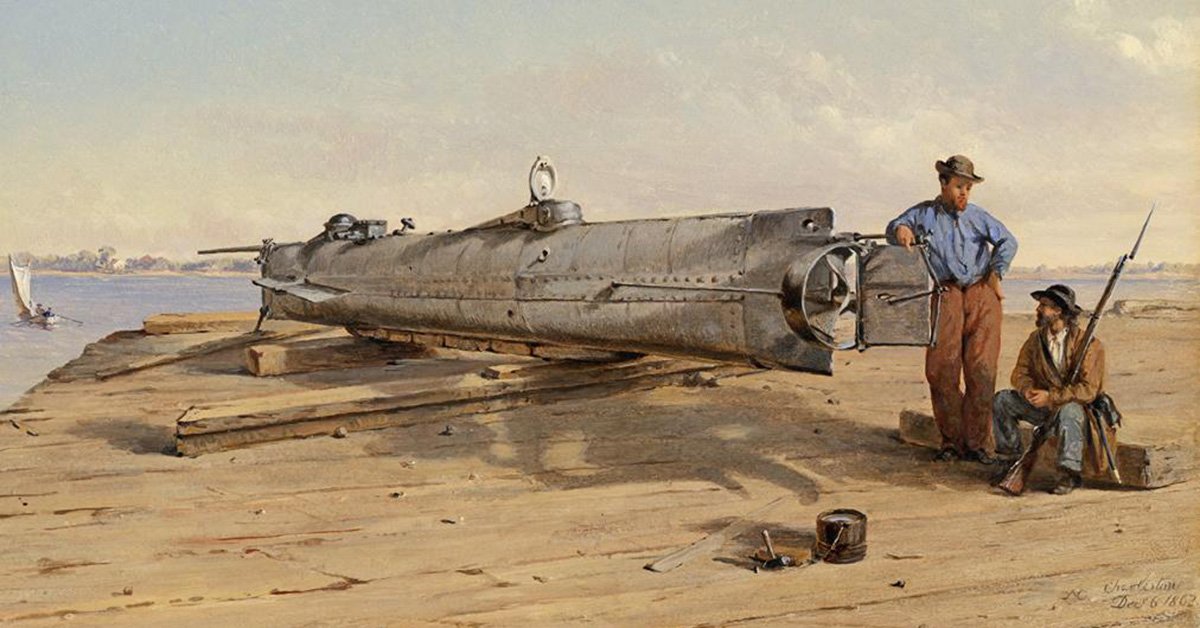
The Hunley made history that night as the first sub to sink an enemy vessel. As Dixon guided the Hunley away from the scene, though, the sub went missing with no indication of what happened. The Hunley’s whereabouts proved a source of fascination for many archaeologists, historians, and the like for more than 130 years.
It was easy to see why.
“There’s a morbid fascination with sinkings and a little bit of the tragedy of it,” Virginia Theerman, a historian and curator of historic textiles at The Charleston Museum, told We Are The Mighty in a recent interview. “There’s also an interest in humans accomplishing things that are incredibly unlikely, so you’re talking about a Civil War-era submarine. That was an incredibly unlikely move.”
The Hunley Sank Multiple Times
Named after Horace Lawson Hunley, an inventor and investor, the Hunley had a checkered past even before its final voyage. In the approximately eight months that it belonged to the Confederate military, it sank three times.
According to Friends of the Hunley, a nonprofit organization, the first instance occurred August 29, 1863, when it sank while moored to the dock. While three submariners survived, the other five died.
Hunley likely viewed that incident as a temporary, albeit tragic, setback. Two months later, he planned to show the sub’s seaworthiness in a demonstration at the harbor. With Hunley in the captain’s seat, he intended to direct the submarine beneath a ship and have it pop back up on the other side. When the Hunley dropped out of sight, it never returned to the surface that day.
It wasn’t until November 7, 1863—three weeks after the October 15 test—until searchers recovered the Hunley. All eight submariners inside died, including Hunley. When they found Hunley, he was holding a candle in the forward conning tower.
The evidence pointed to human error as the likely reason for the second sinking of the Hunley, Friends of the Hunley noted. It said a key valve remained open, allowing water to flood the submarine’s compartment. Hunley probably forgot to shut the valve or couldn’t because he couldn’t find a lost wrench.
“The sub’s keel weights had been partially loosened, which suggested the crew realized they were in danger, but not in time to save themselves,” Friends of the Hunley reported.
The Hunley’s Final Voyage
On both of those occasions, rescuers retrieved the Hunley so the Confederates could deploy it. They did so five months later when the submarine went out on patrol and targeted the Housatonic.
Shortly before 9 p.m., sailors on the Housatonic’s deck noticed an object in the water roughly 35 yards away. While one officer mistakenly thought it was a porpoise, the crew soon knew that it was no animal. The Housatonic sounded the alarm, and bullets from the sailors’ weapons struck the Hunley’s metal hull. They had no real effect.
A torpedo caused an explosion that severely compromised the Housatonic, causing it to sink in five minutes.
Five crew members died aboard the Housatonic, and the death toll would have been greater if not for the quick reactions of the USS Canandaigua. It was the first Navy ship to arrive at the scene and rescued 150 men who served on the Housatonic.
As for the Hunley, it flashed a blue light to shore, alerting the rebels that it successfully sank the Housatonic and was returning home. In response, the Confederates lit a fire to allow the Hunley’s crew to find them easier in the nighttime conditions.
It did no good. The next time that someone laid eyes on the Hunley was in 1995, when divers from the National Underwater and Marine Agency found the wreck. They located the Hunley, covered with mud and silt, four miles offshore and 30 feet below the surface.
Recovery teams did not take the Hunley out of the water until five years later.
The eight men crammed into the Hunley—which was about 40 feet long, 3½ feet wide, and 4½ feet tall—were found in remarkably good shape. When they located Dixon, they discovered a gold coin next to him. It had an indention, consistent with a strike from a bullet, along with an inscription: “Shiloh, April 6, 1862.”
“They Must Be Really Uncomfortable”
Theerman didn’t know much about the Hunley’s backstory when The Charleston Museum hired her. Now she knows a lot more, especially as the museum prepared to open its current exhibit to the public. “The H.L. Hunley: The Personal Stories Behind a Civil War Submarine” debuted this month and will run through April 4, 2027.
The exhibit includes numerous tools and components from the Hunley, along with replicas of the submarine, a bench, and crank. Mannequins of the eight submariners and their artifacts are also on display, Theerman said.
The Hunley’s actual rudder is there too. All of it is displayed in a U-shaped configuration, and there is an interactive component.
“I was walking through the gallery this morning, and a couple were talking about the dimensions,” Theerman informed WATM. “It’s 42 x 48 inside the submarine. They were really looking at the cross section of the submarine and going, ‘Wow, that’s really small. They must be really uncomfortable.’”
Theerman said no one is completely sure why the Hunley sank.
“We do know that the tide was against them, so the working theory these days is that they were trying to get away from the sinking of the Housatonic,” Theerman said. “They didn’t want to get caught, so they were going to wait out the tides and sneak back to shore, and they just miscalculated the air and suffocated.”
Whatever the cause, at least those who invested their energy so heavily in finding the Hunley solved one mystery. They discovered the submarine’s location. Because they did, its crew received a proper burial in 2004.
Don’t Miss the Best of We Are The Mighty
• The Loyal Lee: Robert E. Lee’s cousin took the war to the South with the Union Navy • The Civil War started and ended at the same guy’s house • The vital role that the US Army played in the establishment of Juneteenth
The story behind the Civil War sub that sank a Union ship, then disappeared
The post-Civil War ban on home distilling is heading to the Supreme Court
Why grave robbing Confederate Civil War dead is big business
The Loyal Lee: Robert E. Lee’s cousin took the war to the South with the Union Navy
The Civil War started and ended at the same guy’s house