The tragedy and controversy surrounding Operation Babylift
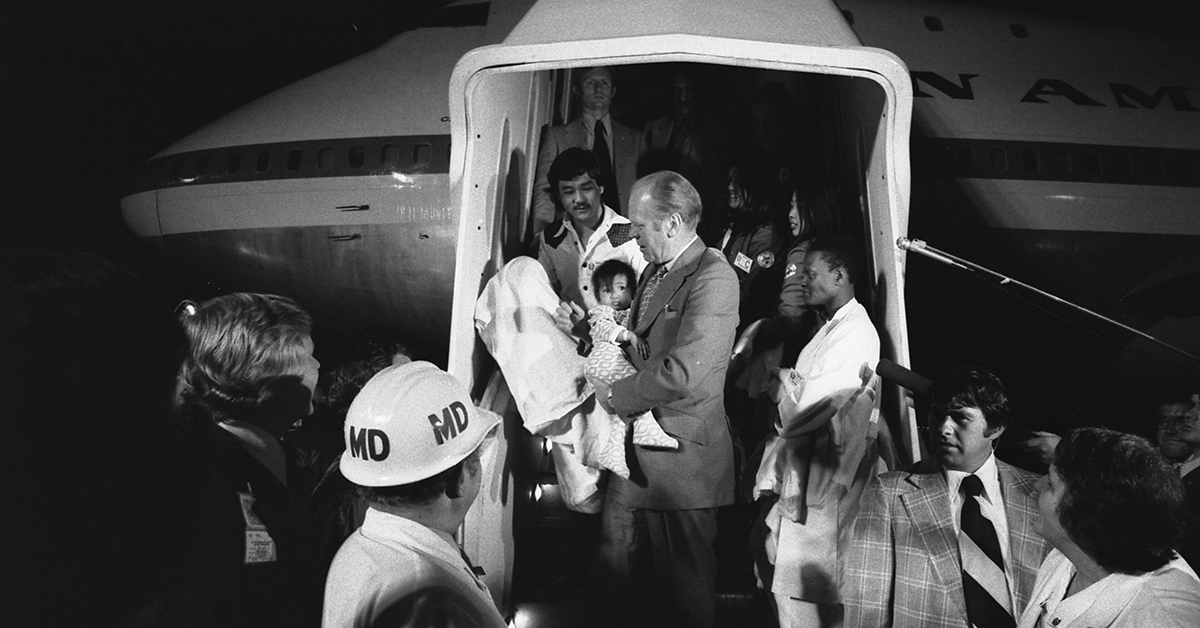
Two years after the United States military pulled out of Vietnam in 1973, the Communists moved ever closer to overrunning South Vietnam.
Before Saigon fell, President Gerald Ford threw a supposed lifeline to children in Southeast Asia that the war left without parents. So on April 3, 1975, he authorized Operation Babylift—a bold endeavor that resulted in the evacuation of roughly 3,300 Vietnamese orphans from the embattled country.
“Everyone suffers in a war, but no one suffers more than the children, and the airlift was the least we could do,” Ford said.
Ford and his supporters equated Operation Babylift with an act of mercy. Some American and Vietnamese citizens hardly saw it that way. From the outset, the operation created controversy. It also encountered tragedy.
The First Transport Plane Crashes
Operation Babylift’s first flight was intended to transport approximately 250 small children out of their embattled country. Nurses, volunteers, and 36 women from the Defense Attaché Office Saigon joined them.
The U.S. Air Force C-5A Galaxy transport plane was in the air for only 12 minutes on April 4, 1975, when its rear cargo door malfunctioned. That failure severely impacted the operation of the aircraft’s tail, prompting the pilots to attempt to return to Tan Son Nhut Air Base.
They didn’t make it.
“We came to a stop, and I thought to myself, ‘I’m alive,’” said Col. Bud Traynor, the pilot. “And so I undid my lap belt, fell to the ceiling, rolled open the side window, and stepped out and saw the wings burning. And I thought, ‘Oh, no, that’s the rest of the airplane.’”
The crash, which occurred two miles from the airfield, killed 138 people—including 78 children. Ford offered his condolences after the crash, but he made one thing perfectly clear.
Operation Babylift was going to continue.
Outside of the Civil War, the Vietnam War divided the American public like no other conflict in the nation’s history. Operation Babylift was no different.
Some saw it along humanitarian lines and the right thing to do. Others considered Operation Babylift as little more than a barely disguised attempt to gain sympathy after a hugely unpopular war. Some also painted the Ford administration as arrogant for believing the Vietnamese orphans were better off in America, so far removed from their homeland and heritage.
And then there was this: Some of the children on those Operation Babylift flights were not orphans at all. It was not uncommon during that tumultuous period for Vietnamese parents to put their offspring in orphanages, because they didn’t have enough money to feed them. They often visited their children there, with no intention of ever giving them away permanently, PBS’s “American Experience” reported.
When some tried to express their concerns to the government, they claimed they were ignored. That lack of response led to Nguyen Da Yen, et al., v. Kissinger—a class-action lawsuit against Secretary of State Henry Kissinger, the federal government, and some adoption agencies.
The suit, filed through the nonprofit Center for Constitutional Rights, claimed Operation Babylift was unconstitutional.
“It constituted nothing more than a final, cynical attempt by the administration to put public relations pressure on Congress in order to win eleventh-hour military aid for the Thieu regime [in South Vietnam],” the plaintiffs alleged. “… No attempt was made to locate the families or friends of many of the children before placing them on the Babylift.”
A Small Number of Reunions
The lawsuit gained little traction in the judicial system.
A judge threw it out, ruling the filing did not meet the standards for a class-action suit. The judge further sealed the records and forbade the plaintiffs from alerting Vietnamese families as to their children’s whereabouts, according to “American Experience.”
In the end, a small number of the Operation Babylift orphans reunited with their Vietnamese families, usually only after years of painful separation. Even so, some considered the mission a success. Others, like University of Washington history professor Christoph Giebel, viewed Operation Babylift as chaotic and in a much less favorable light.
“It assuages the feelings of guilt or acrimony that [the war] caused in American society,” Giebel told the university’s student newspaper in 2025. “We can all unite behind saving the children. It was driven by a healthy dose of white saviorism and was used to displace grotesque violence meted out by Americans over the years.”
The State Department ended Operation Babylift on May 9, 1975.
Don’t Miss the Best of We Are The Mighty
• This Navy aviator escaped his captors during the Vietnam War and lived to tell about it • ‘The Iron Major’: James Capers Jr.’s long road to the Medal of Honor • An Air Force plane crashed in Death Valley during the Cold War (and is still there)
The tragedy and controversy surrounding Operation Babylift
‘Pressure’ is a D-Day film unlike any other before it
Why grenades in movies look nothing like real life
The story behind the World War II aircraft that started Air Force One
9/11 hero Welles Crowther to receive Presidential Medal of Freedom