This is why the 1st Marine Division ships out to ‘Waltzing Matilda’
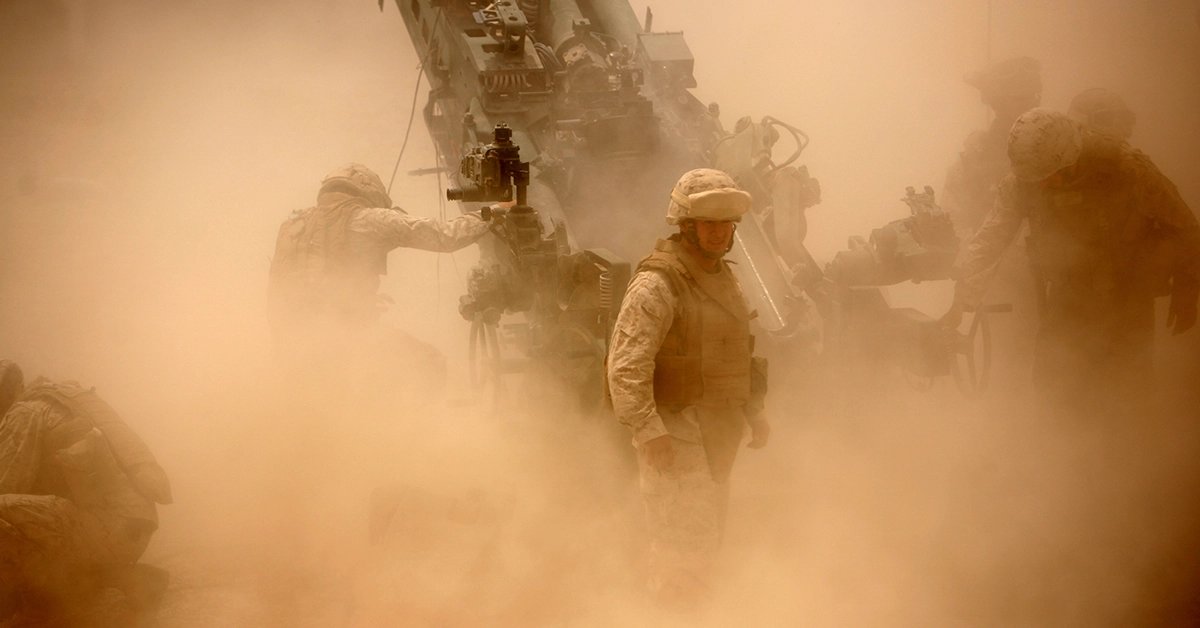
When considering the music that we’d want to play as we ship out to a combat zone, very few of us would think of choosing a 19th century Australian folk song about a hobo who stole a sheep.
And yet, that’s exactly what the Marines of the 1st Marine Division do every time. It may seem odd that United States Marines choose to deploy using Australia’s unofficial national anthem, but a closer look at the history of the unit (and how the song ends) helps make sense of it all.
During World War II, the Marines of “the Old Breed,” the 1st Marine Division, famously began the first Allied offensive against Japan in the Pacific at Guadalcanal. Armed with old Springfield M1903 rifles and meager stores of food and ammunition, the Marines wrested control of the island from Japan in just over six months.
It earned them their first of three Presidential Unit Citations in World War II and a well-deserved rest in Australia.
After the months of fighting and privation, the Marines were looking worse for wear. Sick from dysentery and physically weakened from wiping the floor with the Japanese, the men were just worn out. When they first docked in Brisbane, they were housed in what amounted to a series of shacks in swampland.
When the Marines’ commander, Gen. Alexander Vandegrift, ordered that the entire division be moved, the Navy told him there was no way to spare the number of ships needed—and they had nowhere to go, anyway. That’s where Admiral William “Bull” Halsey and the city of Melbourne came in. Australia’s second-largest city offered to take them with open arms and Halsey would get them there.
Camps of already-pitched tents and bunks were waiting for them as they landed in Melbourne. The sick and wounded were transferred to a newly-finished hospital in nearby Parkville and the rest were given unlimited liberty for the next 90 full days. One account says the citizens of Melbourne even opened their homes to the Marines. It was a mutual love affair for the guys who left their homes in the U.S. to fight with and for the Aussies.
On George Washington’s birthday, Feb. 22, 1943, the Marines marched a parade through Melbourne. During this parade, the 1st Marine Division Band decided to play the Australian folk favorite, “Waltzing Matilda.” The Australian onlookers loved it and cheered loudly for the procession.
Thus began the love affair between the 1st Marine Division and Australia.
When winter came, the Australians even gave the Marines their winter jackets, which were soon adopted by the USMC uniform board (no small feat). This is also where 1st Marine Division’s now-famous blue diamond patch was designed. Aside from the the red “one” and “Guadalcanal” markings, the patch also features the constellation Southern Cross, which is a symbol of Australia.
Every camp set up by the 1st Marine Division is called “Matilda.” The division’s official song to this day is “Waltzing Matilda.”
The Australians were jubilant for the Marines’ victory on Guadalcanal. It was bad news for the Japanese who had invaded nearby Papua New Guinea, an Australian protectorate. After their rest, the Marines’ next move prevented the Imperial Japanese Navy from invading mainland Australia by taking the war to them yet again, invading New Guinea via Cape Gloucester.
As for the sheep thief in “Waltzing Matilda,” he was confronted by police for his theft and refused to surrender, instead throwing himself into the nearby body of water, a billabong, to evade capture and then haunting the site forever.
Don’t Miss the Best of We Are The Mighty
• How ‘Major Payne’ became a Marine Corps comedy classic • This Marine Corps veteran codified the modern handgun shooting technique • Why the Marine Corps only uses six body bearers for funeral ceremonies
World War II
World War II
This is why the 1st Marine Division ships out to ‘Waltzing Matilda’
World War II
Meet the dog who went from a family pet to a World War II hero
World War II
The immense challenge of teaching World War II in 270 minutes
By Daniel Tobias Flint
World War II
The National Guard unit that stormed Omaha Beach on D-Day
World War II
The story of 4 brothers who served on the Juneau with the Sullivans