What the WWII secret agent who rescued my grandpa can teach us about protecting democracy
The views and opinion expressed in this article are those of the author and do not necessarily reflect the views or positions of any entities mentioned.
On a summer day in the French Alps, Peter Ortiz made a decision. Surrounded by more than 100 Germans with machine guns, the 31-year-old American Marine major stepped into the open and called out in German, French, and English, waving a makeshift white flag.
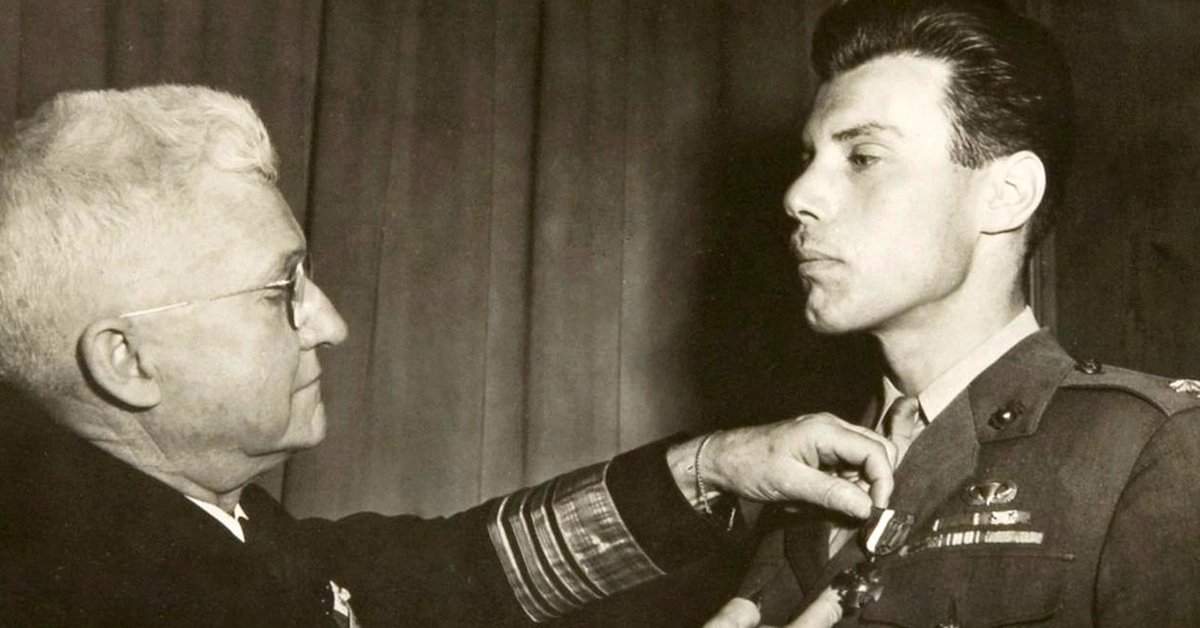
Ortiz, a commando in the Office of Strategic Services (OSS), had parachuted into occupied France twice in the previous six months on secret missions to arm and mobilize the French Resistance in support of the Allied landings. While he had many covers, the tall, tanned commando with bright blue eyes and perfect French regularly appeared in his Marine Corps uniform.
His bold work training resistants, rescuing downed airmen, sabotaging Nazi infrastructure, and spying had earned him a place on the Gestapo’s most-wanted list. As he attempted to surrender, he was confident that the Germans would realize who he was—and that he would be tortured and killed, not warehoused as a prisoner of war.
Standing face-to-face with the enemy officer in charge, Ortiz explained that he and his men would turn themselves over on one condition: that the Germans spare the village of Centron. He knew that if he escaped through Centron, its residents would face brutal reprisals, as had been the case with several nearby villages the Nazis had recently massacred.
Pierre “Peter” Ortiz was the most battle-in decorated member of the OSS, America’s first intelligence agency. He also acted in many of his war buddy’s—director John Ford’s—films, and even inspired a few 20th-century movies with his World War II exploits.
Yet, as it goes with many heroes, most Americans don’t know his name. I only learned about Ortiz because, three months before he surrendered in Centron, he rescued a downed American pilot named 2nd Lt. Murray Simon. That pilot—a 23-year-old Jewish New Yorker—was my grandfather.
Ortiz led my grandpa through France in a stolen SS staff car and aboard trains with Nazis. Following a treacherous trek across the Pyrenees and stops in Spain and Gibraltar, they arrived in England days before D-Day.
As America celebrates its 250th, Ortiz’s story offers three lessons we would do well to remember:
He treated his privilege as a responsibility.
It would be fair to call Ortiz a “nepo baby.” He was born on New York City’s Upper East Side in 1913. His father—an impeccably dressed Condé Nast executive—helped found Vogue Paris and insisted that his son go to boarding school in France. Ortiz could have eschewed military service.
Instead, like many members of the Greatest Generation, he sought it out: At 18, he ran away from school to enlist in the French Foreign Legion against his father’s wishes. He fought in the deserts of North Africa and on the front lines of France in 1940 against the Germans. He docked in New York the day after Japan attacked Pearl Harbor. He was so eager to join the U.S. military’s fight against fascism that, while awaiting a commission, he enlisted in the Marine Corps. He had seen firsthand what Hitler was capable of and acted accordingly.
He leveraged symbolism—for the right reasons.
Ortiz wore his custom-tailored Marine uniform behind enemy lines in France. The guerrilla fighters he was training in the mountains had spent years under occupation. They lacked supplies, training, and faith that help was coming. The sight of a valiant American openly in uniform was a powerful statement: the Allies had not forgotten them.
Ortiz’s uniform was, in effect, a morale boost and a signal of solidarity. He also wore his French Foreign Legion ribbons—a symbol that he had not only come to fight for France but with her.
He embraced allyship.
While Ortiz can come off as a lone hero, closer examination reveals a team player who understood that unprecedented challenges demanded unprecedented collaboration. His missions were made possible by coordinated teamwork among American, British, and French military and civilians—people from different cultures uniting around a common goal. As Churchill said in June 1941, six months before America joined the war: “United we stand. Divided we fall. Divided, the dark age returns.”
Ortiz’s legacy is more than a thrilling saga of a real-life James Bond who aggravated the Nazis. He stands to remind us that nations cannot win wars alone, but that righteous individual actions toward a common cause can make a difference.
America would be better served by leaders like Ortiz—people whose courage operates in the shadows rather than in front of cameras, who sacrifice for others rather than accumulate glory for themselves. The heroes worth teaching our children about are rarely the ones demanding to be remembered and made eternal in marble.
This August, I traveled to France to join the villagers who still gather to remember the Marine whom most Americans have never heard of, after whom Centron’s town plaza is now named. Ortiz’s story is one we can’t afford to forget or misread. True heroism, he showed us, sometimes looks like surrender.
I keep thinking about what Elie Wiesel said: “That we have memories is important. What to do with them is equally important.”
Don’t Miss the Best of We Are The Mighty
• It’s time for the VA to recognize spouse proxy for catastrophic veteran illnesses • The ongoing DHS shutdown is a slap in the face to those who protect America • Military promotions should not be political leverage
If you would like to submit an opinion for publication, it must be exclusive to We Are The Mighty. It should be a strong argument about an issue affecting the military, veterans, or the greater military-connected community, and between 400 and 1,000 jargon-free words.
Send submissions to info@wearethemighty.com. Please include an email address and phone number. We will protect the identities of current military members who wish to publish an opinion.
What the WWII secret agent who rescued my grandpa can teach us about protecting democracy
By Katie S. Sanders, Author and Journalist
Military spouse business owners shouldn’t have to start over online with every PCS
America doesn’t win alone: Supporting our wartime allies
By Jerritt Lynn, Director, Membership and Communications, IAVA
Active duty military spouses vote 25 points below civilians. The federal government has never asked why.
By Raleigh Smith Duttweiler, Chief Impact Officer, NMFA
‘Republican Motherhood’ and the civic responsibility of educators in preserving American history
By Daniel Tobias Flint