The last light tank the Army had actually wasn’t bad
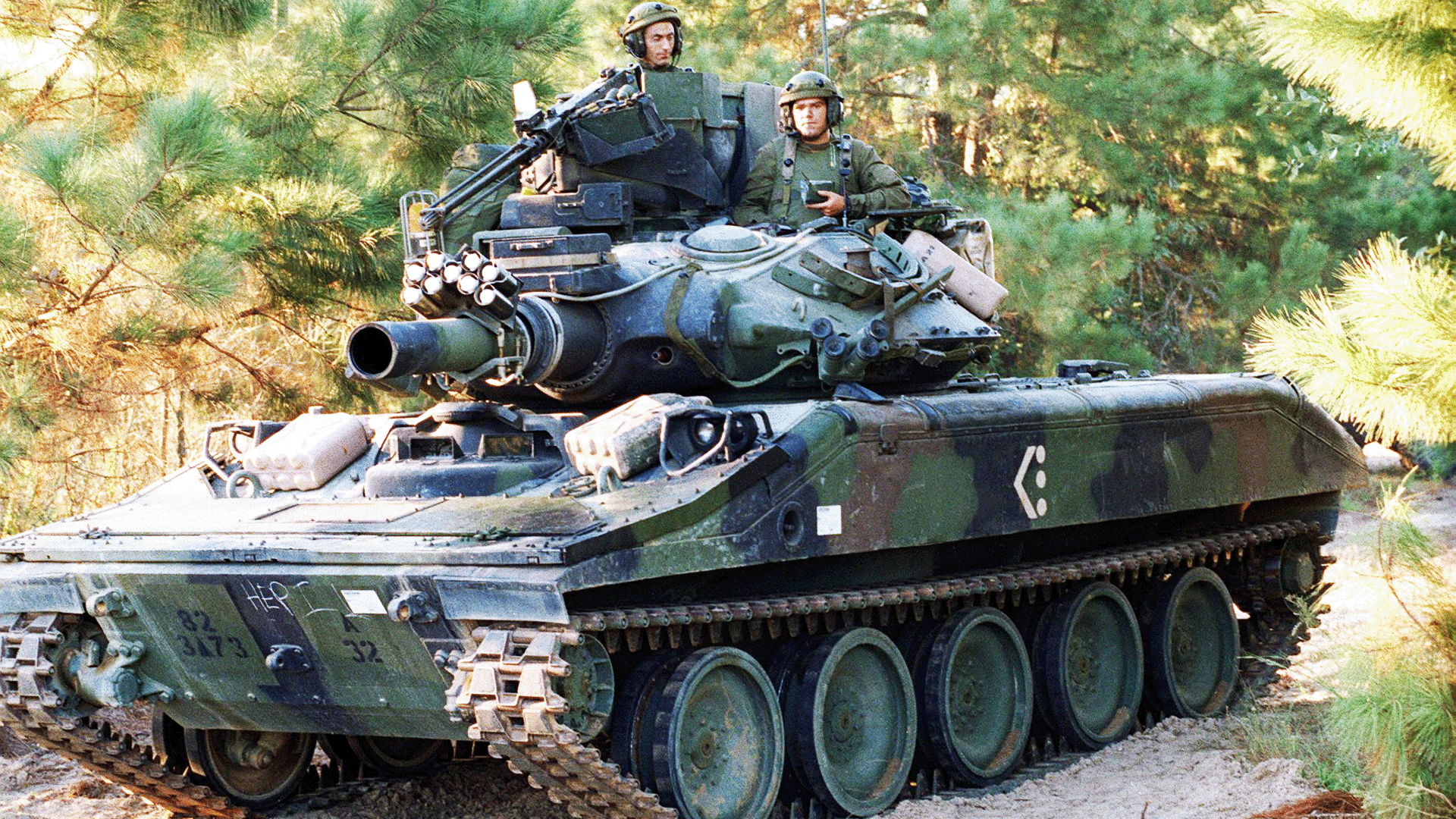
The Army has been on an as-of-yet unending quest for a true light tank or mobile gun capable of landing behind enemy lines alongside airborne troops. Just last year, the service canceled the M10 Booker — a light tank that never was. And that’s hardly the first of its weight class to end up in the Army’s boneyard — there’s the M56 Scorpion and the M50 Ontos, to name two. It hasn’t been since the M551 Sheridan that the service got what it needed out of a light tank, and even then, only kind of.
In 1959, the Army decided to move on from the Scorpion, which it began fielding in 1953, and began designing a new light tank. Leaders wanted something that was air-droppable and amphibious, so it had to be under 17 tons, but also capable of going up against and surviving Soviet T-62 main battle tanks, so it needed armor and a big gun.
You don’t need an engineering degree to see the problem here. Heavy armor and a heavy gun are, well, heavy. So, keeping the tank light enough to survive a parachute drop meant compromises had to be made.
The hull was constructed out of 7039 aluminum alloy. Using aluminum alloys for armor isn’t uncommon. The M113, early Light Armored Vehicles (LAVs), and even modern-day MRAPs use it. The alloys of today are far more capable, though, and nobody expected M113s and LAVs to fight T-62s.
In case they did encounter Soviet tanks, the Sheridan boasted a massive M-81 152mm gun launcher that could also fire an early guided missile called the MGM-151 Shillelagh. The M81 was lightweight at just 1,080 pounds, compared to the 2,800-pound M68 105mm gun found on Patton tanks.
In 1967, the M551 entered service with the Army to give soldiers in Vietnam a better tank for the jungles than the M48 and M60 Pattons. However, because there weren’t enough 152mm shells available, the tank didn’t arrive in country until 1969.
Army Gen. Creighton Abrams, for whom the M1 Abrams is named, placed the Sheridans with the 3rd Squadron, 4th Cavalry Regiment, and 1st Squadron of the 11th Armored Cavalry Regiment for soldiers to test in combat.
Almost immediately, complaints emerged of thin armor susceptible to mines from below and heavy caliber machine guns everywhere else. They’d often catch on fire when hit, driving crews to add improvised armor like sandbags, logs, steel plates, and anything else that could potentially extend their lives.
The 152mm gun was the tank’s saving grace. In close-up engagements against fortified positions, as was common in the jungle environment, it performed exceptionally well. Soldiers grew to appreciate its ability to get close due to its light weight and blast through bunkers.
Sheridans stayed in country until the last combat troops left in 1973, and they left a mixed legacy. The tanks weren’t particularly great at any one thing, and most soldiers seemed to prefer the Patton tank, but Sheridans weren’t designed with Vietnam in mind.
After Vietnam, the Soviet threat was still very real, and Sheridans remained in service. Despite being built to kill Soviet tanks, the Sheridan wouldn’t have been very good at that, either.
The gun velocity was too low to do much damage at any meaningful range. Firing it would also damage the sensitive electronics of the Shilleleigh missile. The rate of fire was also abysmal because of the recoil, which was so extreme the front of the tank would lift off the ground. Crews could only fire about two rounds a minute because of that, compared to the M48 Patton which could pump out as many as 17.
Top Stories This Week
Event honoring servicewomen canceled after most branches decline to attend
Pentagon cuts 180 faiths from recognized religion list
Rescue mission to remote Atlantic island included rare tandem jump
Despite not really doing anything that it was designed to do, the Army kept the Sheridan in service because it had nothing to replace it with. In hindsight, that wasn’t the worst decision, because in 1989 the Sheridan found its calling in Panama during Operation Just Cause.
It is over Panama where the Sheridan performed its first and last combat jump with the 3rd Battalion, 73rd Armored Regiment. This is also the first and only combat jump of a light tank anywhere.
Despite some problems with the drop, once on the ground, the tank’s large gun once again proved its worth, destroying fortifications and roadblocks. The presence of tanks also provided a psychological blow to the Panamanian soldiers who encountered them.
The Sheridan’s lightweight, high speed of a reported 43 miles per hour, and big gun gave soldiers a mobile gun system that could keep up with them as they tore through the small Central American Country.
This would prove to be the high-water mark for the Sheridan. Though it was deployed during Operation Desert Storm in 1991, it was mostly used for security and reconnaissance purposes.
Following that, some of the tanks were sent to the National Training Center at Fort Irwin, Oklahoma, where they served as opposing forces. Dressed up as the Soviet tanks it was meant to fight, Sheridans helped train future generations of armor crews until it was finally retired in 1997.
The Sheridan is often ridiculed and derided, but nobody has been able to make a better version, and it did serve faithfully in three different conflicts. Every attempt to replace it since, like the M8 armored gun system and the M10 Booker, has failed, and the Army still does not have a light tank.
We discuss the misunderstood marvel that is the M551 Sheridan in depth on our YouTube channel, which you can check out here.