The ‘Purple Heart Battalion’ fought Nazis abroad and injustice at home
A month after the Japanese attacked Pearl Harbor, the United States Army took a drastic step amid the fear and hysteria gripping the nation.
In January 1942, it booted out all Japanese American soldiers and ROTC cadets from the service. Upset by the decision, a group of Japanese American cadets in Hawaii pleaded their case to the state’s military governor.
“Hawaii is our home, the United States our country,” they implored, according to a 2025 article on the Army’s website. “We know but one loyalty, and that is to the stars and stripes. We wish to do our part as loyal Americans in every way possible, and we hereby offer ourselves for whatever service you may see fit to use us.”
The discrimination didn’t stop there. In February, President Franklin D. Roosevelt issued an executive order that placed approximately 120,000 Japanese Americans into internment camps. Stripped of their freedom, they endured the fallout of a heinous attack they didn’t commit, all because of their heritage.
Their government’s actions did not strip many of them of their willingness to serve. About 33,000 of them either enlisted or were drafted during World War II. Japanese Americans fought heroically for the country of their birth. Most of them served in the 442nd Regimental Combat Team, which included 21 Medal of Honor recipients.
The 442nd suffered so many casualties that it became known as the “Purple Heart Battalion.”
“Remember Pearl Harbor”
In mid-1942, the Army formed the 100th Infantry Battalion. It was composed of 1,400 Hawaii National Guardsmen. These Japanese Americans were known as Nisei, a Japanese word pronounced “NEE-say” and meaning “second generation.” White officers commanded them, and the battalion chose the motto “Remember Pearl Harbor.”
While the 100th battalion acquitted itself well on battlefields in Europe, it sustained heavy losses. Help was on the way. Roosevelt activated the 442nd Regimental Combat Team on February 1, 1943, and a couple of months later, these Nisei soldiers went to Camp Shelby, Mississippi, for training. The drills lasted almost a year for some soldiers; others were called into active duty sooner than planned to help out the 100th.
The 442nd initially saw combat in Italy in June 1944, successfully causing the retreat of German forces there. It then assisted in helping the Allies capture Rome before moving on to France. In August, the 100th Infantry Battalion became the 442nd’s first battalion.
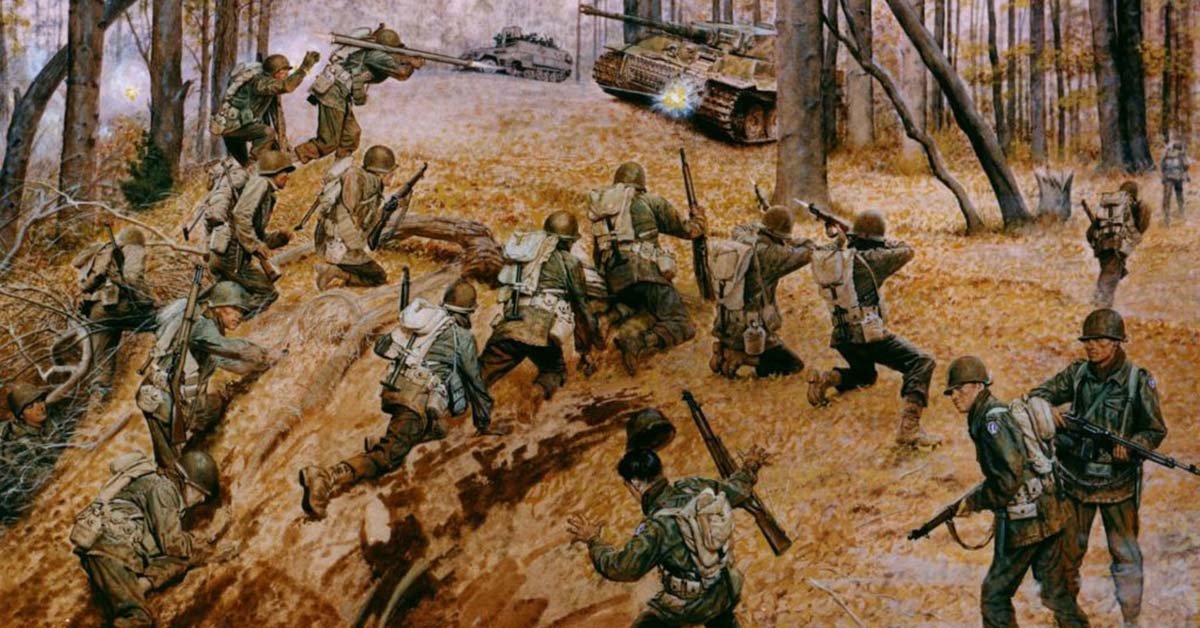
In late October 1944, the Japanese American soldiers in the 442nd found themselves in the Vosges Forest along the French-German mission. The 141st Infantry Regiment needed rescuing after the Germans trapped them. It was the 442nd’s task to free the “Lost Battalion.”
Saving the “Lost Battalion”
Just like the 100th Infantry Battalion, the 442nd Regimental Combat Team also had a motto. They adopted the moniker “Go for Broke.”
The Nisei soldiers refused to allow the injustice and prejudice they endured to affect their military service. For two seemingly endless days, they battled dense foliage and icy rain as they attempted to avoid setting off German mines. As they neared the ridge where the Germans had more than 270 members of the 1st Battalion, 141st Infantry Regiment, 36th Infantry Division surrounded, the enemy unleashed artillery fire, the National Museum of the U.S. Army reported. The 442nd sustained several casualties but kept fighting.
The 442nd launched several attacks, but could not save the Lost Battalion. Finally, after the Nazis killed one of his fellow Nisei soldiers, Pvt. George Sakato charged the enemy. By himself, he killed 12 Germans, wounded two more, and personally captured four others. Sakato also helped his platoon detain 34 Germans as prisoners.
“As a unit, we were used like cannon fodder,” Sakato later said. “… I was willing to die for my country.”
The same day, Pvt. Barney Hajiro charged a slope ominously called Suicide Hill. Hajiro took out two machine-gun nests and killed two snipers while dodging fire.
Sakato and Hajiro epitomized the fierce resolve of the 442nd’s soldiers. That determination finally paid off six days into the intense fighting when they saved the Lost Battalion.
Serving Despite Intense Prejudice
The 442nd became one of the most decorated units in U.S. military history. Its soldiers accounted for not only nearly 9,500 Purple Hearts, but also 4,000 Bronze Stars, 560 Silver Stars, and seven Distinguished Unit Citations (later renamed the Presidential Unit Citation).
On June 21, 2000, President Bill Clinton told the story about a soldier in the 442nd Regimental Combat Team who died in France late in the war. A chaplain discovered a letter in the dead service member’s uniform. It detailed how someone burned down the Japanese American family’s home in what they wrongly considered an act of patriotism.
During that ceremony, Clinton awarded 21 Medals of Honor to Japanese-Americans. Nineteen of them served in the 442nd Regimental Combat Team or the 100th Infantry Battalion.
Seven living veterans attended the ceremony, including Sen. Daniel Inouye. The president touched on the bigotry and hatred these men faced.
“Their own country had dared to question their patriotism, and they would not rest until they had proved their loyalty,” Clinton said. “As sons set off to war, so many mothers and fathers told them, ‘Live if you can; die if you must; but fight always with honor, and never, ever, bring shame on your family or your country.’
“Rarely has a nation been so well-served by a people it had so ill-treated.”
Don’t Miss the Best of We Are The Mighty
• A former violinist singlehandedly cleared a mountain fortress during World War II • Meet the one-legged spy who helped rid the world of the Nazis • The Marines and the rare rifles you didn’t know were at D-Day
World War II
The ‘Purple Heart Battalion’ fought Nazis abroad and injustice at home
This might be the best EDC handgun for troops who carried the M9
World War II
How ‘Axis Sally’ became the first woman convicted of treason against the US
Mighty MilSpouse
Georgia families slam privatized military housing for dangerous living conditions in new report
A National Guard veteran helped take down the Butler County Trump shooter with a PSA rifle