Why the Navy says it wants 15 battleships
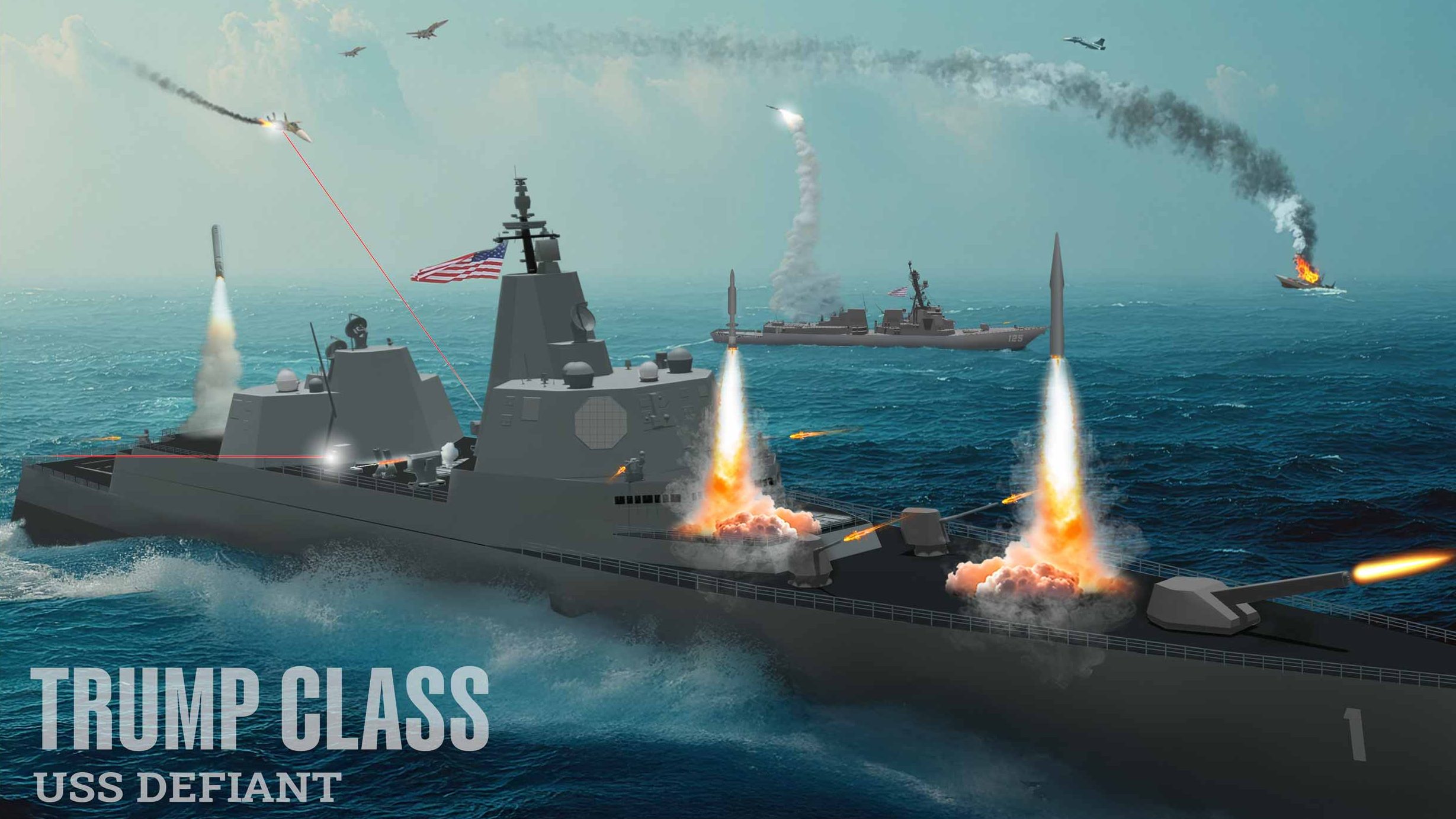
To get more missiles and advanced technology like lasers and rail guns out to sea, the Navy wants to see 15 Trump-class “battleships” built over the next 30 years.
The BBG(X), as it is listed in the Navy’s new 2026 shipbuilding plan, would be a nuclear-powered surface combatant built around long-range fires, command and control, and future weapons that current surface vessels like destroyers may not have the space or power to support. The plan shows 15 BBG(X) purchases across its 30-year procurement profile, getting started with three between fiscal years 2027 and 2031 at a cost of $43.5 billion, or $14.5 billion per hull.
This is just a proposal, and a lot has to happen — congressional approval, shipyard capacity, weapons development — to make even a single BBG(X) a reality.
Even as a proposal, the plan for these battleships suggests that at least some in the Navy think the surface fleet needs something bigger and more heavily armed than today’s destroyers.
Arleigh Burke-class destroyers have become the workhorses of the fleet, engaging in fighting in the Red Sea, the Strait of Hormuz, and the Persian Gulf in the past few years. Burkes boast the Aegis combat system, air-defense missiles, land-attack weapons, anti-submarine systems, and the sensors needed to protect carriers, amphibious ships, and everything else in the fleet.
But the Navy’s plan says that the ships have reached the limits of their capacity, and that a planned next-generation DDG(X) would require “undesirable capability and weapon systems compromises,” which sounds like a problem.
According to the Navy, the BBG(X) is the answer to that problem.
The warship is described as the high end of a future “high-low surface fleet mix.” With deeper magazines, more power, more internal volume, and future weapons, the BBG(X) is intended to sit at the top of that mix, with smaller vessels and unmanned systems filling out the rest.
One of the arguments for the BBG(X) is magazine depth. Ships can only fire the missiles they carry. Once an Arleigh Burke-class destroyer’s vertical launch system (VLS) cells are empty, they need to be reloaded, and that has traditionally meant returning to a port or a major naval installation.
However, there are other ways to address concerns over magazine depth. A modern Flight III Arleigh Burke carries 96 Mk 41 VLS cells. The Navy’s shipbuilding plan buys seven DDG-51 destroyers for about $25.3 billion through fiscal year 2031. That is 672 VLS cells spread across seven ships.
Early information on the BBG(X) gives them 128 VLS cells. If that holds, five Trump-class battleships would have 640 VLS cells, or 32 fewer than the seven Burkes, while costing $72.5 billion if each vessel costs $14.5 billion.
That comparison is not a perfect one. The BBG(X) may carry larger weapons, newer launchers, hypersonic missiles, and other systems that destroyers cannot.
However, concentrating so much firepower onto one hull has opened the BBG(X) to criticism. Amidst the proliferation of small drones and low-cost means of long-range strikes, such as the Shahed, there’s the possibility that any large vessel could just end up being a very large target.
Top Stories This Week
19-year-old soldier completes Ranger, Airborne, Air Assault and Pathfinder schools
Security Forces airman becomes first Air Force graduate of Army’s revived jungle school
One dead, others wounded in shooting at Fort Hood recreation area
To defend itself from those threats, BBG(X) plans to employ rail guns, high-energy lasers, and other measures, some of which aren’t past the prototype stage. Electromagnetic rail guns are a cautionary example of betting on boundary-pushing weapons. The Navy spent $500 million on the concept before shelving the program in 2021 to focus on hypersonics, directed energy, and other programs.
The Navy is also trusting that domestic shipbuilding capacity will increase. Despite doubling spending on ships over the past 20 years, this has not happened, and the Navy’s surface fleet is smaller than it was two decades ago.
Building advanced warships is complicated. It requires not just a lot of space, but a large, skilled workforce. This has been a challenge facing shipbuilders for years, though efforts are underway to remedy it.
The Navy also plans to ask Congress to change rules around building ships overseas. In the shipbuilding plan, leaders want to build up to two auxiliary ships in foreign yards and want to explore building “large-scale, non-sensitive modules (i.e. hull structures) in allied overseas facilities” to then be transported to the U.S. for outfitting of the sensitive components.
These proposals would certainly help, but building a large, first-of-its-class warship with several advanced systems running off nuclear power will not be easy, even with ideal conditions. Other recent shipbuilding efforts, like the Constellation-class frigate, Zumwalt destroyer, and Littoral Combat Ships, do not inspire confidence.
The Navy may need more missiles, power, and room for new tech that current vessels can’t support, and the BBG(X) provides all that, on paper. But the Trump-class plan requires that weapons development works as intended, shipyards ramp up, and Congress continues to approve funding, among other things. And that’s a lot of things that have to go right for this to work out. If you want a deeper dive into this, we break down the good and the bad in the battleship plan on our YouTube channel, which you can watch here.