A final public flight for the Marine Corps’ legendary Harrier jet
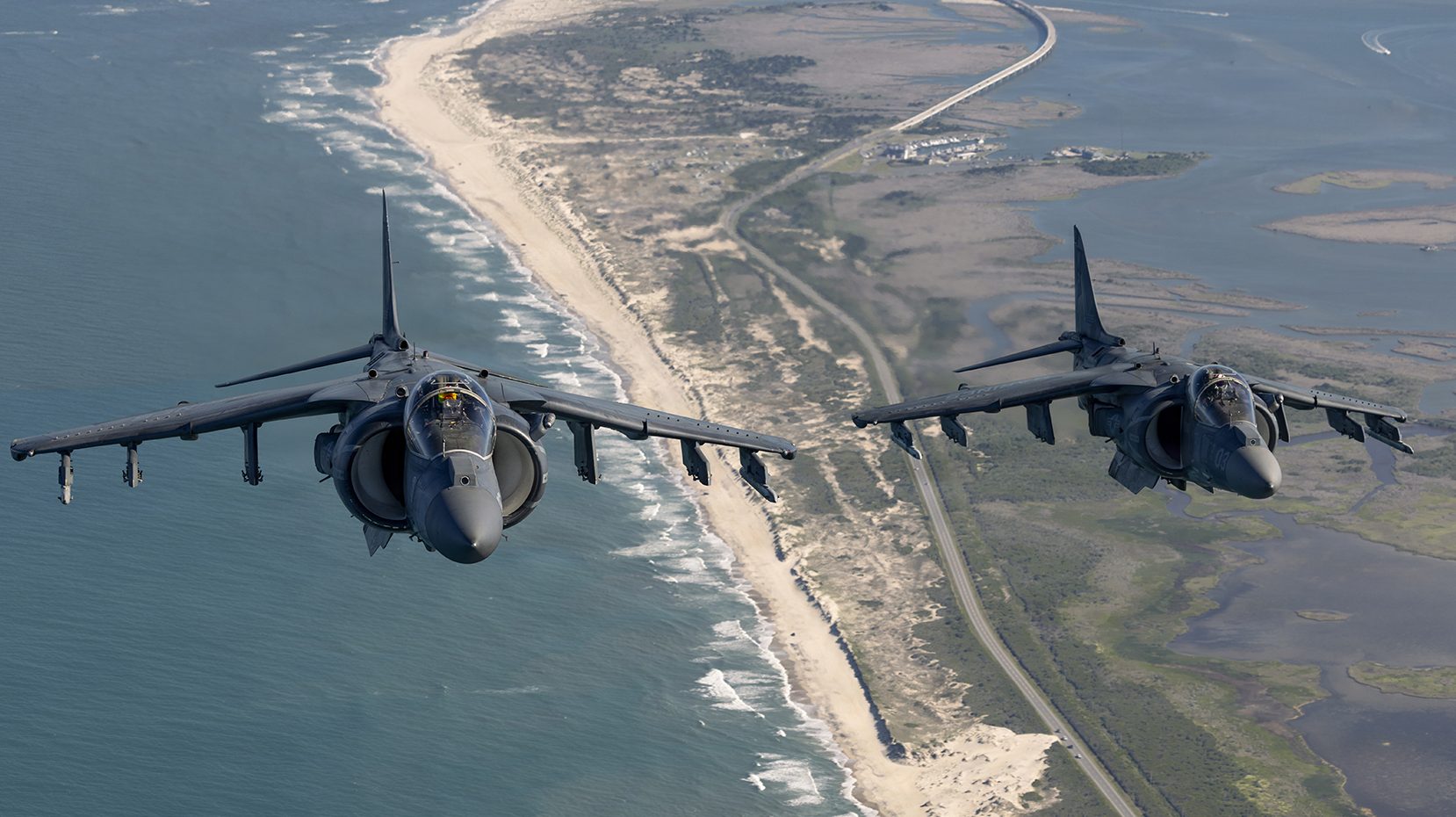
A flight of the Marine Corps’ legendary AV-8B Harrier IIs, ground attack jets that can take off and land vertically, will make a final public flight this week to mark the aircraft’s retirement after more than four decades of service with the Corps.
The Harrier’s “sundown” ceremony is scheduled for Wednesday at Marine Corps Air Station Cherry Point, North Carolina. The Harriers being retired belong to Marine Attack Squadron 223. A detachment from the squadron deployed to the Caribbean last year as part of the U.S. military’s buildup in the region that culminated in the Jan. 3 special operations forces mission that captured Venezuelan President Nicolás Maduro.
The ceremony on Wednesday will include a flyover of a formation of five Harriers that will then land in front of a crowd that is expected to reach several thousand people, according to a statement from the Marine Corps to Task & Purpose.
Senior Marine Corps leaders are expected to attend the event along with local and state officials, and retired service members with ties to the Harrier community, the statement says.
Top Stories This Week
24th Marine Expeditionary Unit deploys to Caribbean
The special ops replacement for the MK17 SCAR-H will fire 7.62 and 6.5mm ammo
By Jeff Schogol, Nicholas Slayton
Out of the 22 Navy officers just promoted to admiral, none were women
By Patty Nieberg, Matt White
Although Wednesday’s ceremony will celebrate the end of Harrier flight operations with the Marines, it may not mark the very last time the Harrier flies altogether, according to the Marine Corps.
Marine Attack Squadron 223 will deliver its remaining Harriers to aircraft museums and storage facilities over the next several months, and that may involve further flights, Corps officials said. The squadron is scheduled to officially deactivate in September.
When military aircraft like the Harrier are retired, they are often sent to the Air Force’s 309th Aerospace Maintenance and Regeneration Group at Davis–Monthan Air Force Base, Arizona, commonly known as the “boneyard.”
The Marine Corps first began flying Harriers in January 1985. Prior to that, the British had used the aircraft during the 1982 Falklands War, during which the Argentinian pilots nicknamed the plane “La Muerta Negra” or the Black Death.
Marine Harriers have seen combat in Iraq, Afghanistan, Libya, and elsewhere. Their ability to take off from short runways and perform vertical landings also made them ideal for Marine amphibious assault ships.
‘A gunny and a tank of gas’
Harriers were designed to stay close to Marines in combat, said retired Marine Lt. Col. Mike “Gravy” Rountree, who flew Harriers from 2003 to 2011, remembered how “miniscule” the support elements were for the jets at primitive forward operating bases early in the Iraq war.
“They were a gunny and a tank of gas and a couple of ordnance Marines,” Rountree told Task & Purpose. “And they were able to land the jet, turn the jet, launch the jet with minimum ground support, be back on station in a heartbeat, and it did not depend on any tankers.”
What makes the Harrier unique from other aircraft is not so much its technology, but rather how the Marine Corps used it, Rountree said.
“The Harrier didn’t need an airfield,” Rountree said. “All it needed was a Marine flying it. And the Marine flying that Harrier was was uniquely built for that mission of supporting the ground commander, and that was just the jet to do it.”
The Marines used the Harrier’s ability to make short takeoffs and vertical landings to deploy the aircraft on ships as part of Marine Expeditionary Units, providing ground commanders with an independent air force that they could assign missions, he said.
In other words, the Harrier completed the Marine Air-Ground Task Force concept, or MAGTAF, Rountree said.
“Now that MAGTAF commander, that ground commander, has his own air force with him all the time,” Rountree said. “ And sure, it’s not bringing an F 15 E Strike Eagle amount of bombs. It’s not bringing a B-52 amount of bombs, But it’s bringing close air support fires that’s near and dear to his heart to enable his ground scheme of maneuver – and that’s what breaks the Harrier out.”
During the first Persian Gulf War, the Harrier was the first Marine tactical strike aircraft to arrive in theater and some of the planes were based about 40 miles from the Kuwaiti border, said retired Marine Maj. Michael Decker, a former infantry and intelligence officer who is currently a research analyst with the RAND Corporation.
Harriers flew 3,380 sorties during the ground war for a total of 4,083 flight hours while maintaining a mission capable rate of higher than 90%, according to Naval Air Systems Command.
Related Service stories

Yes, I Served in Iraq. But What if People Mistake Me for a Hero?
Illustration by Kim Vo The Department of Motor Vehicles was a good place to lose your identity, not find it, especially 30 minutes before cl
Officers only: New report lays out what a ‘US Cyber Force’ could look like
A new report argues that an independent Cyber Force should be staffed by only commissioned officers and warrant officers to better develop t
Navy researchers find wreck of World War II submarine that vanished 82 years ago
Nearly 82 years to the day after the USS Herring went missing during World War II, the Navy said it had found the wreck of a submarine that