The Signal Corps women of World War I
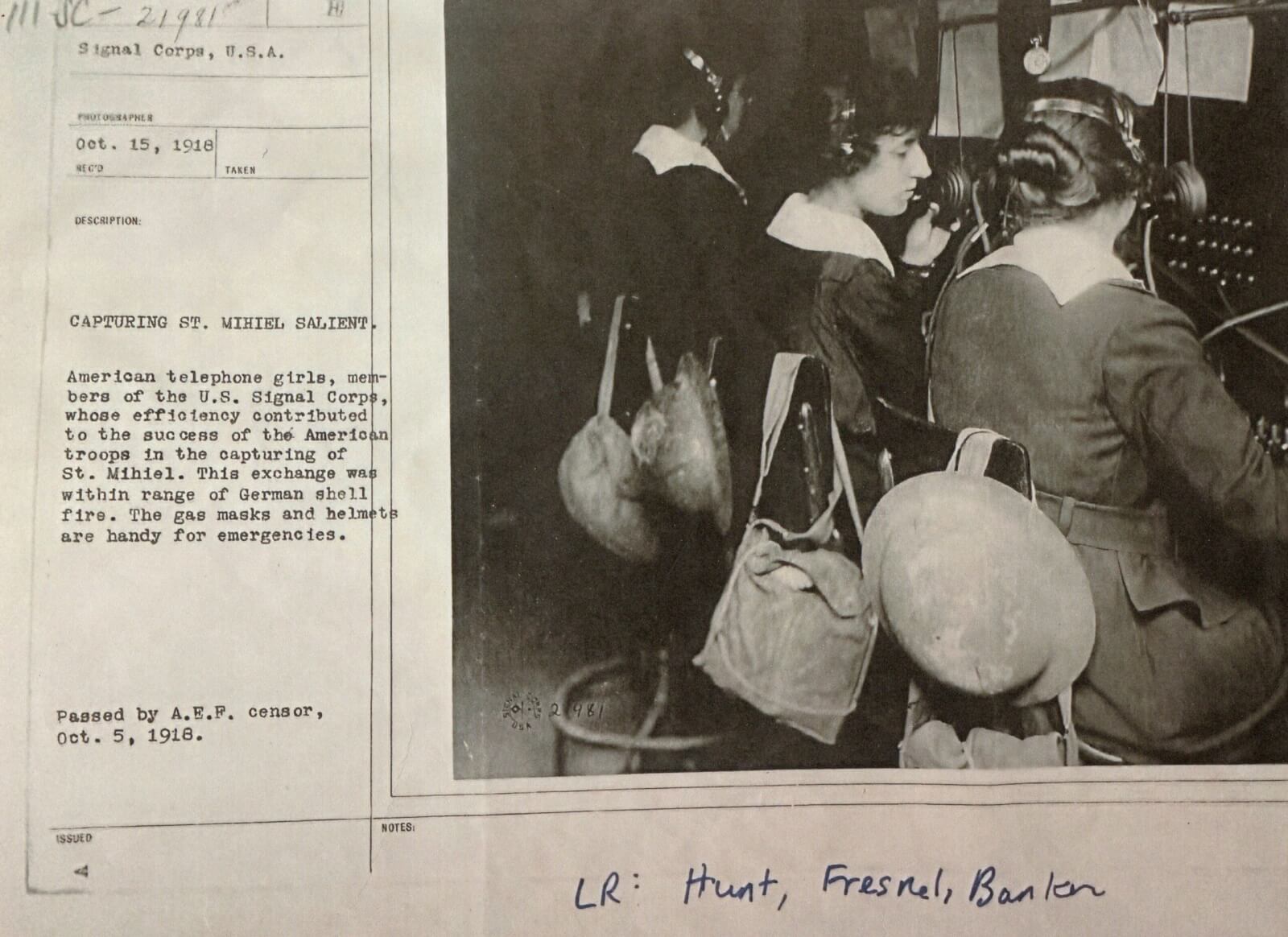
In World War I, communication was as critical as the front lines. Orders moved through switchboards and had to be delivered quickly and accurately. To meet that demand, Gen. John J. “Black Jack” Pershing chose an unconventional solution.
Beginning in 1917 and drawing from a workforce of switchboard operators that was already predominantly female, the Signal Corps recruited women as bilingual telephone operators who could translate conversations as they connected them. More than 7,000 applied; fewer than 500 were accepted.
Later nicknamed the “Hello Girls,” they were trained in military procedures and advanced switchboard operations before deploying overseas. They took the Army oath, donned regulation uniforms, and carried identity discs (the precursor to the dog tag). Operators were expected to rapidly connect calls while translating English and French in real time between American and Allied Forces. At the height of the war, they handled as many as 150,000 calls per day; over the course of their service, they connected more than 26 million calls.
Marie Edmée LeRoux was among them. She sailed to France from Hoboken, New Jersey, in June 1918. Her granddaughter, Catherine Bourgin, said the women quickly proved their value.
“The women earned respect,” Bourgin explained in an interview with Military Families Magazine. “They were supported by the Signal Corps and Gen. Pershing and all.”
The Hello Girls were close to the fight. Some worked just three miles from the front, maintaining communications during major offensives. A small detachment led by Grace Banker was assigned to the First Army Headquarters and played a key role during the Battle of St. Mihiel in September 1918.
Banker, a Barnard College graduate, was chief operator of the first unit sent overseas. Her writing — and records preserved by her granddaughter, Carolyn Timbie — offer a clear picture of the professionalism the unit brought to their work.
“[I watched] the Statue of Liberty fade from sight. For the first time, I suddenly realized what a responsibility I [had] on my young shoulders,” she wrote of her departure in her diary.
Their impact was recognized immediately. Brig. Gen. Edgar Russell described the women as “indispensable.” Banker received the Distinguished Service Medal, one of only a small number of Signal Corps members to do so. Timbie noted that Banker viewed the honor as representative of the entire unit.
Yet when the war ended, the women were classified as civilians and denied veteran benefits.
The term “Hello Girls” itself reflects that disconnect. As Timbie noted, it was not one the women used for themselves — they were trained specialists performing a critical military function.
“They considered themselves members of the Signal Corps,” she said.
In 1977, after years of attempts to recognize their service, President Jimmy Carter signed legislation granting the women veteran status. By then, only a small number of the roughly 450 who served were still alive to receive acknowledgment.
LeRoux was not among them. She died in 1945 and was buried without a military headstone; it would take until 2024 for that error to be corrected. Her granddaughter, Bourgin, has since worked to help preserve those stories, connecting with historian Elizabeth Cobbs and organizations like the Doughboy Foundation.
“These stories need to continue to be told,” Bourgin said, “so the Army does not forget that part of Signal Corps heritage.”
In her conversation with Military Families Magazine, Cobbs described the Hello Girls’ service as part of a broader shift.
“There was a real pride in the way that women and men served and supported each other and brought their best talents to bear in this great campaign,” she said. “They learned to work together as professionals … sitting down and working together through fire, through battle … 24 hours a day, relying on each other’s diligence and duty and competence. And that’s actually a really beautiful thing.”