These are 10 of the longest-serving weapons in the US combat arsenal
If it ain’t broke, don’t fix it—especially when tools that ain’t broke spent decades proving themselves in combat. While modern warfare evolves at a relentless pace with new technologies and platforms emerging every few years, the U.S. military arsenal has long depended on a select group of weapons so well-designed, reliable, and effective that they simply refused to become obsolete.
These firearms, many of them products of legendary designer John Moses Browning, combine stopping power, durability, and battlefield adaptability in ways few replacements have ever truly matched. From the trenches of World War I through Korea, Vietnam, and into the warfare of the 21st-century, they provided American troops with the firepower necessary to defend the world’s lone superpower. Their enduring legacy proves that when a weapon gets it right, “good enough” can mean unbeatable for decades.
1. M1903 Springfield .30 Cal Rifle
The M1903 was one of the first rifles in the U.S. arsenal to utilize the famous .30-06 round and served as the standard American infantry rifle during World War I. Although officially replaced by the M1 Garand in 1937, it remained in service due to the insufficient number of Garands needed to fight a global war on multiple fronts.
The Springfield .30 caliber was retained as a sniper rifle through the Korean War and even into the Vietnam War era before finally being retired after over 60 years of service. But that doesn’t mean it went away—it’s still used by drill teams, color guards, and shooting enthusiasts.
2. M1911 .45 Cal Pistol
The M1911 is a creation of the legendary gunmaker John Moses Browning, and it endured in service for over 100 years. As its name indicates, it was first produced in 1911 while the United States was still officially an imperial power. Its staying power is directly related to its stopping power. It was used to great effect in the Philippine-American War and it remained a mainstay of the U.S. military in some form through the wars in Iraq and Afghanistan.
The pistol became an icon for its strength in battle and was beloved among those who used it. The M1911 was phased out in favor of the Beretta M9 9mm pistol in the late 1980s, officially being retired in 1985. But it stayed in service with Marine Special Operations units and with the U.S. Army’s Delta Force.
3. M1919 .30 Cal Machine Gun
The M1919 was another one of John Moses Browning’s successes. An air-cooled version of the M1917, which served U.S. troops well in World War I, saw extensive use in World War II and in the Korean War. Even when the M60 entered service as its replacement, some units just didn’t want to give up their reliable machine gun—and it remained in the U.S. military arsenal for decades .
The M1919 was phased out in favor of the new M60 in the late 1950s. However, the Navy, having a surplus of weapons, converted many to 7.62 mm and used them on gunboats patrolling the rivers of Vietnam.
4. M2 .50 Cal Machine Gun
The “Ma Deuce” is the most emotion sparking weapon in the U.S. arsenal: beloved by the troops who use it and feared by those on the receiving end. Designed by John Moses Browning near the end of World War I, the big .50 cal arrived too late for that fight and entered full production in 1921. It didn’t take long for the military to realize they had something special: a heavy machine gun that could reach out and touch aircraft, light armor, fortifications, and infantry with devastating effect.
From the skies over Europe and the Pacific in World War II to the jungles of Vietnam, the deserts of Iraq, and the mountains of Afghanistan, the M2 has proven itself across every domain and nearly every conflict since. Its versatility is unmatched—flexible mounts on vehicles, aircraft, ships, and ground tripods—and its .50 BMG round still delivers the kind of long-range punch and barrier defeat that lighter machine guns can’t touch.
What really cements its legend is pure durability. In 2015, a 94-year-old example (serial number 324, one of the earliest production guns) turned up still in active service and running strong. Despite decades of proposed replacements, the military has never found anything that does the job better across so many roles. With modern tweaks like the M2A1’s quick-change barrel, the Ma Deuce is still the gold standard.
5. B-52 Stratofortress
The B-52 Stratofortress was built to end the world—or at least convince the Soviets it could. Designed in the early 1950s as a high-altitude nuclear bomber for Strategic Air Command, it was the ultimate Cold War deterrent. It never flew that mission. Instead, the BUFF (short for “Big Ugly Fat F*cker) became the workhorse of the U.S. arsenal (in the air, at least)for more than 70 years and it’s still flying combat and training sorties today.
From the massive Arc Light strikes over Vietnam to the opening salvos of Desert Storm and precision strikes in Iraq and Afghanistan, the B-52 has delivered more ordnance than almost any other aircraft in history. Its enormous payload capacity, intercontinental range without refueling, and ability to loiter for hours make it uniquely effective whether it’s saturating area targets or supporting ground forces with smart weapons and stand-off missiles. What was designed for Armageddon has spent most of its life shaping battlefields the old-fashioned way.
The Stratofortress’s staying power is nearly unbelievable. Airframes that first flew in the 1960s are still in the inventory, racking up flight hours their original designers never imagined possible. The Air Force has poured serious upgrades into the fleet: new engines, advanced radar and avionics, modern defensive systems, and next-generation weapons integration. It also plans to keep the B-52 in service well into the 2050s and beyond. In an era of stealth bombers and hypersonics, the old BUFF remains indispensable because nothing else matches its combination of range, payload, versatility, and cost-effectiveness.
6. M60 .30 Cal Machine Gun
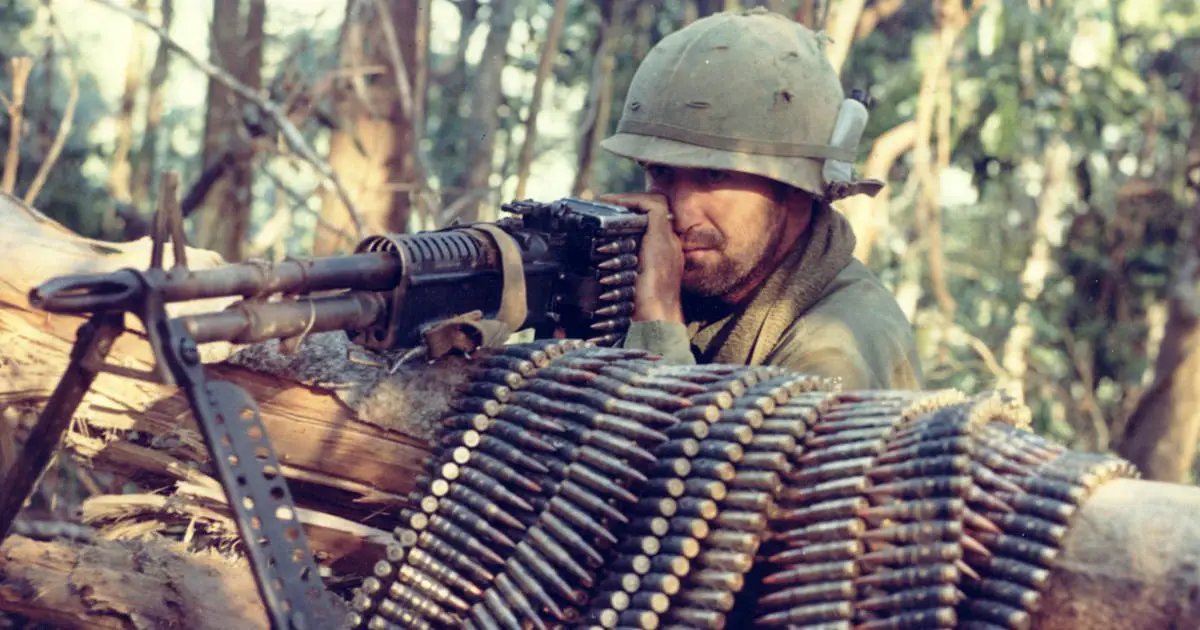
The M60 entered service in 1957 and quickly became the signature machine gun of the Vietnam War. Troops called it “the Pig”partly because of its hefty 23-pound weight and partly because it could eat through ammo belts like nothing else in the U.S. arsenal. Whether carried by a two-man team on a jungle trail, mounted on a jeep or riverine boat, or swinging wildly from the door of a Huey, the M60 delivered serious 7.62mm suppressive fire that could chew through vegetation and light cover in a way the smaller M16s never could.
Next: The M60 ‘Pig’ caught plenty of hate, but the love was real
It served as the U.S. military’s standard general-purpose machine gun through the 1980s and into the early 1990s, when the more reliable and NATO-standard M240 gradually took its place. But the M60 never truly left the fight. Special Operations units—especially some SEAL teams—kept it around for missions where its particular balance of weight, rate of fire, and familiarity was important. It also remains a go-to door gun on helicopters to this day, still doing the same job it did over the jungles of Vietnam more than six decades later.
The M60’s story is one of a weapon that got the job done in the mud and heat of Southeast Asia, earned a permanent place in the hearts of the guys who carried it, and simply refused to be completely replaced.
7. M14 .30 Cal Rifle
The M14 had one of the shortest careers as America’s standard infantry rifle. It was adopted in 1959 and largely replaced by the M16 just five years later. But like the other weapons on this list, it never actually left service. Built around the hard-hitting 7.62x51mm NATO round, the M14 delivered the range, accuracy, and stopping power that the lighter 5.56mm M16 could not match, which is exactly why it survived as a specialist weapon long after it was pushed out of the front-line role.
During the Vietnam War it was already being converted into the M21 sniper rifle, and later the M25. Decades after most troops had moved on to the M16 and M4, the M14 made a serious comeback in Iraq and Afghanistan. Upgraded into the M14 Enhanced Battle Rifle (EBR) with a modern chassis, optics, and rails, it was issued to designated marksmen who needed to reach out farther and punch through cover, barricades, or light vehicles. Soldiers and Marines who carried the EBR often spoke highly of its accuracy and authority at longer ranges—exactly the qualities that made it worth keeping in the U.S. arsenal.
More than 65 years after it first entered the inventory, the M14 platform is still in limited but active use across the services. What was supposed to be a brief transitional rifle became a long-serving battle rifle that proved its worth every time the mission demanded a little more reach and punch than a carbine could provide.
8. M16 5.56mm Rifle/ M4 Carbine
Since it replaced the M14 in 1964, the M16 and its carbine-length sibling (the M4) have become the longest-serving standard rifle family in U.S. military history. What began as a controversial introduction in Vietnam—plagued by early reliability problems caused by ammunition changes, lack of chrome-lined chambers, and inadequate cleaning instructions—evolved into one of the most adaptable and widely used small arms platforms in the world. Once the issues were addressed with the M16A1 and subsequent versions, the rifle earned a hard-won reputation for being lightweight, controllable, and accurate enough for the vast majority of engagements.
The shift to the shorter M4 carbine in the 1990s and 2000s proved especially transformative. Easier to handle inside vehicles, buildings, and helicopters, the M4 became the go-to weapon for most troops during the Global War on Terror. With the addition of optics, lasers, suppressors, and modular rail systems, the platform kept pace with modern tactics while maintaining the core advantages of the 5.56mm round: low recoil, high magazine capacity, and manageable weight for the average soldier or Marine.
Despite repeated attempts to find a replacement (through multiple formal programs and countless unofficial debates) the M16/M4 family has stubbornly refused to be displaced as the standard issue rifle of the U.S. arsenal. Its logistics footprint is enormous, its aftermarket and training ecosystem is unmatched, and its performance in real-world combat has only improved with each generation of upgrades. More than 60 years after it first entered service, the M16 and M4 remain the baseline weapons for the majority of U.S. troops, a testament to how thoroughly they got the fundamentals right once the early growing pains were solved.
9. LGM-30 Minuteman Ballistic Missile
The LGM-30 Minuteman has been the backbone of America’s land-based nuclear deterrent since it entered service in 1962. As part of the nuclear triad (alongside bombers and submarine-launched missiles), it has provided a rapid-response, silo-based capability that has remained on continuous alert for more than six decades. The Minuteman III, the version still in service today, was the first ICBM to field multiple independently targetable reentry vehicles (MIRVs), allowing a single missile to strike several widely separated targets and dramatically increasing its effectiveness against hardened or dispersed threats.
What makes the Minuteman remarkable is how thoroughly it has been modernized while retaining its core design. Successive upgrades to guidance systems, propulsion, warheads, and command-and-control links have kept the missiles relevant through the end of the Cold War, the post-Cold War drawdown, and into the current era of renewed great-power competition. The Air Force currently maintains 450 Minuteman IIIs (down from a peak of 1,000 in the 1970s) distributed across hardened silos in the northern United States, ready to launch on short notice.
Despite its age, the Minuteman has never been replaced in the U.S.arsenal. Extensive life-extension programs have kept the fleet viable far longer than originally planned, buying time until the next-generation Sentinel ICBM enters service in the coming decades. For more than 60 years, the Minuteman has stood a silent watch.
10. M61 Vulcan 20 mm Cannon
What makes the Vulcan remarkable is how completely it has refused to become obsolete. While many aircraft guns have come and gone, the M61 and its improved variants remain the internal cannon on the F-15, F-16, and F/A-18 families, and it continues to serve in the close-in weapon system role aboard Navy warships as the Phalanx CIWS, providing last-ditch defense against missiles, drones, and small boats. The same basic design that once shredded enemy aircraft over Southeast Asia now protects carrier strike groups in the 21st century.
More than 65 years after it first entered the U.S. arsenal, the M61 Vulcan is still the standard by which most aircraft cannons are judged. Its combination of blistering rate of fire, proven reliability, and adaptability across air-to-air, air-to-ground, and naval defense roles has kept it in service long after most weapons from its era were retired. In a world of missiles and directed-energy weapons, the old six-barrel Gatling gun is still very much in demand.
Don’t Miss the Best of We Are The Mighty
• Why miniguns like the M134 can fire thousands of rounds per minute and not jam • A 100-plus year history of iconic US military helmets • Your standard rifle can now be an anti-drone weapon. Seriously.
These are 10 of the longest-serving weapons in the US combat arsenal
Mighty MilSpouse
Overqualified, underemployed, and still showing up: the military spouse employment challenge
By Sara Jane Ginn
World War II
Why one of the largest Soviet war memorials is in Berlin
World War II
A former violinist singlehandedly cleared a mountain fortress during World War II
What happened to the German mercenaries who fought against the American Revolution
Related Legacy stories
This American flag survived D-Day, then was returned to the US 75 years later
When Howard Vander Beek died in 2014 at the age of 97, he left behind a distinct reminder of his World War II service. Vander Beek, a lieute
Medal of Honor recipient and legendary Vietnam War helicopter pilot ‘Old Snake’ has died
Retired Army Col. Bruce Perry Crandall, the legendary helicopter pilot who was awarded the U.S. military’s highest decoration for valor for
Air Force crew honors WWII-era Flying Tigers with A-10 paint job
It started as a routine transfer. Following an asset transfer from Korea, maintainers at Moody Air Force Base, Georgia, accepted and process