A Medal of Honor recipient explains what being an American means
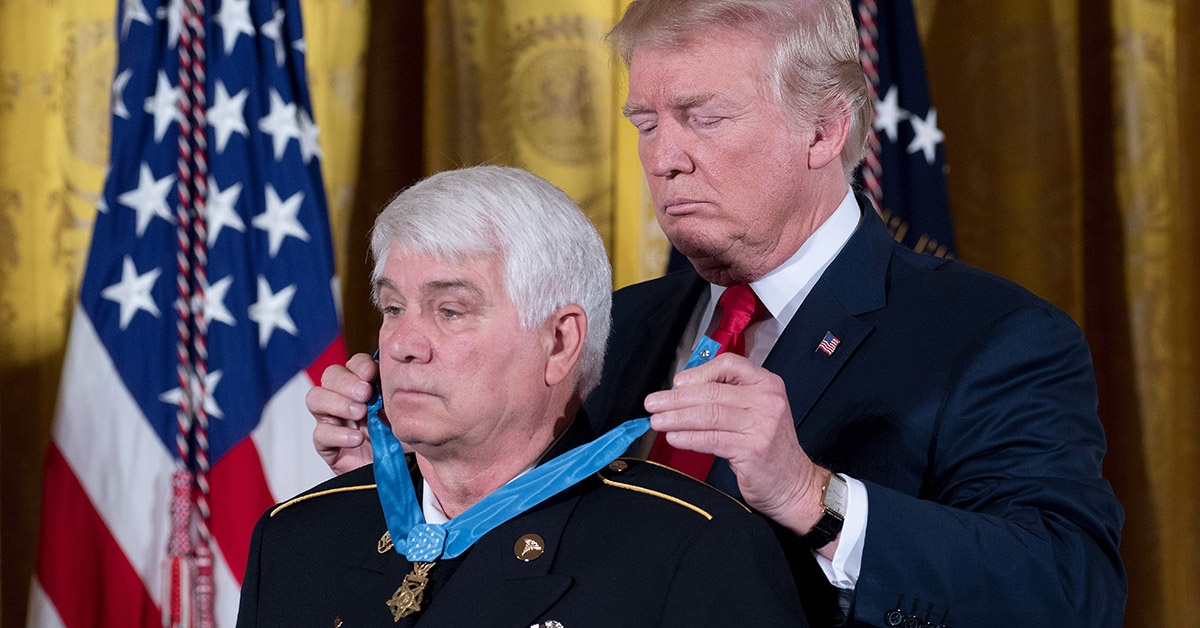
In spring 1968, Jim McCloughan signed a contract to teach and coach two sports at a high school in his native Michigan.
The next week, McCloughan received a letter that the United States military needed him more. Drafted into the Army, McCloughan reported to Fort Knox, Kentucky, for basic training. He then went to Fort Sam Houston in San Antonio to become a combat medic.
McCloughan (pronounced Muh-clue-in) became an exceptional medic.
His skills and courage were never on finer display than from May 13-15, 1969, during the Vietnam War. During an action that earned McCloughan the Medal of Honor 48 years later, he repeatedly risked his life to tend to wounded comrades, sometimes ignoring a direct order to do so. He never abandoned his duties despite sustaining severe shrapnel wounds, according to his Medal of Honor citation.
On the second day of the battle, the North Vietnamese killed another platoon’s medic. That left McCloughan as the only one in the company. He wasn’t going anywhere, at one point refusing evacuation.
“When supplies ran low, Private First Class McCloughan volunteered to hold a blinking strobe light in an open area as a marker for a nighttime resupply drop,” his citation read. “He remained steadfast while bullets landed all around him and rocket propelled grenades flew over his prone-exposed body.”
After his service, McCloughan embarked on a four-decade career as an educator and coach. He is now 80 years old and, as always, appreciative of every day. As America prepares to celebrate its 250th birthday on Saturday, July 4, 2026, McCloughan spoke with We Are The Mighty about what being from the U.S. means to him. His comments were edited for clarity and brevity.
How Did Military Service Change Your Outlook on Life?
“I wish I would have known what I knew after I got out of the service, having served in a third-world country. I did appreciate being an American…, but I never knew how great I had it until after I saw how great people didn’t have it. I have found out that many people who become American citizens appreciate their American citizenship more than some of us that have been born here. I think it is because they have something to compare what we have here to what they had before.”
Was Celebrating July 4 a Big Deal for Your Family Growing Up?
“Yeah, matter of fact, everyone has a crazy uncle. I had a crazy uncle, Wayne McCloughan. He could buy explosives in Colorado. He lived in Colorado, and he’d bring them to Michigan to do the fireworks on our front lawn. I can remember as a little boy watching that.
“What I am going to tell you next, I thought everybody else lived that way. I didn’t have electricity until I was 5 at my house. I didn’t have running water nor a flushing toilet until I was 8. We had a pump out back, a hand pump; we had a ‘two-holer.’ I don’t know if you know what a two-holer is, but it’s not a very fancy place to go to the bathroom. I’ve lived here in Michigan all my life. There was a lot of yellow snow in the wintertime, because I never made it to that sucker.”
What Did You Coach?
“I coached high school. I coached three football teams, 22 wrestling teams, 38 high school baseball teams, and 35 American Legion teams. And then, of course, Little League, 22 Little League teams, 13 junior wrestling programs. I finally got to do what I loved, what I wanted to do, and what I worked toward. I was blessed more than I deserved. I had a wonderful career. Had two sons who were very active in athletics, very good athletes, too.
“Over the 250 years, 1.3 million [service members] have given their lives. Those individuals never got to do what I got to do. They never got to meet their soulmate and marry. They never got to see the birth of a child, watch that child grow, graduate, and, as I got to do, coach that child. Never got to walk their little girl down the aisle, dance that father-daughter dance at the ceremony after the wedding, and every holiday, every anniversary, like we’re celebrating now, every birthday, every reunion. No matter what kind of reunion, they’re not there. They gave, as was said lately, all of their tomorrows so we can have all of our todays.”
What Does It Mean to You to Be an American?
“To be an American makes me a lucky person. I dodged a lot of things in Vietnam. My wife says I had more than nine lives, and if you read my citation, you’ll probably know that I should have died in that particular battle alone. I feel lucky to be an American.
“I call us not the most powerful military in the world but the most compassionate. To go to Vietnam and fight for people who couldn’t fight for themselves, for their independence, and to be a part of that powerful military [was an honor]. People have asked me, ‘Would you do it all over again?’ And my answer is this: ‘Nobody gets up in the morning and wishes there was a war that they could go to, but had I not gone to Vietnam, I would have never met the most kind, considerate, loving, and compassionate individuals that I have ever met in my life. Ninety-seven percent of Vietnam veterans were honorably discharged. I met some of the most honorable people that I’ve ever met.”
Did You Look at Freedom Differently After Serving?
“Oh, sure. And you also look at the fact that you laid your life on the line, like my grandpa did in World War I, and my dad did in World War II, and my Uncle Wayne, crazy Uncle Wayne, did in the Korean War. I was a part of a family that, through generations, did what we had to do as soldiers.
“I look at it as, now I know the cost of our freedom. I held, as a combat medic, 18-, 19-, and 20-year-old boys in my arms. I heard their last words, and I saw the last breath of their lives leave their bodies. I know the price of freedom. I know what I have to hold in my hands. And by the way, my wife and I saved and saved and saved, and the house that we now live in, I can flush six toilets in this house.”
What Does the Medal of Honor Mean to You?
“One thing about the medal that I have around my neck, it belongs not just to me, but in the battle that we, 89 men, earned it in. I wear it for them as well as myself. We fought against 2,700 enemy soldiers. It was a flawed mission. It’s not the medal—and that’s not belittling the medal at all—it’s the action that is done to earn that medal that counts.
“In 2019, I got a letter in the mail. I noticed the town and I noticed the state, but I did not recognize the individual, and I opened it, and here’s what I read: ‘My name’s Austin. You don’t know me, and I don’t know you. My mom was born after my grandpa came home. You had saved his life in 1969, and she was born in 1970. I was born in 1991, and last week, my wife and I had a baby boy. This Sunday, I get to celebrate Father’s Day because of you.
“I had never thought of it that way. I saved 10 Americans, one Vietnamese interpreter, and I read that to my wife with tears in my eyes, and she said, ‘Oh, yeah, Jim. You didn’t save 11 people. You saved 11 family trees.’ That grandpa called me a few months later in November. He was on his fourth bout with cancer from Agent Orange, the lovely Agent Orange, and he told me he would not beat this one. He wanted to thank me for the 50 extra years of life that I had given him.
“On the 14th [of May in 1969], I’d saved a man’s life who went on to be one of the top geoscientists in the nation. He emailed me to thank me for the 57 extra years of life he had, and, I guess, probably around 50 that he was a top geoscientist. It would have never happened. Somebody saved your ancestors; otherwise, you wouldn’t be here, either.”
How Hopeful Are You that the Nation Can Come Together for America’s 250th?
“Were you alive when the [Twin Towers] were hit? Did you notice how we came together? It seems to me that during the most joyful times, during the most trying times, unbelievably we come together as a nation. It happens all the time with floods, tornados, and things like that. People from all over the United States will come together and send whatever it is that’s needed to those areas.
“That’s one of the greatest things that I will enjoy about this Fourth of July. Maybe those political things will be set aside, and we will all think about the freedoms that we enjoy and have. I’ve always said that freedom is a great thing. If you want to thank a veteran, enjoy your freedom but don’t misuse it and don’t abuse it. Don’t step on someone else’s freedom, because they’ve earned it, too. I hope that during the Fourth of July—and the whole weekend, as far as that’s concerned—that we can pull together and all enjoy it at one time.”
What Are Your Plans for Saturday?
“Hopefully, I will enjoy a nice calm day. Of course, we will have our family around and about, and to look at the fact that we can celebrate together, it’s a real, real joy.”
Don’t Miss the Best of We Are The Mighty
• JFK’s words of wisdom to the military leaders of tomorrow • These were the last surviving veterans of every major American war through World War I • The Pilgrims only stopped at Plymouth Rock because they ran out of beer
A Medal of Honor recipient explains what being an American means
Celebrate America’s 250th with a real Revolutionary War cocktail
9 reasons why the 1911 should be America’s national weapon
SFC’s Chloe Turner on why sport fishing is reeling in veterans
‘The Rise and Fall of an Ancient Superpower’ reveals the true, sometimes surprising history of Sparta